Hey everyone, I thought I'd do something different for this one. Instead of just showing the preview, I'll give some insight on the process behind creating those images. While the WIPs basically show the evolution of the image, I think a lot of the process is not actually there.
1) It all starts with this: a very very small thumbnail. Whenever I have an idea for a future character, or have an idea that I think it's good, I make a small thumbnail on my sketchbook. This is basically the 1st physical evidence of a drawing. It's there so in the future, when I actually do work on the project, I know where to start.

2) Step 2: with a general idea in mind, I start to get references. For characters I'm not familiar with, I do a broad background check, to make sure I get the idea behind the character. Personality, if there's alternative versions, if that situation would make sense for that character of if I have to think about something else .... basically I "do my homework" about that character.
This is also where the direction of the project is decided. There were situation for example that a thumbnail wasn't really good for the initial character, but great for another one. This actually happened with Lady Liadrin. The original thumbnail of that image was about Leah (diablo3) reading a book in an old building, while sitting on a big window frame. But that made a lot more sense for Liadrin, to be on a balcony enjoying wine.
And if an idea doesn't really work for a character now, it might work in the future.
In terms of references, for those curious, there's usually between 30 to 100 images of reference, depending on how complex the scene is. References for hair, anatomy, poses, you name it.
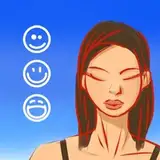
For characters that are based on tv shows or movies, I often also take a lot of prints of the show, to get a good idea of facial details, expressions, gesture and things that define that character. For Faye in particular, I really loved her "dramatic attitude", and how in many scenes she waves her hair back complaining about how "exhaustive" it is to be her. So I wanted to convey that in a very iconic scene of her sunbathing in the series. =D

3) With the thumbnail in mind and dozens of references collected, I do a first rough sketch of the image. This is good to see if the composition works, to try out a few slightly different version and settle on a final choice.
This gives me the general idea of where everything will be, the initial angle of the camera and whatnot.

4) This is where the hard work starts. To go from that rough sketch to an initial lineart, it often take something like 2-4h. If you have seen the behind the scenes on artists that have a realistic style, you probably seem that they often had models (or themselves) posed in a very similar way, to use as reference. Pretty much all classic pin-ups there's a picture of a girl sitting on a studio in the exact same pose.
That's really important because there's a lot of subtle gestures that are really hard to imagine on your own. For example, on Laura (x-23) images, I spent a lot of time on the mirror checking how a person would look like if they just casually leaned there and scratched something on the mirror. And while it's possible to use my own pictures as reference for some cases, I'm still a man lol. My body definitely doesn't look like the ones I draw here lol. And finding references on the exact poses that I want would be a nightmare.
So in order to speed up the process and retain the quality, I often use those posing softwares that basically allow you to pose a female dummy doll, move the camera around and whatnot. This is great because it allows me to find the best (and sometimes more revealing ;)) camera angle, place some generic blocks/cylinders to use as reference for the general perspective. With that "mock-up" version and a LOT of references from real woman in similar poses, I can use that informations to build my models.
It takes a lot of time because pretty much 90% of the drawing has to be correct on the lineart. Fixing or changing any part of the drawing later on is a nightmare. And often it can lead to anatomy mistakes or that situation where "something is off, but you don't know exactly what". Also, I think it's important that what you see in the preview is a very good indication of the final image, so we don't have a situation where I show a preview of something, and you guys get something else as the final product.
So all the variants the drawing will have (in terms of pose, clothing etc) are planned for the start. While I don't know the exact hours, I have a very solid estimate on how long the image will take. So in order for the character to have for example, 2 sets of legs (one for nsfw, one for sfw), that "production time" has to be accounted for, which essencially means that other areas of the drawing have to be made in a way that's quicker to draw.
For example, if I already know I'll have 2 sets of something, I already draw the image in a way that's quick to swap between version A and B, organize the layers accordingly and have everything neat and set up to be as efficient as possible. Which is exactly why I don't do "requests" of variants. I know it might sound dismissive if I simply say "no," but if I have to change something after all is done and organized, It's very time consuming. Some changes that might seem simple, might actually take several hours, and that's a time that wasn't accounted for on the whole project.

5) This is how the shading is done. It starts with a basic shading to get the shapes, volumes and lightning correctly. This sets up the stage for all the rest. Usually image #1 is fairly quick, taking 1-2h at most. But getting it right at this point makes the rest a lot easier.
Image #2 is refining the shading, which also takes about 2-3h tops. This hair in particular was fairly quick, taking 20min or so. But more complex hair, like Asami on the voyeur, or Valeera (the halloween pin-up) which has a lot of volume, curls and shapes can take up to 1h-1h30.
Going from Image 2 to 3, while it may not looks like a big difference, is where a big chunk of the work is. There's a LOT things to keep in mind for an image to work, and they all need to be fixed. Until image 2 there's not a lot that can go wrong, because it's just the shading and the character in a white background. But when you start to add lightning, effects, background, things interacting, etc, there's a lot of subtle adjustments to be made, so that the image retain a good contrast, the values remain good, making sure all the little mistakes were cleared and fine details are in place.
Once all that is done, it's time to color, and that will result in the final image that you guys are familiar with =d
So, I hope you guys liked the process, and I think it's interesting to know just how much work goes behind each image to make sure the final result is great =D
Lee
2020-03-14 23:59:34 +0000 UTCLee
2020-03-11 21:39:26 +0000 UTCLee
2020-03-11 21:30:53 +0000 UTCLee
2020-03-11 21:30:41 +0000 UTCTarliArt
2020-03-11 20:26:33 +0000 UTCCraig from Omaha
2020-03-11 18:22:29 +0000 UTCCiarán M
2020-03-11 17:47:00 +0000 UTCMitulaa
2020-03-11 17:44:50 +0000 UTC