I took the iron I already smelted and re- smelted it. The iron was old and rusty from forging experiments. Iron oxidises faster when in the forge due to the hot and oxidising conditions. So I tried smelting it again to turn the rust back into iron. The first attempt involved charging the iron into a furnace in a single charge. The results were m...
2025-04-03 21:32:30 +0000 UTC
View Post
I made a water powered forge blower. I tried 2 designs, the first being a large diameter, under shot water wheel with a belt drive going to the fan, and the second being a smaller diameter water wheel powered by a falling stream of water directly driving the fan attached to the same shaft. The second method was the only one that worked reliably ...
2025-03-06 21:32:15 +0000 UTC
View Post
I added a fly wheel to the one way spinning blower. It smooths out changes in rotor speed. Each stroke takes more effort but fewer strokes are needed. I did an iron smelt and it produced average results due to the rotor coming out of the thrust bearings in the support stakes. So I made journal bearings by drilling a hole right through the stakes...
2025-02-06 21:34:23 +0000 UTC
View Post
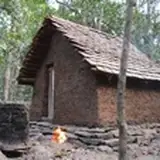
Catastrophe! My brick hut got destroyed by a falling tree. It stood for 2 years and 8 months and would have lasted longer if not for the accident. In the video I salvage the bricks and other materials from the hut for future projects. Also, I do maintenance on the newly completed 2 walled tiled hut which is still standing and show the A frame hu...
2025-01-07 21:11:54 +0000 UTC
View Post
I Built a 2 walled Tiled Hut. The video is a compellation of the last 2 videos with the new footage beginning at 36:26 It has two opposing gable end walls made of mud with 10 wooden poles spanning the gap between forming a roof covered with tiles. The design is experimental with the main advantage being that it doesn't have side walls that ...
2024-12-05 21:26:28 +0000 UTC
View Post
I built mud walls that I capped with roof tiles so they don't dissolve in the rain. This method is good for building in wet weather, where the tiles can be taken off to add more layers. I intend to build a roof on the walls when it's tall enough. Much appreciated.
2024-10-31 21:08:06 +0000 UTC
View Post
I built an A-frame hut to make roof tiles in preparation for the wet season. Thatch rots quickly here so my aim is to move away from thatch to tiles. I made 132 roof tiles and fired 42 of them in the video. The A frame structure has proven to be a simple but effective workshop for making roof tiles in, with a large floorspace to lay the tiles (a...
2024-10-03 21:05:21 +0000 UTC
View Post
I tested the water bellows with an iron smelt and it made 5 g of cast iron droplets, proof of concept that the bellows works. There are still teething problems with the new method but it shows potential. Much appreciated.
2024-09-05 22:01:21 +0000 UTC
View Post
I built a Water Bellows. It’s an upside-down clay pot with an inlet valve and an outlet spout. The inlet valve is simply a hole in the pot with a leaf plastered to the inside with wet clay so that it forms a one-way flap valve. When pushed down into water, the valve shuts and air is forced out of the spout and into the fire. When the pot is li...
2024-08-01 21:44:04 +0000 UTC
View Post
I made a hashbrown from wild Polynesian arrowroot. I wanted to see if it could be made with the fibre as well instead of just the starch alone. It turned out ok but was still a bit bitter. Next time I'd soak it longer and rinse it more times. Much appreciated.
2024-07-04 21:47:41 +0000 UTC
View Post
I made charcoal in a closed pot. It's basically using the retort method but instead of a metal retort it was a clay pot. It worked making good quality charcoal on a small scale. I then tried to scale it up and fire a large pot in a kiln but the pot broke during the process and the charcoal burned out. Much appreciated.
2024-06-06 22:06:06 +0000 UTC
View Post
I previously made wood ash cement under the possibly false assumption that it was the calcium in the ash that gave it its cementitious properties. However, as some have pointed out, it may be more due to the material acting like a geopolymer. Alumina and silica are activated by sodium and it forms polymers of aluminosilicates. The video shows wa...
2024-05-02 21:39:29 +0000 UTC
View Post
There has been a strong wet season here (The worst since the 1970's) which has slowed down production of bricks and cement. The video shows normal brick production and then the thatched workshop collapses and so a smaller one is built to continue brick production. Fortunately, the brick and wood ash cement hut remains un affected. The video high...
2024-04-04 21:29:03 +0000 UTC
View Post
I tested the one-way spinning blower in an iron smelt and it is more effective than the previous both way spinning blower. Using the same amount of ore and charcoal, the original blower yielded 30 g of iron where as the new blower yielded 51 g. The previous all time record was 41 g from several years ago but the new blower it beat that by 10 g o...
2024-02-29 21:57:45 +0000 UTC
View Post
I made a type of forge blower that spins continuously in one direction only, driven with a simple rope and stick, using a novel technique I developed. The rope, wrapped around the rotor, is pulled down and back via the stick on the power stroke, tightening and causing the rotor to spin clockwise. The stick is then lifted up towards the rotor and...
2024-02-01 22:06:21 +0000 UTC
View Post
I made a fish trap and caught various aquatic animals in the creek over the course of a full year during different seasons. The trap is simple to make and requires no bait to work. All the animals were caught and released, but it is feasible that many traps could provide a source of protein in a given stretch of creek provided it contains fish a...
2024-01-04 21:23:51 +0000 UTC
View Post
I built a natural draft furnace and then smelted ore in it, obtaining a small amount of iron metal. A natural draft furnace is one where it works due to convection alone so no bellows or blowers are used. I've made a natural draft furnace before but this time I actually succeeded in making some iron. I then conducted a second smelt with left ove...
2023-11-30 21:01:19 +0000 UTC
View Post
I made a blower with a volutes shaped housing and where the fan spins in one direction only using a weighted crank mechanism. It produces a high volume of air flow but at a lower pressure than the original. The project was a good lesson in how to make volutes, but improvements need to be made to get the RPM of the rotor up while maintaining cont...
2023-11-02 21:14:23 +0000 UTC
View Post
In this video I test the 3m x 3 m thatched huts ability to make and fire bricks for the first time. Also, I built a charcoal kiln in the same hut to produce charcoal as a fuel for iron smelting. Until the thatched hut was built, these activities were all done outside in the weather, where the bricks would dissolve in the rain and the fire wood w...
2023-10-05 21:00:51 +0000 UTC
View Post
I made a downdraft kiln to test out how it works. A down draft kiln is one where the fire goes up from the firebox into the ware chamber and then is pulled down to an exit flue near the height where it entered, before being drawn up a chimney. Because heat rises, the hottest air stays in the kiln allowing it to reach higher temperatures in theor...
2023-08-31 21:15:43 +0000 UTC
View Post
I made a furnace insulated with wood ash for smelting iron. I'd previously seen rocket stoves that used wood ash as an insulation and remember reading that dry wood ash performed as well as the mineral wool insulations they use in modern furnaces. It worked well but the blower broke during the smelt. It was the third most successful smelt I've d...
2023-08-03 21:35:10 +0000 UTC
View Post
I built a covered workshop to make bricks under to protect them from rain while waiting to be fired. Rain is rare during the dry season but a heavy shower can undo the work of brick making slowing down the process. Soon after I finished the new shelter it did indeed rain, testing the effectiveness of the workshop. Hopefully I'll should be able t...
2023-07-06 22:30:39 +0000 UTC
View Post
I cleared an area to make bricks in and then built a new kiln to fire them in, making a batch of 50 bricks to test it. The new design uses fewer bricks than the original (74 compared to 100) and is simpler to build. The kiln worked and a new source of clay proved useable. Much apreciated.
2023-06-02 01:15:48 +0000 UTC
View Post
I tested the effectiveness of roasting ore and using lime as a flux in iron smelting. First I roasted the ore and then smelted it. This gave an improvement in yield. Then I collected snail shells as a source of lime (calcium), crushed and added it to the ore and then smelted the mixture. It produced nearly no iron at all. I think this is because...
2023-05-04 21:01:32 +0000 UTC
View Post
I needed more charcoal for smelting experiments so I made a video demonstrating the three methods I use. Pit charcoal is the quickest and easiest but produces a lot of smaller pieces that are low density. Mound charcoal makes better quality larger pieces but is more time consuming. Kiln charcoal produces more and better quality charcoal with les...
2023-04-06 22:16:57 +0000 UTC
View Post
I developed a cement made from iron bacteria that sets hard and doesn't dissolve in water once it dries and requires no fire at any stage of it's processing. I got the idea when I read that bog ore, a type of solid mineral, is formed by iron bacteria in swamps. So I experimented by forming the bacteria into 3 small pots. I then air dried the pot...
2023-03-02 22:03:03 +0000 UTC
View Post
I think I figured out how to turn the brittle cast iron I've been producing into malleable iron that can be forged flat. When ever I smelt local ores it always produces cast iron prills rather than softer blooms of low carbon iron as one would expect from the bloomery process. I believe this because the prills are very hard, but when struck hard...
2023-02-02 21:00:21 +0000 UTC
View Post
I made a water filter from loops of cane to siphon clean water from dirty water. Engineers at MIT ( https://meche.mit.edu/news-media/mit-engineers-make-filters-tree-branches-purify-drinking-water) had already u...
2023-01-05 21:00:30 +0000 UTC
View Post
I made a slow potters wheel. It's used to form pots while turning around a central axis. Having a central axis, this is a true potters wheel unlike the round batter plates I have formed pots on in the last video. It is the intermediate step between the batter plate and the kick wheel. Much appreciated.
2022-12-01 21:00:07 +0000 UTC
View Post
I used a method of processing clay where the raw clay is separated from the stones by being suspended in water in one pit and then having the clay settle in another pit. The method greatly reduces the effort of picking out stones from the clay manually, allowing the processing of clay on a larger scale. The resultant pottery was good quality, ma...
2022-11-03 20:54:31 +0000 UTC
View Post