G. Willow Wilson's Wonder Woman: A Retrospective
Added 2020-01-30 03:30:33 +0000 UTCWelcome to the first in a new exclusive offering for our Patrons. Each month, we will be publishing exclusive essays by our contributors on various topics. In our first essay, Doris V. Sutherland explores the 2018-2019 run on Wonder Woman by G. Willow Wilson.
***
Wonder Woman must surely be among the least consistent of the major superhero characters. While we all know what Superman, Batman and Spider-Man stand for and what to typically expect from their exploits, Wonder Woman has been harder to pin down: generations of creators have come up with distinct takes on the character and her world, some more successful than others, and most of them contradictory.
From November 2018 to October 2019, Wonder Woman was scripted primarily by G. Willow Wilson, the author perhaps best known for re-inventing Ms. Marvel as a put-upon New Jersey teenager with body-stretching powers. In taking on Wonder Woman, Wilson moved from Ms. Marvel's smalltown adventures to a rather different setting — the realm of gods and myths. With her run recently concluded, now is a good time to look back on what she achieved...
Love, War and Confusion
Wilson's run on Wonder Woman opens with the previously-established villains Ares and Grail imprisoned in a Themysciran cave. Ares’ incarceration has given him time to reconsider his role as the god of war:
I used to think that conquest was the same of immortality. That history belonged to those who carve their names into the ruined monuments of their enemies… and now—I wonder who remembers the Achaemenids? The Pandyans? Even the great Mithridates, the king of kings, has fallen out of memory. Dust, ash, not even the ruin of a ruin. In the end, the real victor is not war, but time.
And so, Ares has decided to set his mind on something greater still: “something that transcends even time… why Mithridates is forgotten, yet mortal men worship a carpenter who never held a sword.” Grail makes a guess (“It’s love, isn’t it? It’s always love”) but Ares concludes that the crucial factor is justice.
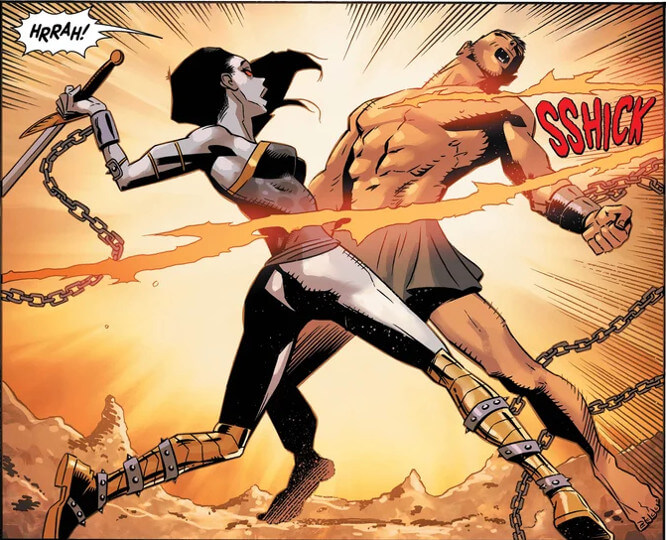
The god of war has a plan, and his next move – unlikely as it may seem – is to persuade Grail to slay him with the God Killer sword that she found in the cave. This triggers an upheaval: the Amazons look on as their island is torn apart by Ares’ death.
And so begins the first storyline in G. Willow Wilson’s Wonder Woman run, “The Just War” (running from issues 58-62). The story takes place primarily in the fictional Mediterranean country of Durovnia, where Commander Etta Candy fills in Diana (and the reader) on the political situation: Durovnia is established as a US ally whose government is currently under attack from insurgents, with Steve Trevor getting separated from his unit during conflict. But although it has one foot in modern geopolitics, Durovnia's other foot is in an ancient dreamland: it is the new home to the creatures of Greek legend, with griffins, dryads and more having fled to the country following the destruction of Themyscira.
Myths and politics turn out to be interlinked, as the warlord helping the insurgents is revealed to be a resurrected Ares. He explains his new agenda to Diana:
I have been sent back, kinswoman. Sent back to right the wrongs I have committed. I’ve been given another chance. A chance to defend the weak against the vicious, to stand for what is right even when the world would rather look the other way. Just as you do. To be remembered for the justness of your deeds… that is the only true immortality.
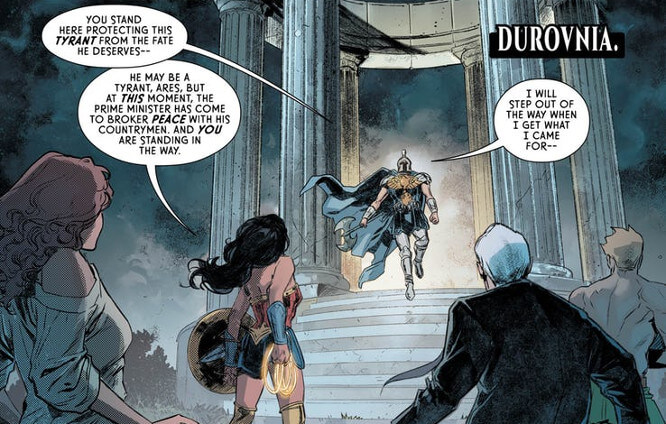
“The Just War” has something of a Homeric ethos to it, with the Greek gods intervening in the wars of mortals. As befits the story's mythic background, its characters tend to embody concepts rather than acting as full-fleshed personages in their own right. This is not an entirely new approach for Wonder Woman.
The very first issue of Wonder Woman, published back in 1942, depicted the world as a battleground between the forces of war and love, amply illustrated by a panel showing Ares and Aphrodite on opposite sides of the globe: “My men shall conquer with the sword!” says Ares; “My women shall conquer men with love!” replies Aphrodite. Diana and the Amazons ostensibly represented the capability of love to triumph over war, but this message was often muddied by the fact that – as a superhero comic – Wonder Woman defaulted to physical conflict as a means for reaching resolution. Nonetheless, the comic showed full conviction in its straightforward good-versus-evil storylines.
But time has moved on since the moral certainty of Wonder Woman’s early Nazi-punching exploits, and so Wilson depicts gods who are appropriately conflicted – even confused. Ares directs a missile so that it lands on a small village of civilians (“Those people supported the government—they stood by as their on neighbors were persecuted and debased!”) and then expresses dismay upon finding a baby among the ruins. He announces a policy of non-intervention, only to go right back to fanning the flames of conflict. His pontifications about just war are at odds with the mayhem that he so readily causes.
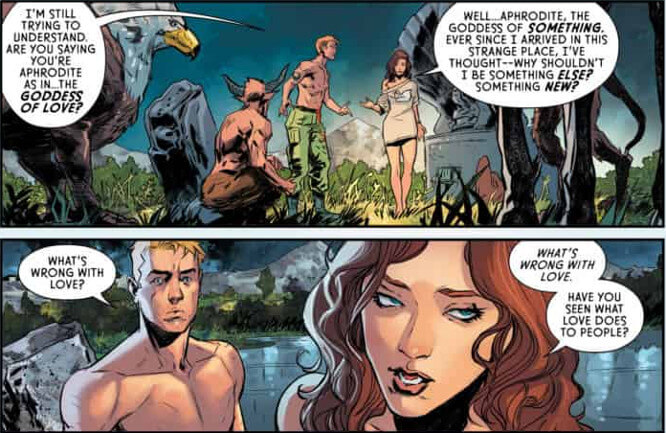
Ares is not the only god in Durovnia. Aphrodite is also there, presiding over a glen of mythical creatures and tending to the wounded Steve Trevor. Like Ares, she is reconsidering her old role, declaring herself tired of love: “For millennia I’ve watched you destroy your lives over a feeling”, she tells Steve. “Leave your homes, your families, give up your dreams, all for something that sours in a few years—or even a few months.”
Steve himself turns out to occupy a sort of no-man's land between love and war. On the one hand he stands for the ideal of warfare as a fair and honourable pursuit, in contrast to the mass destruction of modernity: “war isn’t like it used to be,” he says; “two armies facing each other across a battlefield… I want to fight a good war. A war followed by peace. But we don’t fight wars like that anymore.” At the same time, he stands for love, the concept rejected by Aphrodite: “My job involves running toward people with guns, and if I didn’t have love-for my unit, for my country, my family—I’m not sure I could do it.”
“The Just War” is, in part, a hero-on-trial story that acknowledges Wonder Woman's sometimes muddied treatment of its themes. Ares points out the contradictions in Diana’s character – she speaks of peace while carrying a sword, for one – and uses these to justify his personal inconsistency: in other words, the main villain is a manifestation of Wonder Woman’s own shortcomings. Diana pleads her case, pointing out that her favoured tool is a lasso. “A lasso is not a sword”, she says; “it has no edged side, no blunt side—it is a loop, a weapon with neither beginning no end”. After these rather Freudian observations, she adds that her lasso “uses the aggressor’s own strength against him.”
Despite this, it is not Diana who subdues Ares, but Aphrodite. The goddess intervenes to talk sense into Ares — established as her former lover — by making a point not unlike that made by Steve Trevor. “Once upon a time, the great god Ares saw war as something fought between equals, not the murdering of unarmed old men.” She also whispers something into his ear — exactly what she says is left to the reader’s imagination, but it presumably touches upon their past relationship.
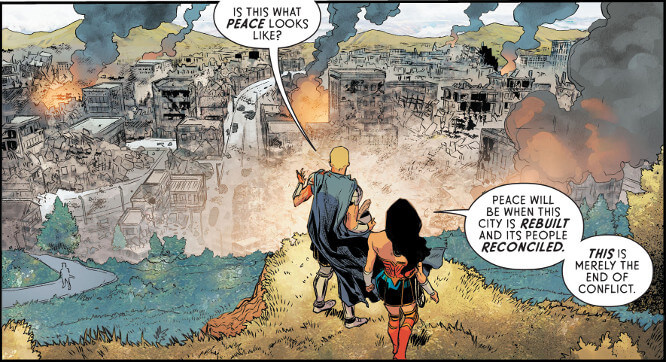
The surrounding political situation is not as straightforwardly settled. The Durovnian prime minister — escorted to safety by Diana — concludes peace talks with the insurgents, and declares a ceasefire. But the story makes a point out of showing the devastation and continued uncertainty: “Peace will be when this city is rebuilt and its people reconciled”, says Diana. “This is merely the end of conflict.” Meanwhile, all of the gods and mythic beings are ordered to leave the country and find new homes.
Gods, Mortals and Compassion
This quasi-Homeric saga of love and war is very different to Wilson’s Ms. Marvel run, which was decidedly low-key and light-hearted in comparison. Wilson would explore more familiar territory in “The New World”, a comedic one-part story in issue 63. Here, Wonder Woman is sidelined, and the issue has an unlikely set of new heroes: Damon the satyr, Cadmus the pegasus and Eirene the minotaur, who previously appeared as minor comic relief characters in “The Just War” and have now left Durovnia for America.
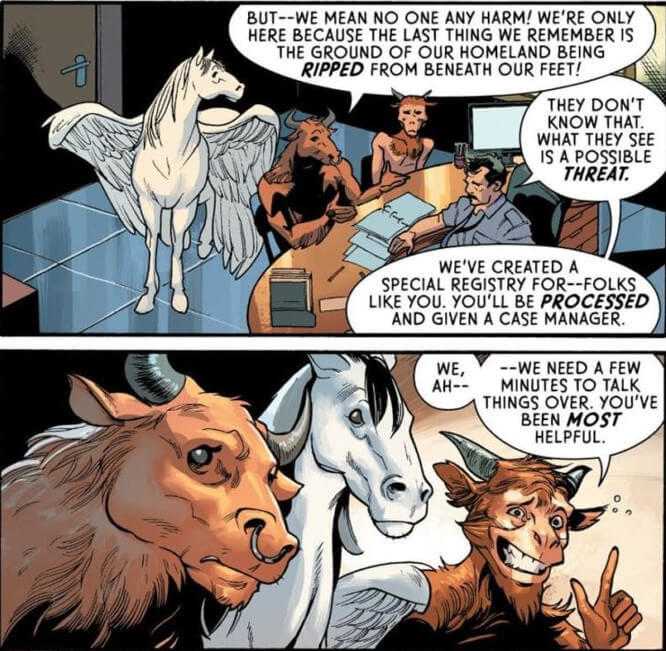
The issue opens with a humorous scene in a Customs and Border Protection office (an official asks the three mythological beasts of their homeland of Themyscira is near Tijuana) and carries on along similar lines, as Damon, Cadmus and Eirine try to fit into their new home of Washington D.C. They visit a restaurant to sample mortal cuisine, but find themselves targets of prejudice:
“People are complaining. They’ve pointed out that pets are not allowed in here, so… one lady would like to know why you can be here but her labradoodle cannot.”
“Is this labradoodle the progeny of the black flame and the winged god Hermes?”
“Maybe. You never know with these rich ladies’ dogs.”
Nonetheless, the three succeed in finding a pair of new friends. One is a male minotaur named Ferdinand, who has already integrated into human society; the other is Maggie, a waitress who initially seems to be a throwaway character but who ends up playing a substantial role in Wilson’s run.
Like Wilson’s work on Ms. Marvel, “The New World” derives humour from mixing high-flying fantasy with mundane life; and, also like Ms. Marvel, it avoids becoming a mere parody: the humorous aspects instead bring genuine humanity and warmth to the fantasy. Wilson’s script is complemented by Emanuela Lupacchino’s pencils, which bring some lovely anthropomorphism to the animalistic protagonists.
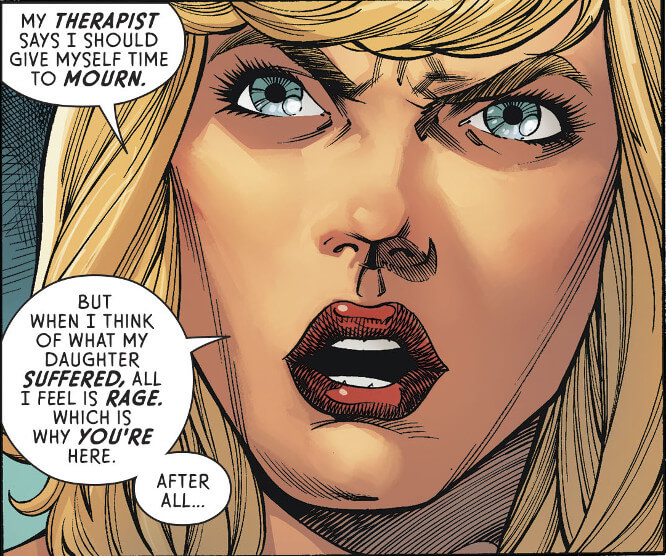
The next storyline, “The Grudge” (issues 64-5), moves things to more straightforward superhero territory. Here, Wilson brings back established antagonist Veronica Cale, a wealthy business entrepreneur who resents “the unregulated, extrajudicial killing machines that call themselves costumed heroes.” Cale comes up with a scheme that involves hiring another refugee from Olympus: Nemesis, goddess of retribution.
Despite using mythological characters “The Grudge” ultimately embraces superhero conventions. As is typically the case with superheroes’ arch-enemies, Cale is portrayed as a dark reflection of the protagonist: her daughter Isadore was on Themyscira when it vanished, paralleling Diana’s loss of her mother Hippolyta and the other Amazons. Issue 65 explains the disappearance of Themyscira in terms of let’s-just-move-the-plot-along scifibabble (“Did not Ares say he remembers his own death? If Themyscira exists to contain him, and he took his own life, might it not have created a paradox too great to withstand?”) Meanwhile, Cale’s scheme — tricking the news media into portraying Diana as the aggressor as she fights Nemesis — is a typical comic-book supervillain plot rather than the stuff of mythology.
That said, the storyline also makes a point of subverting certain conventions. The conclusion has Diana confronting Cale with pity, not retribution, as she realises that her opponent has fallen under the sway of Nemesis: “your desire for revenge is poisoning you now. I know you’re furious with me, but I am not your enemy.” The psychological effects of Nemesis on mortals are established in an earlier scene, where Diana visits the goddess's cave and finds a pile of torn papers and defaced photographs: “the debris of all the lives Nemesis has ruined in the short time she has been exiled to this world… the friendships poisoned by rivalry, the rivalries poisoned by violence… the loves curdled by jealousy and revenge.” The gods are abroad in the world, and villainy can be expected to take a form more subtle than blowing up national monuments.
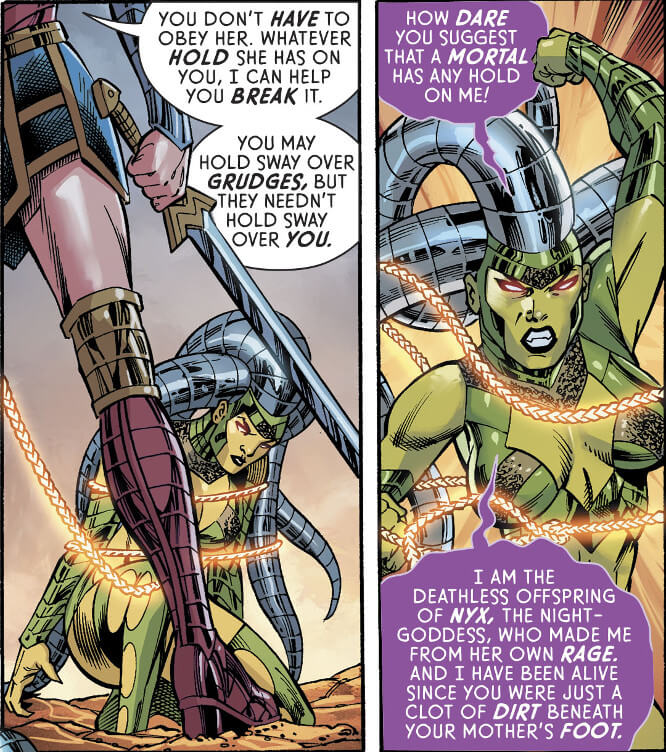
“The Grudge” ends with Diana giving the tearful Cale a hug, promising that she will find Isadore with the rest of Themyscira. This theme of reconciliation continues into the next storyline, “Giants War” (issues 66-8).
Here, the latest mythological refugees are the Titans, who erupt from the ground and go on the rampage in the Rocky Mountains. To take them on, Diana teams up with suicide Squad member Giganta, who agrees to put her size-changing abilities to good use so long as she gets an appropriate payment. “Giants War” sees Wilson move still further into her Ms. Marvel mode, offering superheroics of a decidedly good-natured sort. While Giganta is ostensibly a villain, there is remarkably little across the three issues to indicate that she is an evildoer; on the whole she comes across more as a rather sarcastic sidekick, delivering the sort of barbs that are hardly uncommon within superhero teams (see Geoff Johns’ run on Justice League, for just one example). Her ironic description of herself and Diana as “a couple of super-pals on a madcap adventure that will leave you on stitches” Is not far from the truth. The impression of Giganta as an ultimately innocuous figure is furthered by Cary Nord’s pencils, which portray her as a doe-eyed waif (albeit a very tall one) rather than anything remotely sinister.
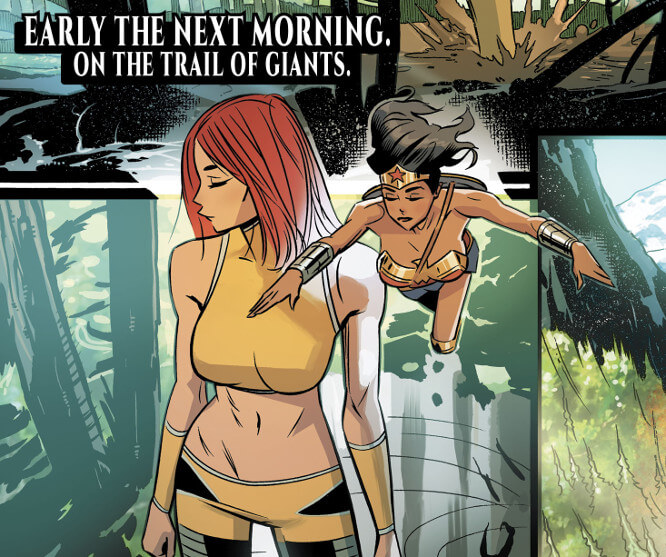
The conflict between Diana and Giganta is generally portrayed not as one between good and evil, but rather one between higher and lower social classes, with Giganta’s mercenary stance arising from her comparative lack of privilege. “You think because you’re this princess, the rest of us must have access to the same unlimited resources and prestige you do,” she says to Diana. “But guess what: we don’t. I have a job. A mortgage.”
“Fine,” replies Wonder Woman. ”If it’s money you want, payment can be arranged.” Giganta’s response: “Don’t say that with your lip curled like it’s something dirty. A girl’s gotta eat. Do you have any idea what my caloric requirements are when I’m at my max height?”
Only in the third and final part of the story does Giganta’s nihilistic streak show, as she slides into the familiar role of villain-as-tempter: “You’re only a hero because you pander to people weaker than you are. If you wanted, you could be something more. You could be a god.”
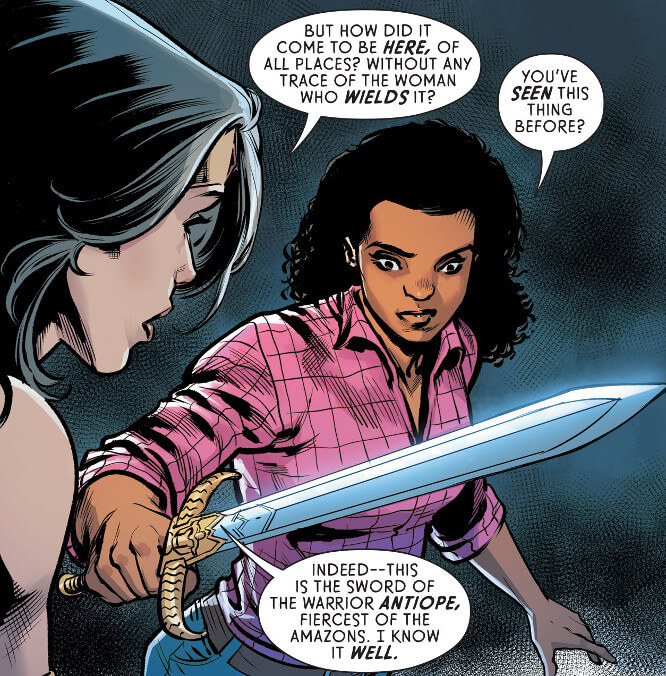
“Giants War” owes little to Greek mythology. Giganta hails from the world of mad science rather than the Olympian pantheon, while the Titans are not Prometheus, Atlas or Hyperion but generic stone monsters — who, it turns out, are not even real Titans anyway. But the storyline does, unexpectedly, crib from Arthurian legend with a subplot in which Maggie — accompanied by her three mythical-creature buddies — finds the sword of the Amazon Antiope in a lake, upgrading her from straight-partner-for-the-comedy-sidekicks to something more significant.
Men, Women and Divinities
“Love is a Battlefield” (issues 69-72) opens with a married man having an affair with a young woman on the doorstep of his suburban home; the canoodling is interrupted by the arrival of his wife – who announces that she is eloping with the family babysitter. This prologue ends with the revelation that the entire street is filled with lovers, kissing and frolicking in their underwear, throwing petals to the breeze, apparently oblivious to a car erupting into flames behind them. When Diana and her comrades (at this point Aphrodite, Maggie and the pegasus Cadmus) arrive on the scene, they soon realise that Aphrodite’s errant offspring —Atlantiades, demigod of desire — must be nearby. Sure enough, the protagonists are greeted by Atlantiades' flock of attendant cupids.
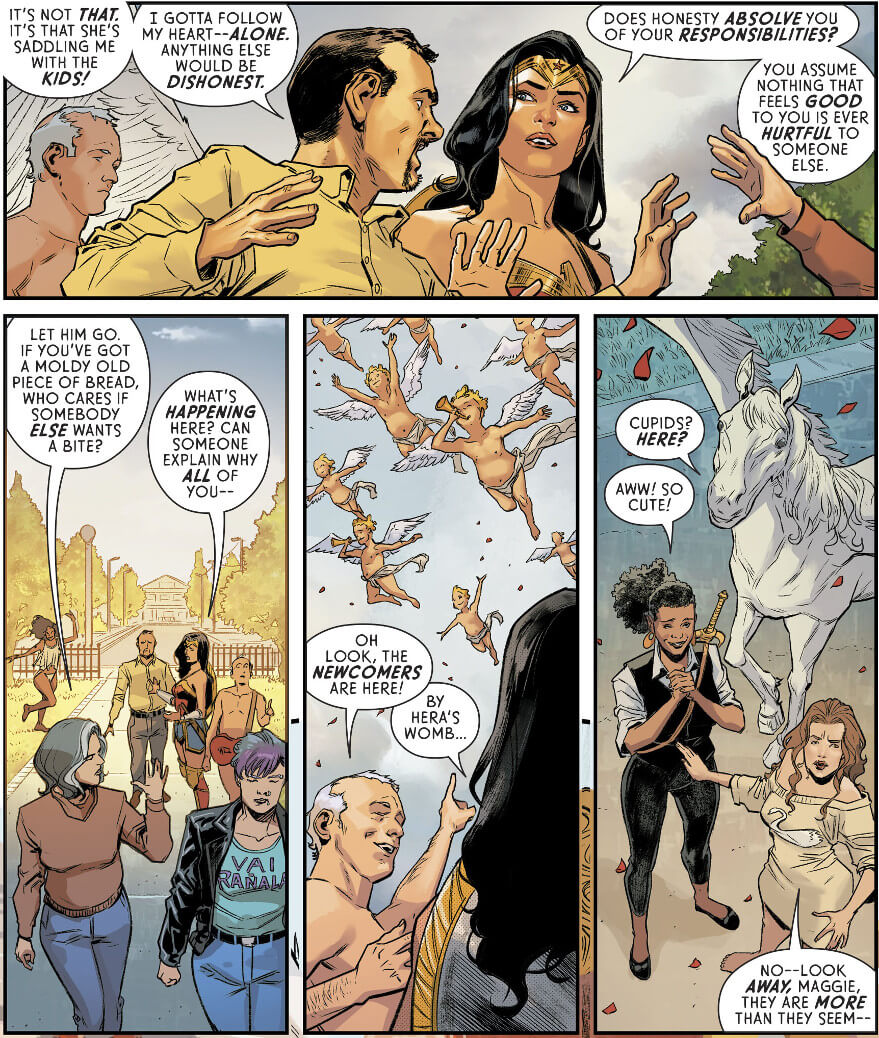
Like many pop-fiction reworkings of mythology, Wilson’s Wonder Woman shows no particular commitment to faithfully adapting its source material. Many a classicist would wince at the comics’ usage of “cupid” (strictly speaking, the Roman name for the Greek god Eros) as a general term for winged, love-bestowing infants — a notion that derives from the Renaissance-era motif of the putti rather than from ancient Greece or Rome. Similarly inexact is the comics’ portrayal of Pegasus and the Minotaur as species instead of individuals, or its depiction of the Titans as generic rock monsters (possibly influenced by Disney’s Hercules, which likewise cast the Titans as elemental giants).
But like many of the better pop-fiction reworking of mythology, the comic — as fast-and-loose as it may be — still appreciates what a rich store of material it has at its disposal. Wilson is willing to incorporate authentic mythological details — even lesser-known ones —if they will fit her story. So it goes with the character of Atlantiades.
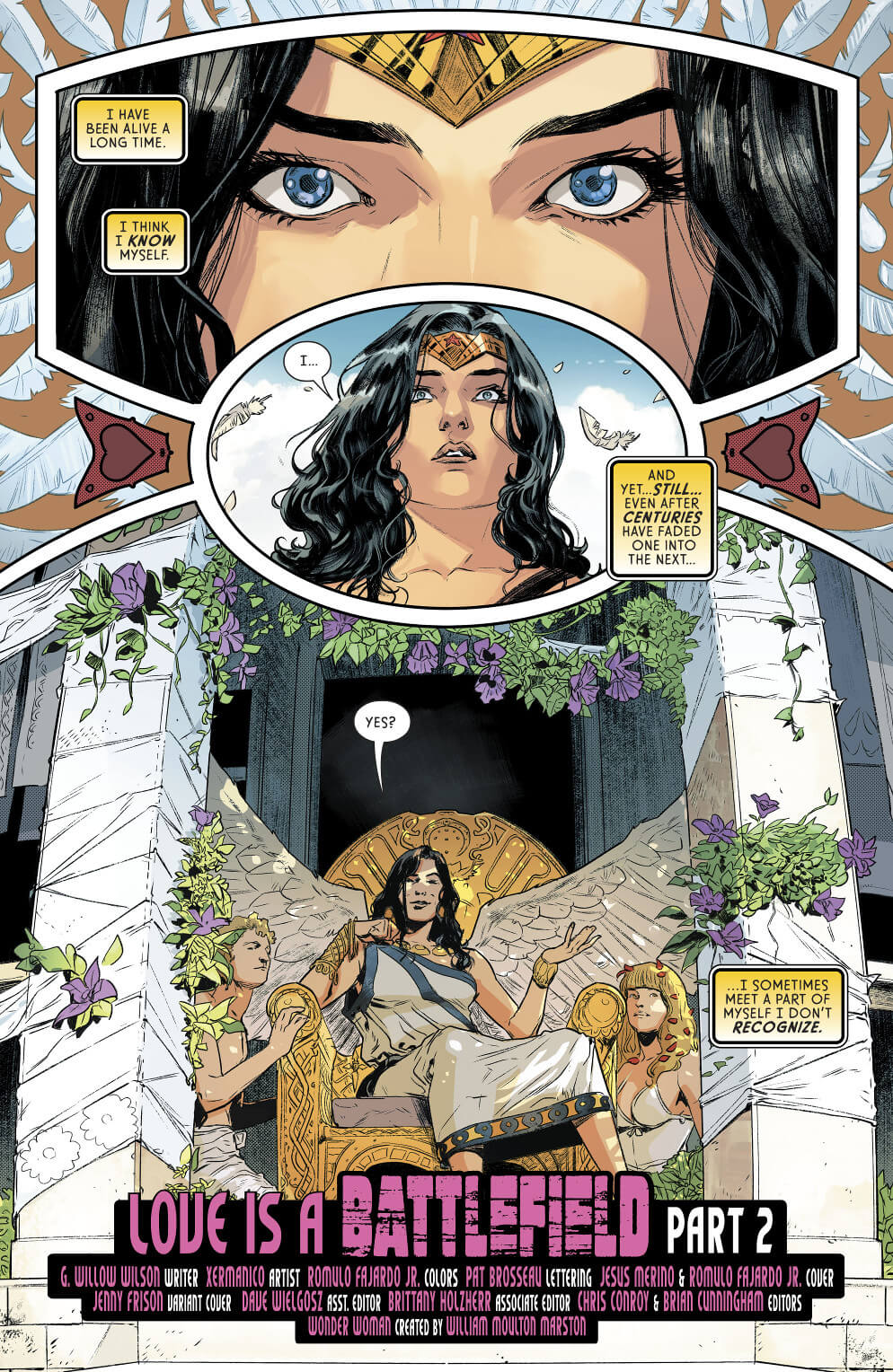
According to their myth, the most comprehensive version of which is found in Ovid’s Metamorphoses, Atlantiades was born male as the son of Aphrodite and Hermes. The story relates that he had an encounter with the naiad Salmacis, who forced herself upon him, in the process praying that the two never be separated. The gods obliged by merging the two together physically, leaving Atlantiades half male, half female. The deity is more commonly known as Hermaphroditus; but as this name has picked up negative connotations, Wilson uses the alternative name of Atlantiades — which, as an aside, is also the name favoured by Ovid, although English translations of The Metamorphoses tend to omit it. The comic acknowledges both names in issue 65, when Aphrodite says of her child that “mortals call them Hermaphroditus, but I named them Atlantiades after my grandfather, Atlas” (this is something of a slip-up as Atlas was Atlantiades’ paternal, not maternal, great-grandfather).
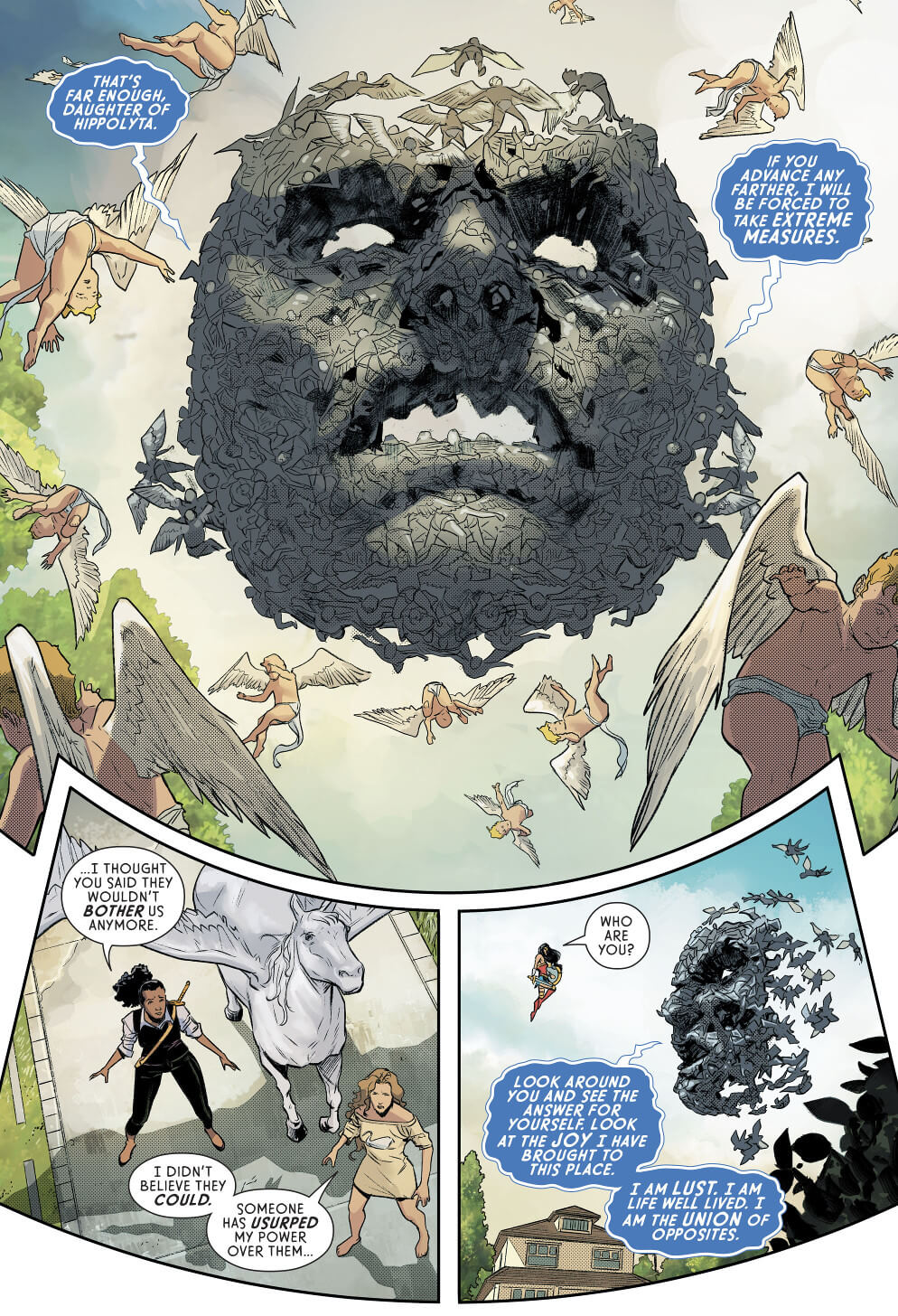
In bringing this quasi-mythical world to life, Wilson benefits greatly from the art of Xermanico, who draws heavily upon Art Nouveau for his compositions -- even including circular borders in the manner of Alfons Mucha behind the flowing-haired characters. Xermanico successfully blurs this idyllic beauty with the weirder aspects of the story -- such as when Atlantiades manifests as a gigantic face formed from a flock of cupids.
While technically the antagonist of the story, as the agent of the disruption that Diana must fix, Atlantiades is not exactly a villain. Much of “Love is a Battlefield” is less a superhero story and more a modern reworking of Shakespeare’s A Midsummer Night’s Dream – a popular source of inspiration for urban fantasy authors who want to tell a lighthearted tale of immortals meddling in the lives and loves of humanity.
The story is also an excuse to put Wonder Woman’s relationship with Steve Trevor under the microscope. The local divinity scorns Diana’s affection for her soldier boyfriend: “I am Atlantiades of the Erotes, the living image of desire and union, both male and female, and you would rebuff me for a mere man who will grow old and toothless and die?” Elsewhere, Steve seemingly appears out of nowhere to express his concerns: “One day I’ll go bald and get liver spots and forget my keys, and you’ll still be exactly the same. It scares me sometimes. So I do — sometimes — wonder if life would be easier with an ordinary person. Somebody who’ll grow old and saggy along with me.” It turns out that this Steve is merely an illusion. Diana accuses Atlantiades of cruelty — only to be told that the illusion arose from her own anxieties.
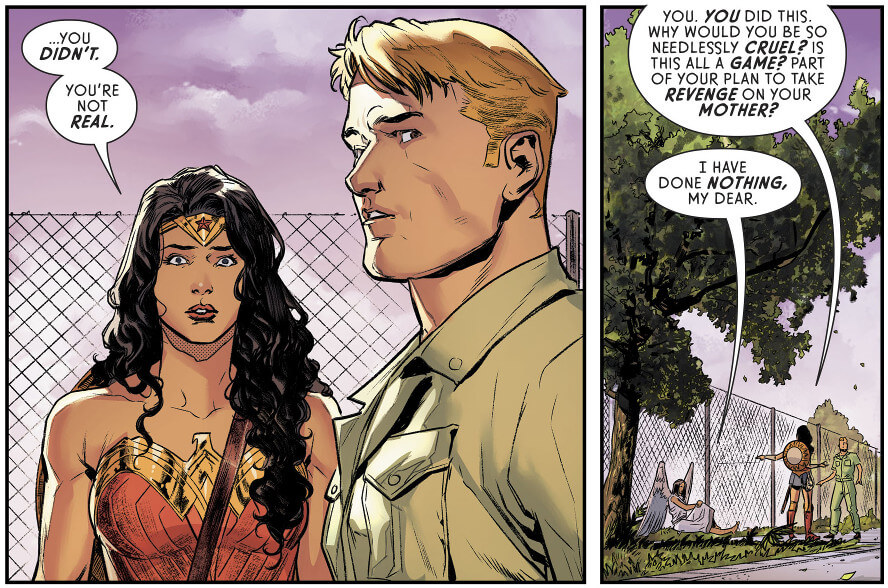
While portraying unfettered romance as a threat to social order, “Love is a Battlefield” has a decidedly pro-LGBT subtext. It is a story that makes a point of endorsing relationships between partners of sundry different shapes and forms, as when Maggie and her pegasus friend Cadmus squabble over the affections of Atlantiades:
"Have you ever… you know… with someone… something… of another species?”
“I’m an Olympian, my dear. Have you ever met Zeus? Or for that matter, looked in a mirror? Hmm? Which of us has been romancing a satyr these past weeks?”
“That’s different!”
“I will pay you a hundred dollars of your mortal money if you can tell me how.”
More obviously, the story contains non-binary gender representation in the androgynous form of Atlantiades. Of all the deities to turn up in Wilson’s Wonder Woman run, Atlantiades has the most development as a character, the comic making a concerted effort to convey their emotional response to being treated as a mere novelty by the Olympians:
I’m thinking it’s been far too long since I had a cult. Everyone remembers you [Aphrodite], but I have been forgotten. Even though my following was once nearly as large as yours. This realm, this sceptical, dissonant plane, is my second chance. You never loved me for who I was, only preened over what I was, trotting me out like some curiosity to increase your own stature among the gods. But these mortals adore me as I deserve.
“I was proud if them”, says Aphrodite, admitting her failure. “I had made, from my body something not even Zeus could match. But my pride was about me, not them. I didn’t consider how they would feel, what they wanted. How they felt being on display before the gods. And as a result, I pushed them away. My own child.” Notably, Wilson avoids Atlantiades’ mythological origin as the product of non-consensual transformation, which would only have muddied the story’s sympathetic portrayal of non-binary gender identity.
Faced with the town collapsing into lovestruck chaos, Diana attempts to talk reason into Atlantiades, who initially rebuffs her (“Reason. Listen to you! You’ve spent too much time in this realm of bureaucrats and soldiers and bored, tired people”) but the two eventually come to an agreement, and the libidinous locals receive a figurative cold shower. Meanwhile, Maggie follows her magic sword to a strange catacomb; this turns out to be the portal through which the Olympians reached the mortal world. Here, she — along with Diana and Atlantiades, who follow her — encounter a monster: a giant with a metal bull head.
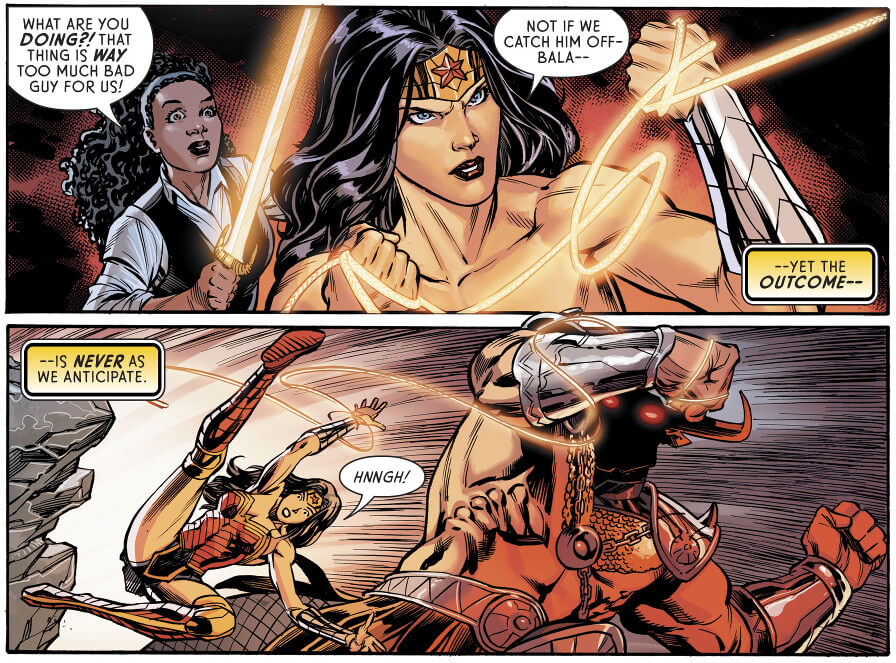
Referred to by Aphrodite simply as a “colossus”, this is a rather generic enemy that recalls the giant stop-motion monsters that turn up in Ray Harryhausen films whenever a spectacle is required. The story’s main role for the colossus is to allow Maggie to show off her new-found sword-wielding abilities, and for Atlantiades to complete their redemption arc as they help out in the battle. Once the colossus is defeated, an army of Lovecraftian fish-people arrive on the scene (the Telchines of Greek mythology, perhaps? Or maybe relatives of the Trench from Aquaman?) In all, the subterranean fight takes up the bulk of issue 72, which is not so much a showcase for Wilson’s writing as an opportunity for pencillers Jesus Merino and Tom Derenick (aided by inkers J. Merino and Scott Hanna, along with colourist Romulo Fajardo Jr.) to let rip with a dynamic set of action pages —swords, wings and lariat flashing in all directions.
Mothers, Daughters and Demons
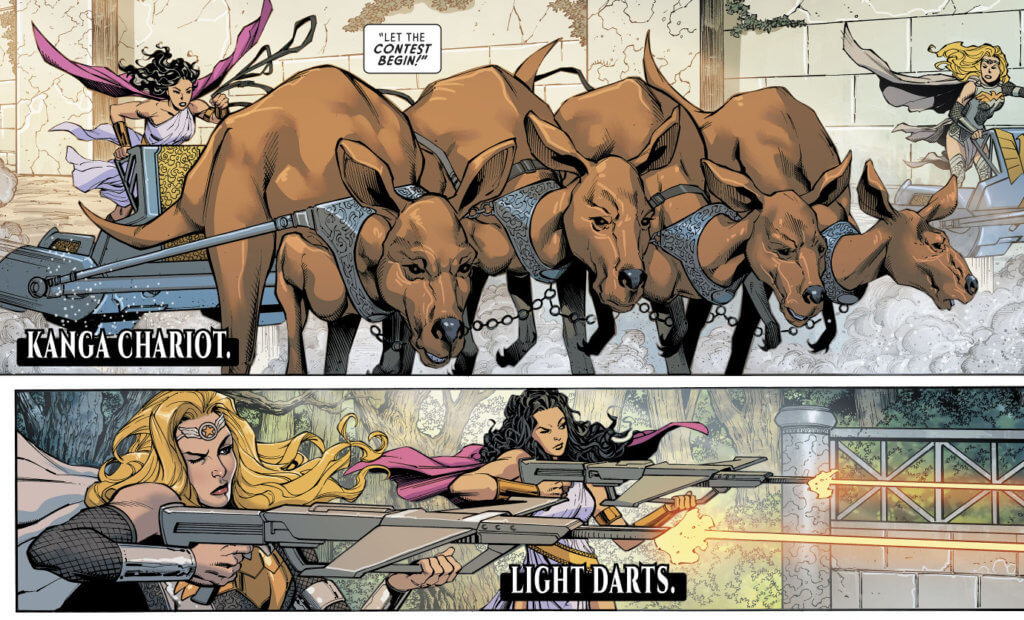
A guest team took over Wonder Woman for issue 73, with Steve Orlando standing in for Wilson to provide the one-issue story “The Queen and the Empress.” This is framed as a flashback to Diana’s childhood, when she and her mother Hippolyta were trapped in Dimension Chi — an alternate Themyscira where the Amazons are ruled over by a paranoid empress. The story allows a distinct change of pace from Wilson’s surrounding run: the alternate-universe Themyscira is clearly modelled on Diana’s home in the original 1940s comics, a bizarre place where Grecian Amazons ride kangaroos and shoot laser guns. This interpretation fell out of favour in later decades but, apparently, lives on in Dimension Chi.
And it is not the only thing living in Dimension Chi, as the next storyline “Return of the Amazons” (74-5) reveals that a band of Amazon refugees led by by Antiope and Philippus have been hiding out there. The first part of this story sees Diana, Atlantiades and Maggie fighting the Empress, the evil double of Hippolyta seen in the previous issue. The fight takes up most of issue 74, and is used to articulate Diana’s anxiety over her relationship with her mother.
The dialogue in the very first page emphasises that dimension Chi was specifically created by Hippolyta as a world without Diana: “a future in which she was not hampered by a child”. Later, when Diana narrates, she reveals that “I no longer know what I know… I am in the past again, a frightened girl who is afraid her mother cannot love her”. During the fight with the Empress, Atlantiades quips that “if this is not an apt metaphor for the troubles we who are born to goddesses have with our mothers, I don’t know what is.” While lacking subtlety, this element successfully raises the stakes for Diana’s eventual reunion with her mother. When Diana and her friends meet the Amazon refugees at the end of the issue, and learn that Grail has conquered Themyscira and taken Hippolyta prisoner, the stage is set for the conclusion to this family drama
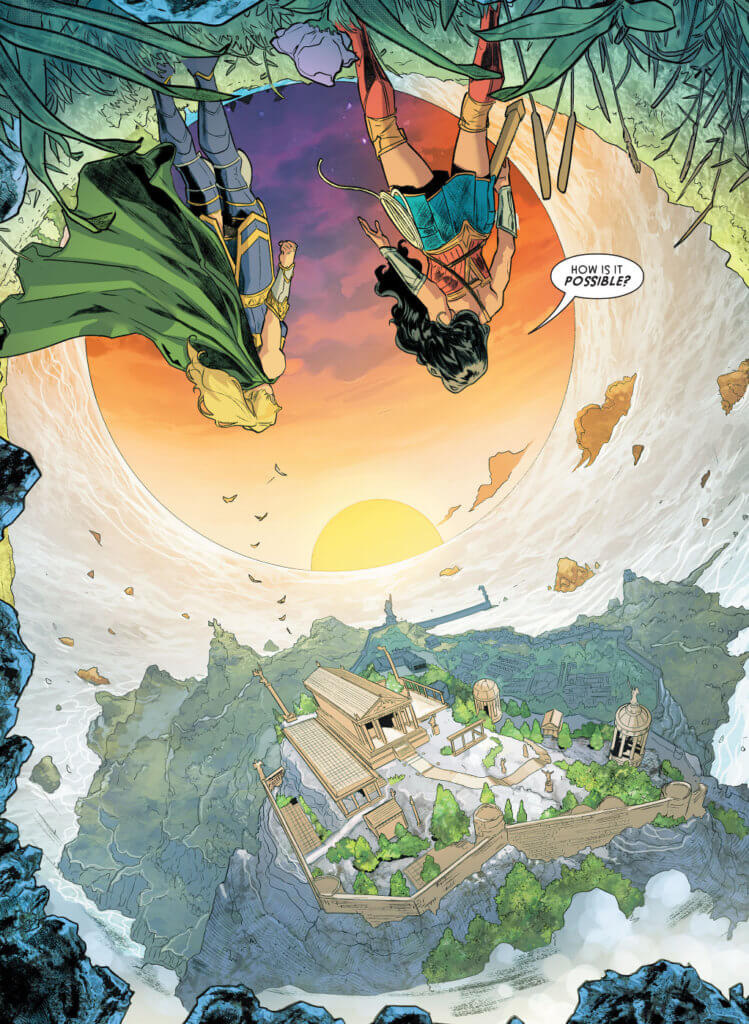
Billed as an “extra-sized anniversary issue” (marking the anniversary of Justice League, rather than Wonder Woman) issue 75 is the sort of all-action climax that traditionally caps off a superhero saga. The expanded length ensures that Wilson and her artistic team have plenty of space to balance the requisite derring-do with a degree of nuance and inventiveness. The story begins with the pre-war reunion of the Amazons, frolicking in Elysian bliss as flowers decorate their hair. Then comes a surreal moment where Diana finds that the fractured Themyscira is shaped like a wheel, so that she and Antiope stand on a ceiling and look down at the land below — Xermanico’s circular Art Nouveau suddenly taking on a more literal aspect.
Grail, whose only previous appearance in Wilson’s run was as a brattish foil to Ares, receives little further development in “Return of the Amazons”. Her main motivation in the story is revenge for having been imprisoned: “I want you to suffer, to be awake as you die, as I was awake in the dark all those months, beneath your feet”. She serves mainly as a default opponent for Diana and her kindred, a sort of negative Amazon — indeed, with her pale skin and glowing eyes, Grail even looks something like a photographic negative. The story establishes that she has pulled together an army of Amazons loyal to her cause, something attributed loosely to her “strange and hypnotic charm”.
The issue does not do a great deal with the idea of a Themysciran civil war, the rogue Amazons being used primarily as extra muscle in the fight scenes. When the battle breaks out, Wilson ensures that the thrusts and smashes are joined by the themes of love and compassion that have always added depth to Wonder Woman’s adventures: Antiope urges her Amazons to use non-lethal methods (“Do not kill if you can wound, do not wound if you can subdue! They may have turned their backs on our tradition… but we will not!”) while Atlantiades turns up to use love itself as a weapon. Although most of the cast are immortals, former waitress Maggie — now a full-fledged Amazon — lends a human touch, uncertain about her newfound abilities (including flight) and her role as warrior, with a dash of comic relief on the side (“Oh my God alive. I have a three-Midol headache!”) If nothing else, the negative Amazon Grail — characterised by her lack of love — at least provides something for the heroes to define themselves against.
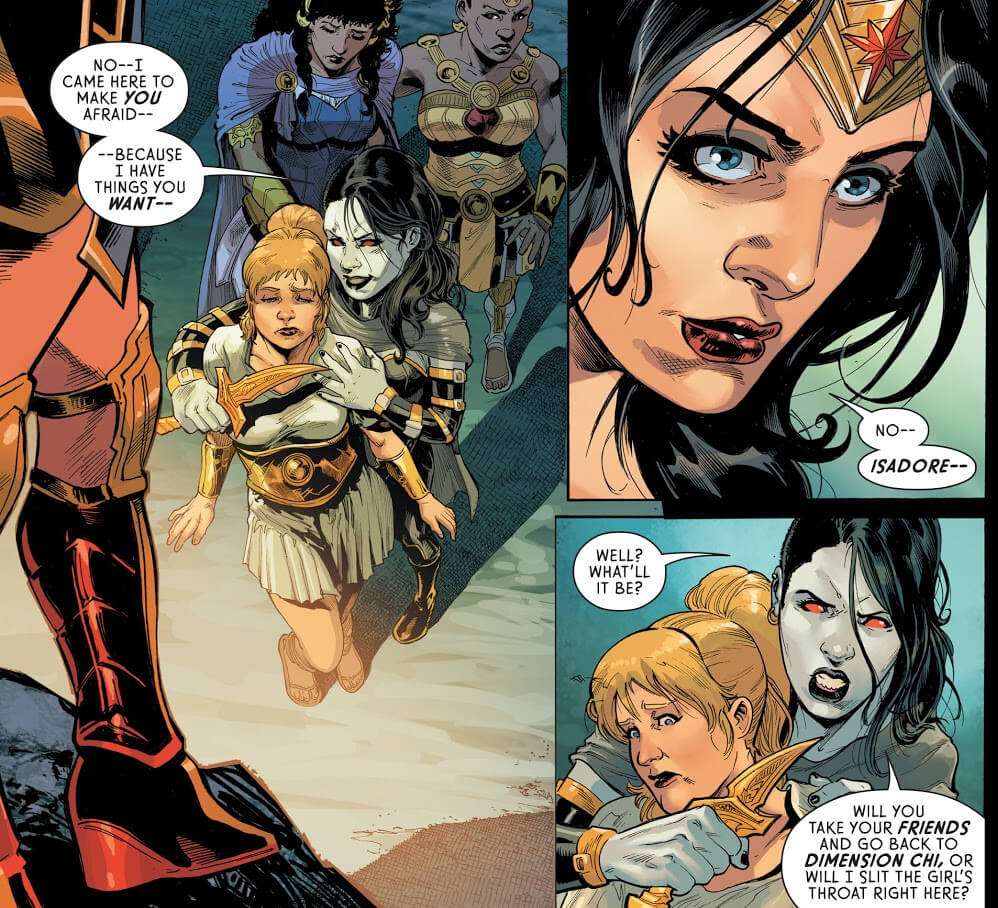
Diana’s long-time friend Nubia is cast as one of Grail’s allies — although she later turns out to have been planning to undermine the villainess the whole time (“Our code of honor is what allows us to protect each other, Grail. Even when our enemies are too dense to see it”) .This rather predictable twist coincides with a more interesting development: Diana rescues Veronica Cale’s daughter Isadore, who is revealed to have been held captive by Grail alongside Hippolyta.
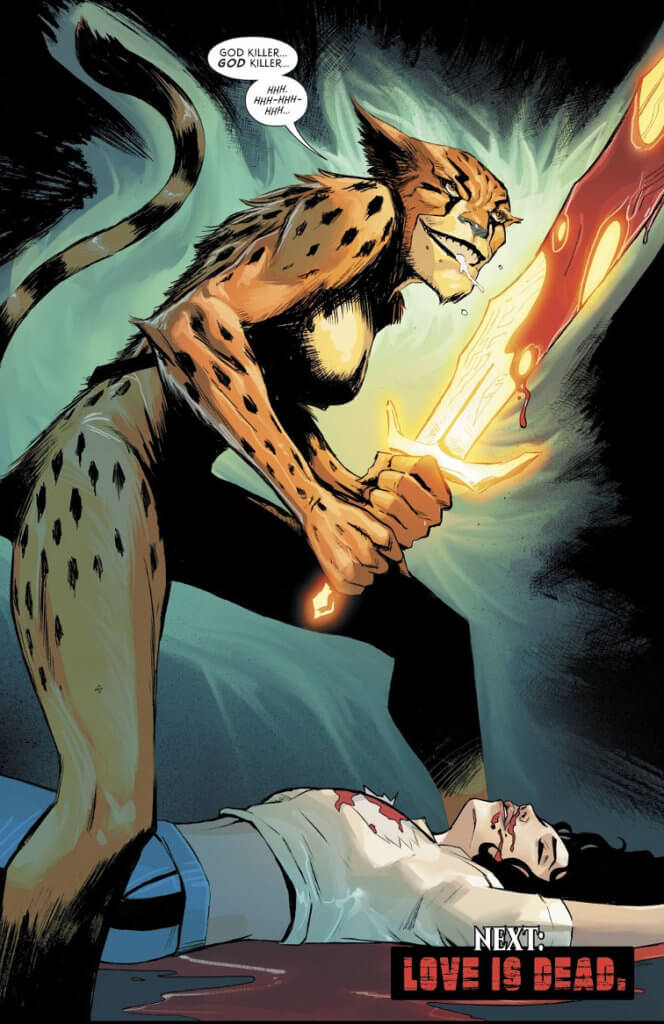
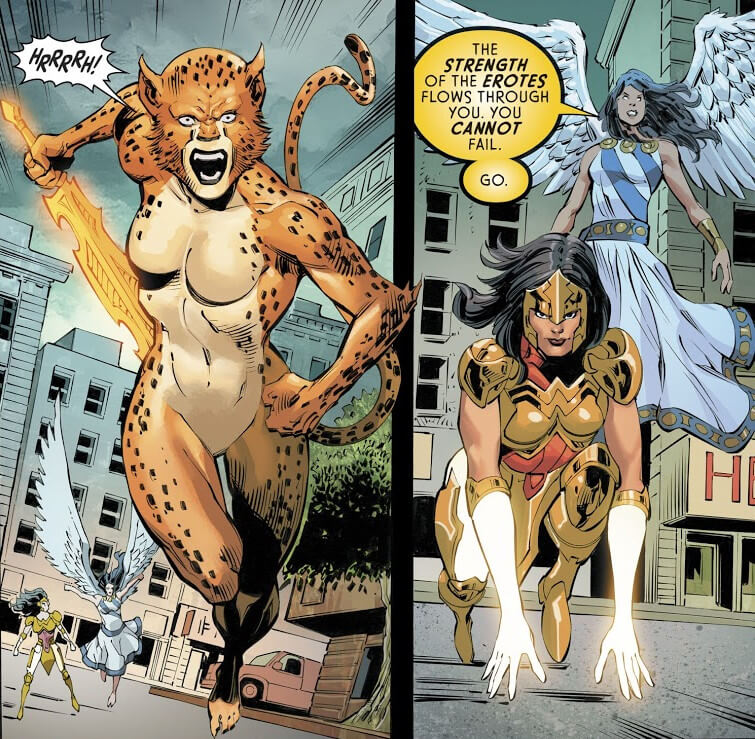
The story in issue 76, “Mothers and Children,” acts as something of an epilogue, tying off plot threads from across Wilson’s run thus far. Atlantiades is reunited with their mother Aphrodite; Veronica Cale is reunited with her daughter Isadore; Diana is reunited first with her mother Hippolyta and then with Steve Trevor as she returns to the mortal world; and the gateway to Themyscira remains open, promising further adventures. Then, at the very end, the issue delivers a twist: Cheetah, that most iconic of Wonder Woman villains, turns up and murders Aphrodite with the God Killer sword.
Love, Loss and Conclusions
Since issue 75, Wonder Woman had been billed as tying in with DC’s “Year of the Villain” event. But it was not until Wilson’s final story arc, “Loveless” (77-81), that the connection truly came into play. The machinations of Lex Luthor, happening mainly in the pages of Justice League, impact the plot as it was Luthor who gave Cheetah the enhanced God Killer sword, and who helped to plunge the world into mayhem with a broadcast encouraging the public to run riot. But Wilson leaves these matters in the background, and focuses on the main cast of Wonder Woman.
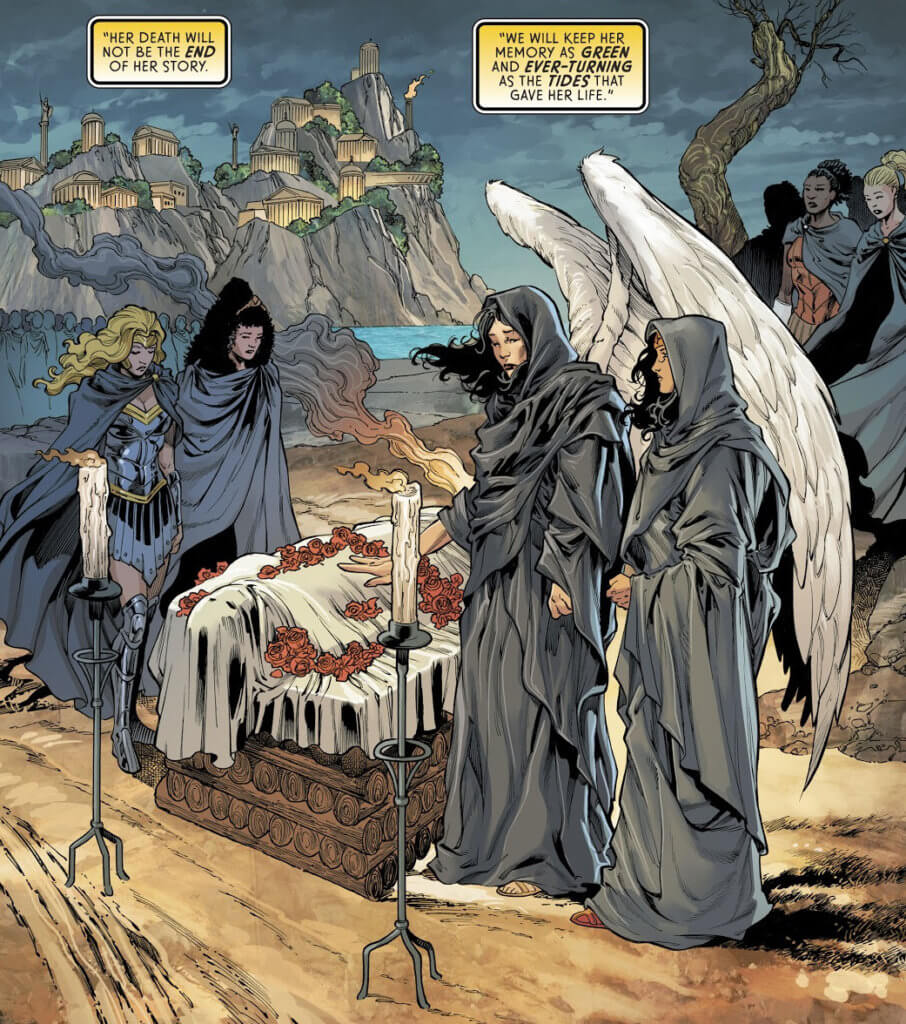
“Loveless” begins with Atlantiades finding their mother’s body, followed by a tearful funeral scene. Then comes Wonder Woman’s battle with Cheetah, who — using the God Killer —succeeds in destroying Diana’s armour, symbolically robbing her of her power. Meanwhile, the death of the love goddess has frozen humanity’s collective heart: crime is rampant, and bystanders ignore people harmed in accidents. “The gods are dead or have fled their posts,” says Diana. “Nothing now stands between us and our worst instincts.”
Wilson uses the death of love to get under the skins of the comic’s cast, each character responding a different way. Atlantiades ends up contemplating their position in the pantheon: “But now that the goddess of love is gone… what am I? Without love, the demigod of unions is just the god of unhappy marriages.” Steve Trevor contemplates his fading relationship with Diana. Etta Candy reacts to the news with smart-mouthed acceptance: “Are you telling me love is dead? That’s the dumbest thing I’ve ever heard, but it explains people not turning up for work... they hate their jobs, but they loved their families.” Villainous Veronica Cale, naturally, admits that she feels little difference without love.
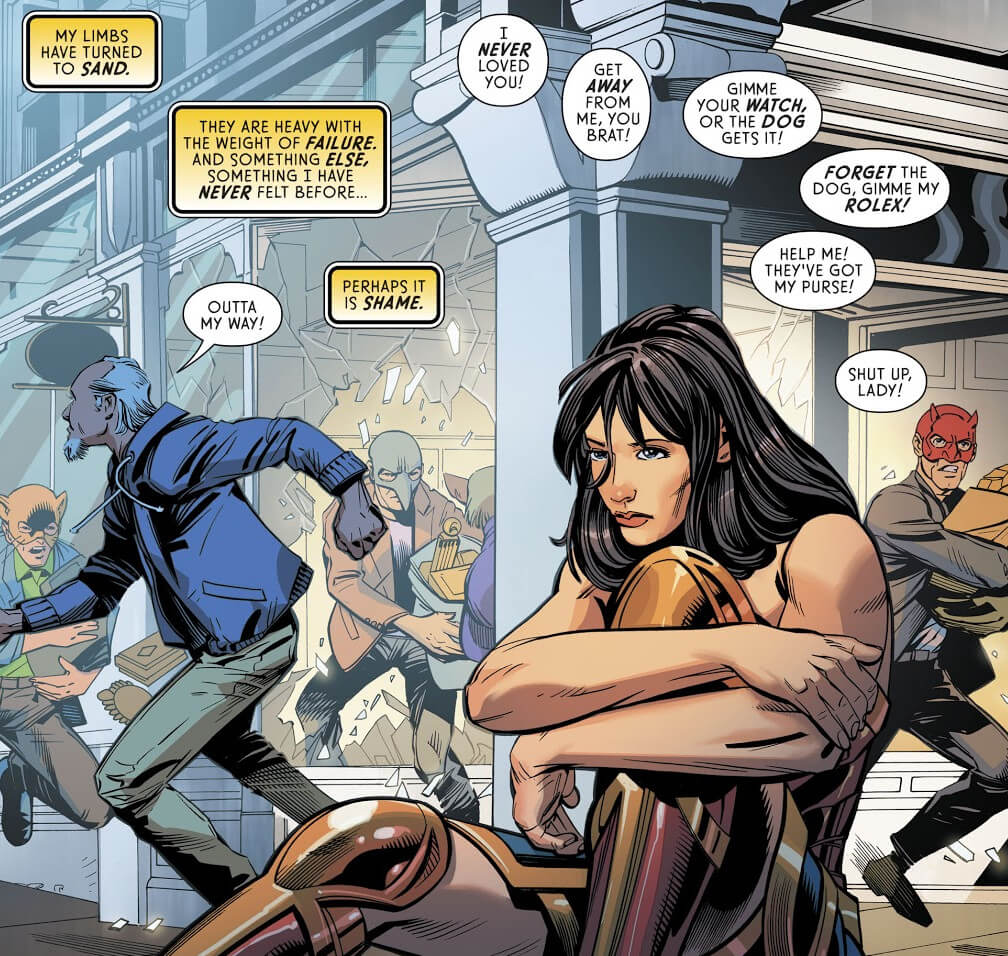
Diana is left defeated — not only by the loss of her sword, shield, bracelets and tiara, but also be the loss of the love that kept her fighting. Issue 79 opens with a large panel of her sitting disconsolate, almost like a beggar, on a street corner as mass looting occurs behind her; she is unable to take on even the most generic of superhero missions. Cheetah, meanwhile, delights in the mayhem. Wilson casts Cheetah as — like Grail before her — a sort of anti-Amazon. She is depicted as being motivated purely by her envy of Diana’s kindred: “if you had granted me my rightful place in Themyscira, none of this would have been necessary”.
During the climactic battle, Diana tries to bring Cheetah down with a chemical weapon provided by Veronica Cale — only to find that Cale has double-crossed her, the chemical instead boosting Cheetah’s powers. But Wonder Woman still has one last tool at her disposal: love.
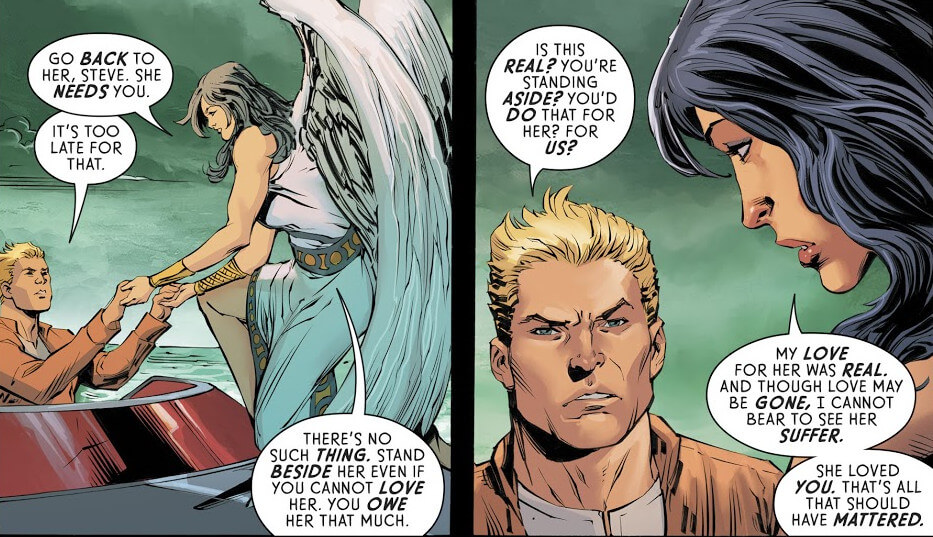
The characters’ romantic relationships are central to “Loveless”. During the course of the story, Steve breaks up with Diana (“It’s not just since Aphrodite. If you were around more, you’d have noticed that things have been rocky between us for a while. But now—it seems like the last reason to stay is gone”). Atlantiades encourages Steve to give Wonder Woman another chance, taking the blame for his departure by acting as a rival for Diana’s affections. “I must have been in love with her”, says the demigod, “because what I felt is gone now, with all love”.
As a result of this realisation, not only does Steve return to Diana, but Atlantiades ascends to godhood, taking Aphrodite’s place as the god of love. Wonder Woman, granted a new suit of armour by Atlantiades, is able to easily defeat Cheetah and grant her the trip to Themyscira that she desired — albeit one spent in a prison cell. Meanwhile, Veronica Cale is forced to face up to the failure of her treachery, and the knowledge that she has now made a deadly enemy of Cheetah.
In “Loveless”, the heroes win because they are ultimately united by love, while the villains fail because they are too divided by contempt to work together. This is a very basic moral framework, one frequently used in children’s cartoons. But as simple as it may be, it is a framework well suited to Wonder Woman, a comic that must reconcile preaching the power of love over hate with its genre-mandated reliance upon physical conflict.
“Loveless” sows the seeds for further stories. It ends with Cheetah being visited in her subterranean prison by a group of creepy supernatural women – characters who had previously been shown meeting the exiled Grail. But these tales were to be handled by Steve Orlando, who took over as main writer with issue 82. As far as G. Willow Wilson’s run is concerned, “Loveless” is the final chapter.
Wilson made full use of the Wonder Woman mythos to tell a story of gods and demigods —drawn both from the ancient myths of Greece and the modern myths of superhero comics — and how their conflicts affect the lives of mortals. But at the same time, she never lost the gift for humoru, light-heartedness and humanity that was on show throughout her Ms. Marvel run. Looking back at Wilson's additions to the Wonder Woman cast, the character of Maggie — the girl-next-door-turned Amazon — is at least as representative as the androgynous love god Atlantiades.
As Wonder Woman continues into the future, different writers and different takes will come and go. But G. Willow Wilson's run on the comic will stand as an example of what happens when that mixture of mythology, superheroics and humanism is put together just the right way.
Comments
I just finished Wonder Woman 779 and wanted to possibly track down some issues from either the New 52 or Rebirth eras to read. Not knowing where to go, I turned to WWAC and, as per usual, you all did not disappoint! This was a fantastic read and I'm now leaning toward the Rebirth era. Thank you!
Ivrione Moonshadow
2021-10-02 09:05:07 +0000 UTC