Subterranean Mutant Semiotics: Morlocks, X-Factor, and the Privilege of Passing
Added 2020-03-11 15:01:02 +0000 UTCContent Warning: This essay includes discussions of transphobia, anti-trans violence, trans-medicalism and passing.
By Dani Kinney
It’s challenging to have nuanced conversations about passing, because of the ways in which passing is determined by the dynamics of privilege. If there is one thing marginalized folks really hate to have to admit is that they may still hold privileges of one kind or another. Privilege itself is not a bad thing, but the way in which you abuse and misuse your privileges or fail to acknowledge them, is.
We need to recognize that for many, passing and “going stealth” are either critical parts of being able to safely navigate a hostile society. We also need to recognize that not everybody has access to the means necessary to achieve this level of safety for a number of reasons. Passing/"going stealth" can be a matter of life-or-death safety, but it is still a privilege that not every trans person has. Because acknowledging privilege is challenging, understanding the privilege of passing can sometimes be framed as invalidating of the experience and trauma of passing trans people.
It doesn’t invalidate anybody’s hardships to acknowledge that they experience a certain amount of privilege relative to others marginalized people. Certainly, none of the trauma that Warren Worthington has suffered through is being invalidated when we say that he has significantly more privilege than the Morlocks. Nor does it excuse the trauma experienced by white middle-to-upper class passing trans women to acknowledge that they experience significantly more privilege and safety than trans women of color with limited access means of transitioning.
The Morlocks are mutants who cannot pass as humans, and "choose" to live in an underground tunnel system, instead of living within human society. In some cases though, mutants without visible mutations [such as in the Gifted TV series] cast off that privilege, altering their appearance in such a way to make themselves visible, and reject the notion of passing. Just as many trans people in our world reject passing and the ideologies that impose the pursuit of "passing" onto trans people. When we look at the mutant metaphor as a surrogate for the experiences of trans people, Morlocks could be framed to stand in for people without the means and levels of access to pass, and/or people who actively choose not to pass.
The Morlocks have a complex history, with significant retcons that re-frame their history that I won’t be engaging with. I’m going to focus on the two stories that play a major role in the way we understand the Morlocks today. The first is among the most common stories to come to mind when you hear the name “Morlocks," Mutant Massacre. The second is Sina Grace’s 2018-2019 Iceman run.
I’d first like to dissect a third story, not because of how the Morlocks are depicted, but because of their absence; Jonathan Hickman & Pepe Larraz’s House of X. Apart from a few mutants lucky enough to have been on a X-roster in the past, the Morlocks are excluded from this story. When you frame House of X as a queer separatist story, the way in which the Morlocks are absent is striking. We never see anybody extend or refuse them an invitation. We never see anybody go to the tunnels to plant a gate-seed. We never see Charles discuss them at all, and yet Sinister is front-and-center in House of X & Powers of X, despite the horrific thing Sinister did to the Morlocks. The major paradigm-shift that is intended to usher in a new era of mutant prosperity is tied to their erasure. Even if they are brought in down the line, it's an after-thought. This new prosperity that Krakoa enjoys is forever linked to the erasure of the Morlocks, a group who would needed it the most. The Morlocks can’t be exploited for their military capabilities, they’re not skilled diplomats or super-geniuses, they don’t fit the models of mutant-valuation that Charles, Magneto, and Moira uphold. This is not unlike the way that non-binary and non-passing trans people are ignored and sometimes outright ridiculed by passing and stealth trans people, because of the way that they complicate certain aspects of mainstream trans discourses.
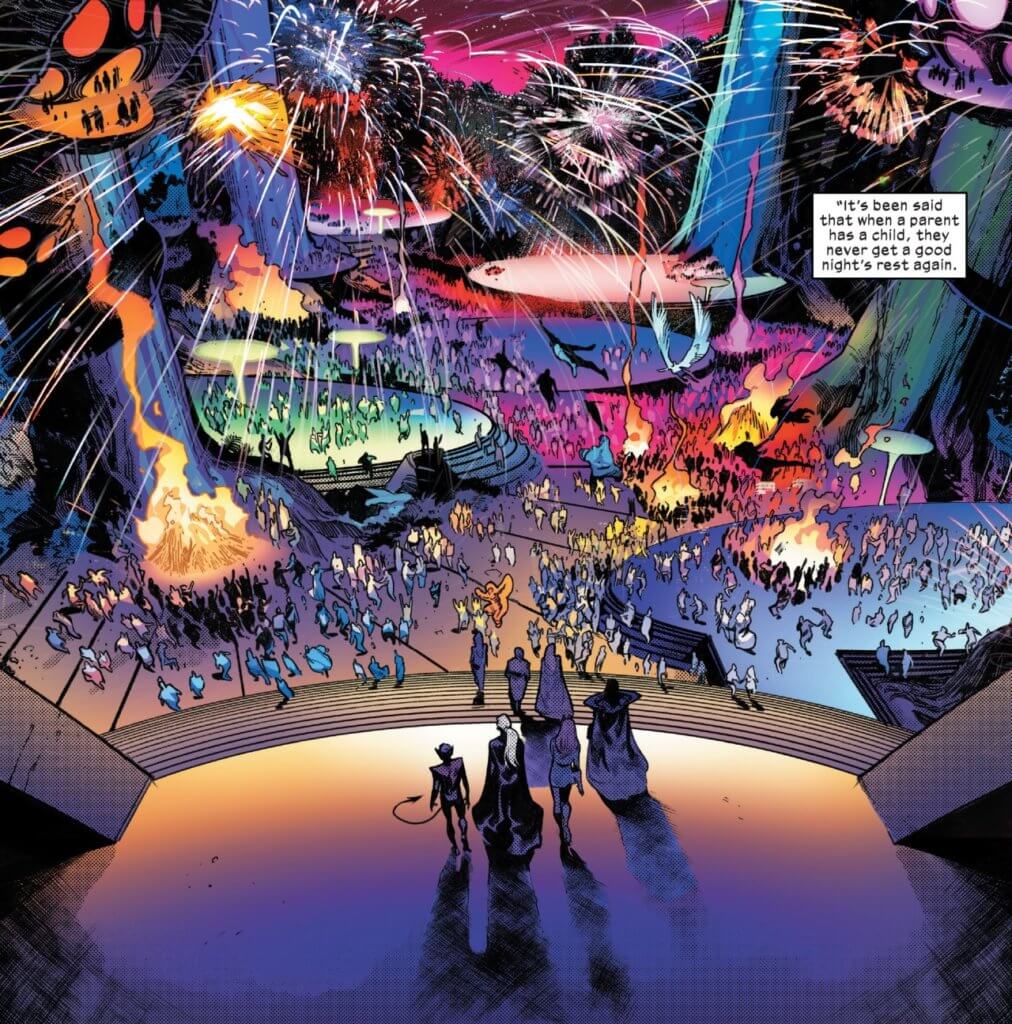 House of X #6, Jonathan Hickman & Pepe Larraz, October 2, 2019, Marvel Comics
When we look at the Morlocks through a trans lens, we see the way in which the larger narratives of Queer and Trans liberation often leave various intersections and identities entirely out the conversation. All too often, non-binary and non-passing trans people are sold out, invalidated, or ignored by many outside of and within the LBTQIA2+ community. We are often neglected by binary trans discourse because of the way we push against or challenge many of its ideological pillars and privileges. We can become "inconvenient", only supported when we easily coincide with their goals. Non-passing and non-binary people represent a reminder of the uncomfortable position trans people hold in our society, just as the Morlocks remind the X-Men who can pass and go stealth of the place that mutants hold in the status-quo of the 616.
This re-frames scenes like the orgy—I mean celebration— in House of X #6. This scene becomes marked by the absence of the Morlocks. We know from the events of Marauders that outside the borders of Krakoa, mutants are still being attacked. For all we know, the declaration of mutant independence may drive the reactionary humans to attack the most vulnerable sections of the mutant population. It’s hard to see the status quo shift as wholly positive once we recognize that one of the most vulnerable and marginalized groups of mutants in the 616 were left out in the open. I read House of X just a few weeks after a reread of the Mutant Massacre. The contrast was striking. It was like the way so many middle-to-upper class queer folks abandoned the fight for broader LBTQIA2+ rights and safety after they got theirs and won the right to marriage. All the while year after year death-counts continued to increase within the trans community, and so disproportionately these deaths were black trans women who were the victims of anti-trans violence. As radical as Krakoa feels, it's a space of privilege and inaccessibility to a large extent that leaves the most vulnerable of the community still at risk, much like white radical queer spaces of our own world.
 Powers of X #4, Jonathan Hickman & R.B. Silva, September 11, 2019, Marvel Comics[/caption]
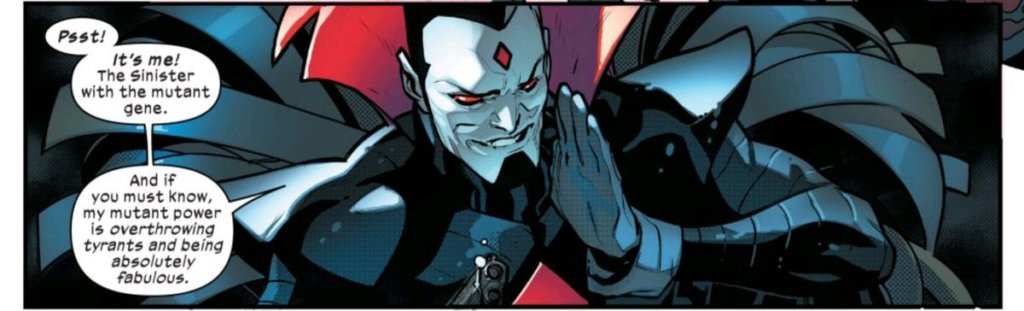
If Marvel is reading, I’ve got a pitch ready to go for a Morlocks ongoing! We could address how Sinister, the man responsible for the atrocities committed against the Morlocks, has secured himself a place on the Krakoan council. We could address how in Powers of X #4 Sinister is framed as glam-goth icon whose "mutant power is overthrowing tyrants and being absolutely fabulous," while we see no support given to his victims. It’s almost as though in order for Charles Xavier to further his own goal, he's allied himself with and empowered a violent, manipulative abuser at the expense of his victims [Nothing 'almost' about it —Ed]. Charles and Magneto knowingly welcomed Sinister despite his role in the murder of so many Morlocks, because he possesses resources that they want. Charles, Magneto, and Moira turn a blind eye to his actions, so long as Sinister continues to give them what they want. This is similar to the way that some highly privileged trans people sell out their community in order to achieve their own prosperity. When this prosperity is achieved by actively harming others in their community, or allying themselves with/supporting the ones harming their community, we need to become critical.
 The Uncanny X-Men #211, Chris Claremont & John Romita Jr., November 1986, Marvel Comics
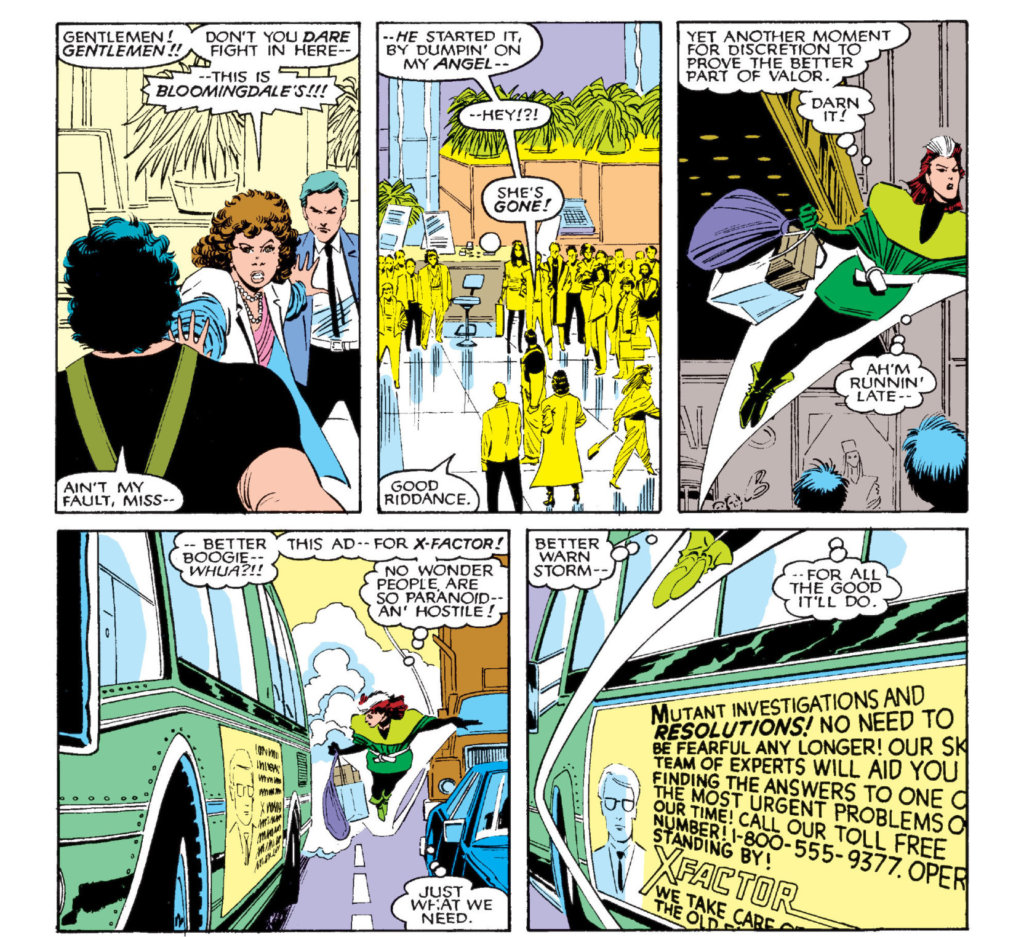
Throughout the Mutant Massacre crossover, X-Factor will become a central anchoring point for much of the anti-mutant sentiment throughout the story. There is so much in the art, narration, and in dialogue that wants to remind us that people look to X-Factor to justify their bigotry. Their presence is a specter in this story, and much can be read in regards to ideas of privilege and access just in observing the ways in which X-Factor navigates their role. As Jean notes, the fact that the members of X-Factor are all human-passing affords them a certain level of ease in navigation that neither the X-Men and the Morlocks are able to utilize.
 The Uncanny X-Men #210, Chris Claremont & John Romita Jr., October 1986, Marvel Comics
X-Factor spends the most time out in public as opposed to in underground tunnels or hidden in the X-Mansion. They have access to a level of safety and security in public spaces that the Morlocks and even the X-Men do not. This is because they are white, because they are passing, and because they are supported by a financially sound institution. Unlike the Morlocks, and many of the X-Men, they’re able to safely move about society free of the risk of abuse or violence. X-Factor becomes the model of passing in this story, implicitly read by others as white-humans.
 X-Factor (vol.1) #9, Louise Simonson, Terry Shoemaker, Published Oct 1986, Marvel Comics
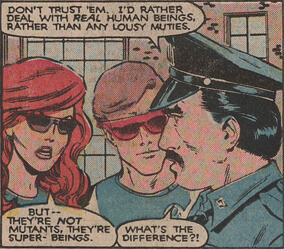
In X-Factor #9 we get a number of interactions between X-Factor and the police who refer to the team as “ our own kind” and "real humans". At this point that we really come to understand that X-Factor comfortably fits within the status quo. It’s the frequency of this message that will really help contextualize the situation that the Morlocks find themselves in. Juxtapositions like this fill the crossover, and because the Morlocks rarely hold space in this story, it’s these juxtapositions that end up telling us the most about them. The more secure X-Factor becomes in the eye of the reader, the more the Morlocks feel increasingly vulnerable and at risk. X-Factor’s membership is also all white and able-bodied, and conforms to the aesthetic contours of their time. This increases their privilege over characters like Storm, who certainly passes as human, but within a white supremacist society. She distinctly stands out, despite passing. Storm is a black woman who takes up & holds space, and is consistently uses choices in fashion to further distinguish herself within her surroundings.
The complexities of passing and safety in this story are just as complex as they are in our own society. A major failing of the story though is consistent with the lack of intersectionality in the mutant-metaphor. In general, we do not see Morlocks who are also people of color, an intersection that really should have been explored. How does the metaphor of Morlocks as non-passing trans people become more complex when the Morlocks also represent black and brown people who do not pass? There is certainly a greater risk of ones safety that comes with being visible while black and brown. But we don’t get to explore and understand the experiences of Morlocks who are people of color, which leaves so much of this conversation in the realm of speculation.
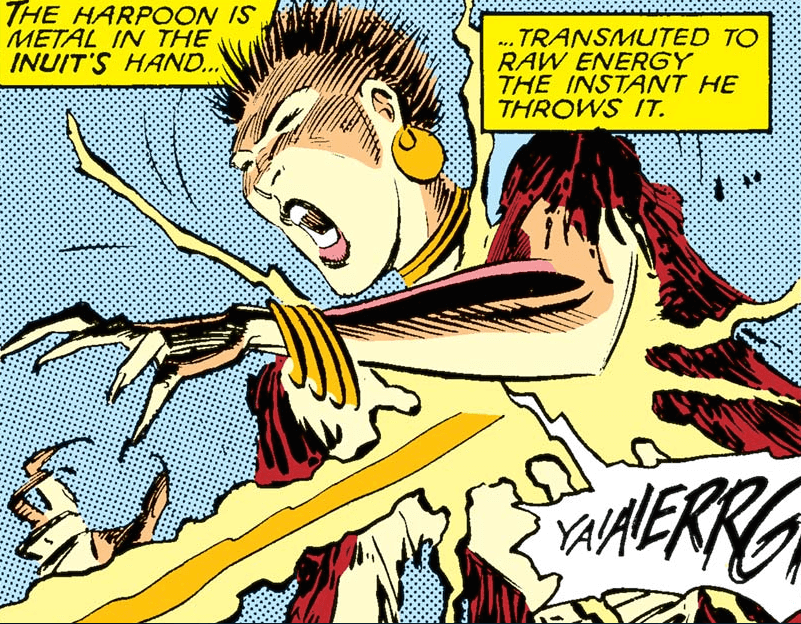 The Uncanny X-Men #211, Chris Claremont & John Romita Jr., November 1986, Marvel Comics
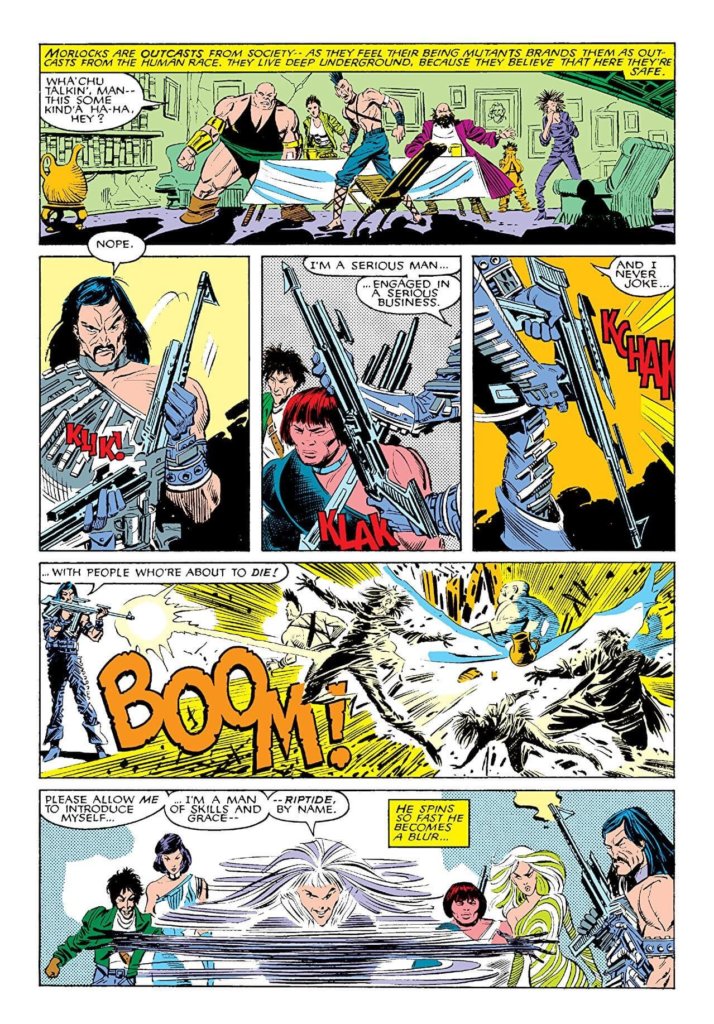
The first time I read Mutant Massacre I developed this implicit sense that despite the fact that this atrocity was being committed against the Morlocks, they were not at the center of their own story. They are peripheral characters in a dedicated publication featuring other characters, yes, but also, the X-Men have shared the spotlight before and there's no reason they couldn't now. However, of the crossover’s 1528 panels, only there are only 146 panels where Morlocks take up at least ⅓ of the panel’s space or could be considered the narrative focus of the panel. Of these 146 panels, fewer than 50 depict a Morlock who is not dead, wounded, or being attacked.
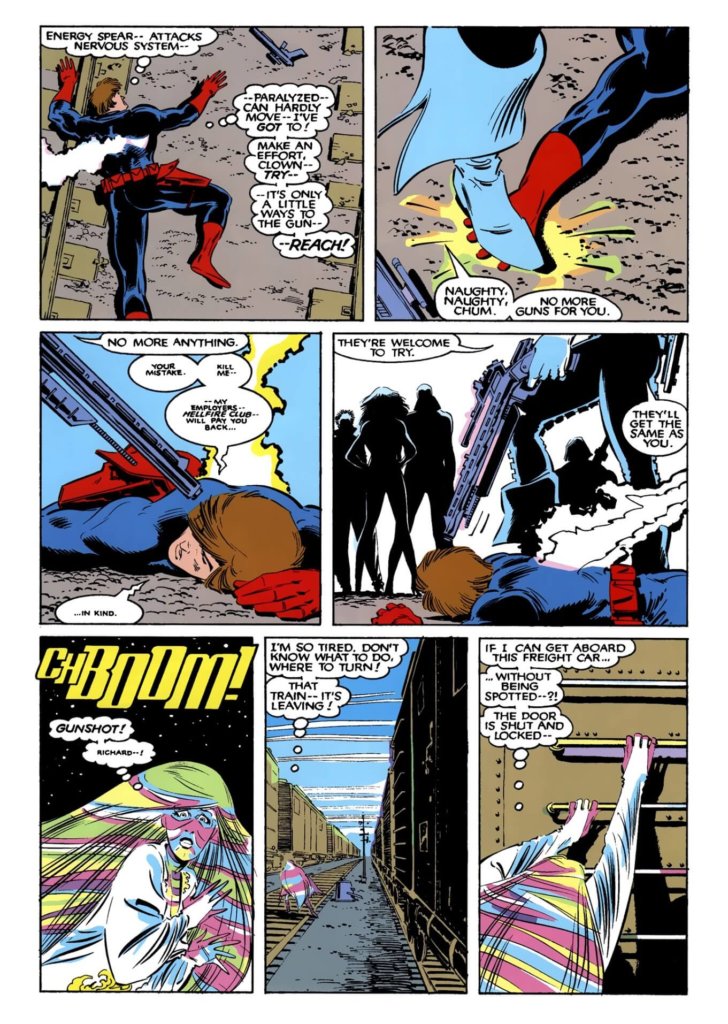 The Uncanny X-Men #210, Chris Claremont & John Romita Jr., October 1986, Marvel Comics
The opening pages of The Uncanny X-Men #210 are a testament to suffering. The first time we interact with characters who represents the Morlocks are Tommy (a vaporwave mutant icon), desperately fleeing attackers we will come to know as the Marauders. The Morlocks are front and center here, but only while we can witness the spectacle of their suffering. It's visceral and triggering for many trans readers. In the next scene we find Dazzler in a tough spot in her life, having had her career ruined because she was outed. This is certainly traumatic, but despite her hardship, she has a security net within her community [ Lila Cheney] to fall back on. And though her pay is significant less and her career ruined, she is not actively being hunted in the depths of the sewers she calls home. She has a job, she has Lila's support, she has access to society in forms the Morlocks do not. She has lost privileges for sure, but she still has some left that the Morlocks do not. This is a hard reality within the trans community, that even in our own hardship we can still acknowledge the few privileges we do hold, that others do not. Is Dazzler experiencing hardship and struggle? Yes. But she has access levels of means and privilege that the Morlocks do not. I think this is an important dynamic to observe in the nuances of how the scene with Dazzler is narrative framed between scenes of Tommy being hunted.
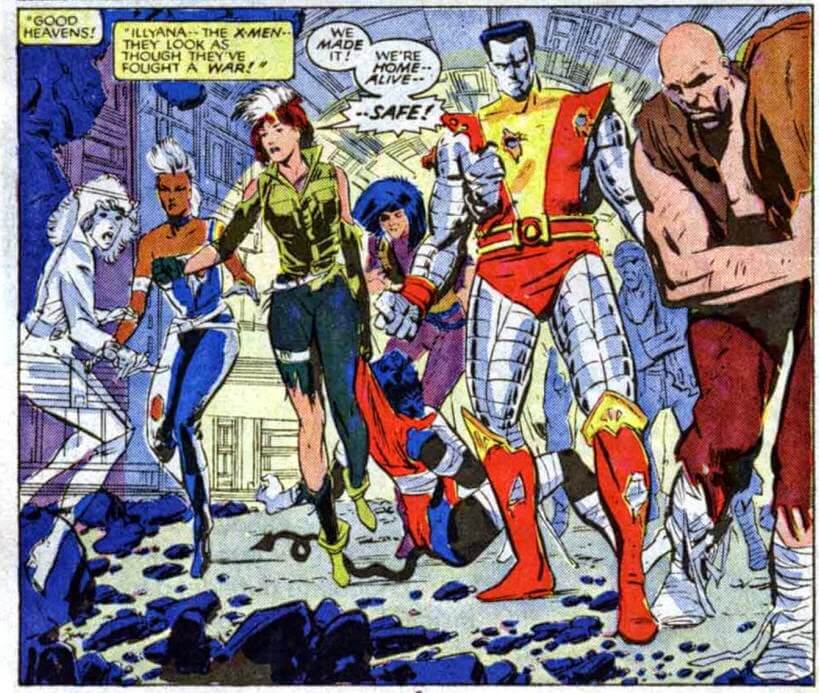 The New Mutants #46, Chris Claremont & Jackson Guice, December 1986, Marvel Comics
Morlocks don't hold space visually if they aren’t actively being hunted or killed until The New Mutants #46. Even then, we really only see a handful of panels where they’re centered, but even in those panels they are advancing other people’s stories or suffering. Then there’s the tie-in issues of The Mighty Thor, which are great comics, but entirely de-center the narrative away from the Morlocks. The only issues that center Morlocks even remotely are X-Factor #11 and Uncanny X-men #212, but the latter really only centers Callisto (a white mutant who largely passes) so that she can serve Storm’s growth. For Storm it's a wonderful exploration of her role as a leader of the X-Men and the complexity of her leadership of the Morlocks. Still though, Callisto’s role in this story is as a catalyst for Storm. She doesn’t have her own subjectivity, and her use on the page is really intended to serve another character's story. The X-Factor issue isn’t much better, although we see the team really engaging with the Morlocks in a way nobody else has been able to do so far, by being proactive.
While we need to be critical of X-Factor's privilege in this story, we need to recognize when they use it well. Their premise, a group of human mutant hunters, is a cover. Their real objective is to secretly use the access and resources their passing affords them, to seek out vulnerable mutants, give them a safe space, and when necessary train them. They utilize their privilege well. We see in this story, X-Factor leading the Morlocks that they could find through the tunnels and to the X-Factor complex. Even though not all of the Morlocks they bring there decide to say, X-Factor provides the Morlocks a safe and secure place to stay. In the same way that X-Factor becomes the model of passing privilege, they also demonstrate very well how privilege can be utilized and exploited to support and protect the most vulnerable. In the real world this should be the case, we shouldn’t condemn privilege but the individuals who abuse their privileges or deny their existence.
This is a narrative thread that will continue on into future publications. Among these, one of the most interesting is a story that centers around a former member of X-Factor, Bobby Drake(Iceman). Sina Grace’s 2018-2019 Iceman mini-series revisits Bobby’s relationship with the Morlocks, largely played out in his interactions with the new leader of the Madin.
I have major criticisms of this series, but I cannot say for sure if any of them are the direct result of authorial intentions. During his time at Marvel, Sina alleges that he was continually subjected to homophobic, toxic working conditions by Marvel’s editorial team at the time. There is no real way of knowing if we got the story that Sina wanted to tell, but from the interviews I’ve read, it feels like he had a much more nuanced story in mind. What we got though was a largely homo-normative story about a white, able-bodied affluent, attractive cisgender man, learning about his own identity. This is achieved by the “grand tour” comics model, where the protagonist moves through a series of vignettes that allow them to engage with characters with whom he shares a history. He then gains a skill or learns a lesson and moves on.
Knowing that Marvel’s editorial team was actively censoring Sina’s ideas to ensure that they stayed within homo-normative models of queer representation, we can really see the characters struggle against the text, pointing to something more radical than what we get. Unfortunately the story we get leaves us with a different conversation on privilege than what may have been intended.
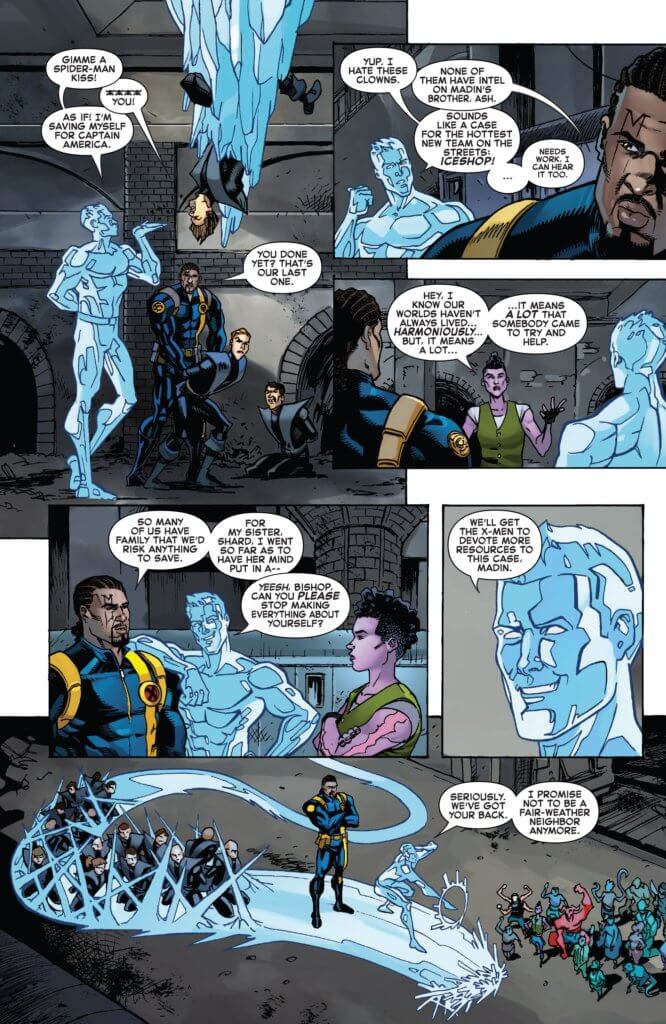 Iceman #1, Sina Grace, September 12, 2018, Marvel Comics
Iceman #1 establishes what will serve as the rails for the story as it moves through the many vignettes, Madin’s brother among other Morlocks have gone missing. Throughout this story, we will see Bobby in good faith try to support and protect the Morlocks. He certainly seems to remember the lessons he learned in Mutant Massacre about the ways in which privilege comes with a responsibility in how you utilize the privileges you are afforded. Unfortunately, we don’t even see too much of Bobby’s growth from his time with the Morlocks. We can speculate on the reasons for this, but the fact remains that in five issues, the Morlocks come and go very quickly. When they do show up, Bobby's behavior is also incredibly toxic in this series. In the image above, Bobby [a cisgender WASP] silences and speaks over Bishop, who tries to sympathize with the Morlocks, claiming he's "making everything about himself." Later on in the series, pictured below, Bobby attempts to make himself larger and more physically threatening towards Madin, claiming that nothing he does for them or the Morlocks seems to be good enough. Bobby feels personally hurt by Madin’s “lack of appreciation” for his efforts, asking " Why can't I ever do the right thing here?". Like many privileged allies, Bobby becomes frustrated that his minimal efforts don't resolve the larger institutional failings that trans people...I mean Morlocks face. It's clear to many readers that Bobby's behavior is toxic, though given that he is our POV character, I feel more could have done to call this toxicity out within the story.
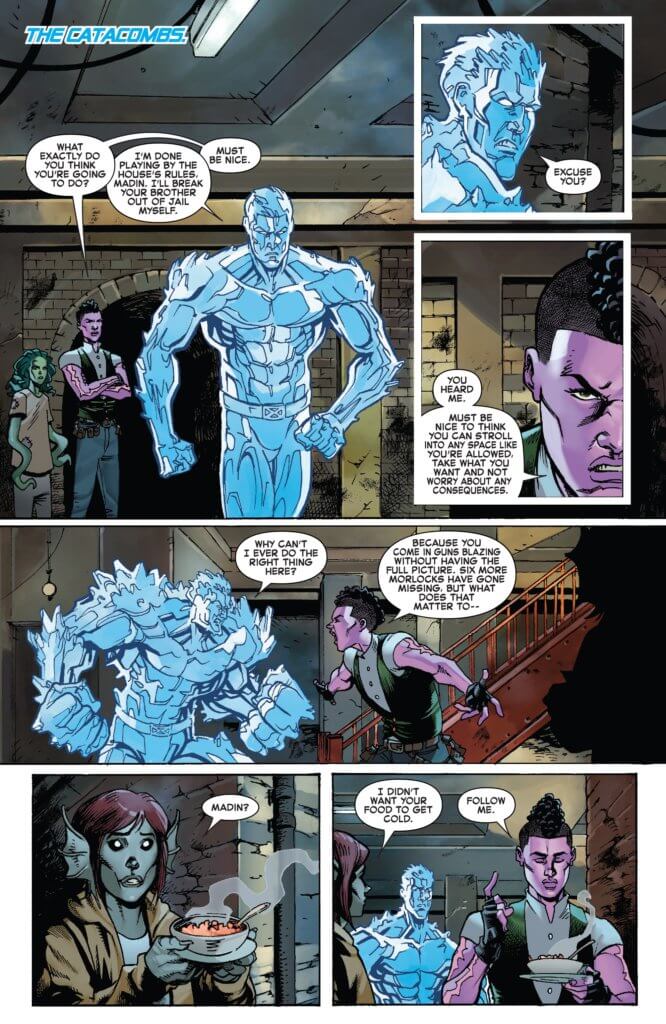 Iceman #4, Sina Grace, December 19, 2018, Marvel Comics
Like Mutant Massacre, this series doesn’t dive into a lot of the structural injustices that are imposed onto the Morlocks. The Morlocks are just scenery, only occasionally becoming vocal when it’s time to teach Bobby a lesson. Their hardship is peripheral to Bobby and his own reactions to other people’s hardship. In some ways, it’s hard to develop in-depth criticisms about the role of the Morlocks in this story. Simply put, the Morlocks are not really there. They are propped up cut-outs of characters, only intended to be seen in the background of somebody else's story. At best they continue to be stepping stones for the X-Men, to advance their own growth. At worst, they are relentlessly tortured and at best outright ignored by the larger mutant institutions.
As a non-binary person, who really fails to pass in any regard, it feels all too real. So much of my life and the lives of many non-binary & non-passing trans people is defined by the gaps we fall through. Whether it’s in the lack of institutional support or the erasure of our needs and experiences in the larger discourse, we so often feel absent in our own lives. It sometimes feels like I live in the tunnels below the city I live in; so connected to society and yet so distinctly invisible to it.
From the direction that Marauders #7 seems to be headed, it looks like we are going to see some changes. There's a uniquely complex relationship at play in this issue, between two characters we have rarely seen interact, Emma Frost and Callisto. In a lot of ways, these two characters stand on such distinct and separate ground. Emma represents the privilege of means and access that come with passing. She also represents something that a small mutant population possess, a fluid ability to choose between passing and non-passing appearances, as the result of her secondary mutation. She can go absolutely stealth if she wants, and when she stands apart from societal norms, it is done through her own choices. Callisto also does more or less pass, though she stands apart from society because of a disfiguration unrelated to her mutation. Callisto also to an extent chooses to live as a Morlock, given that her mutation does not prevent her from passing in society.
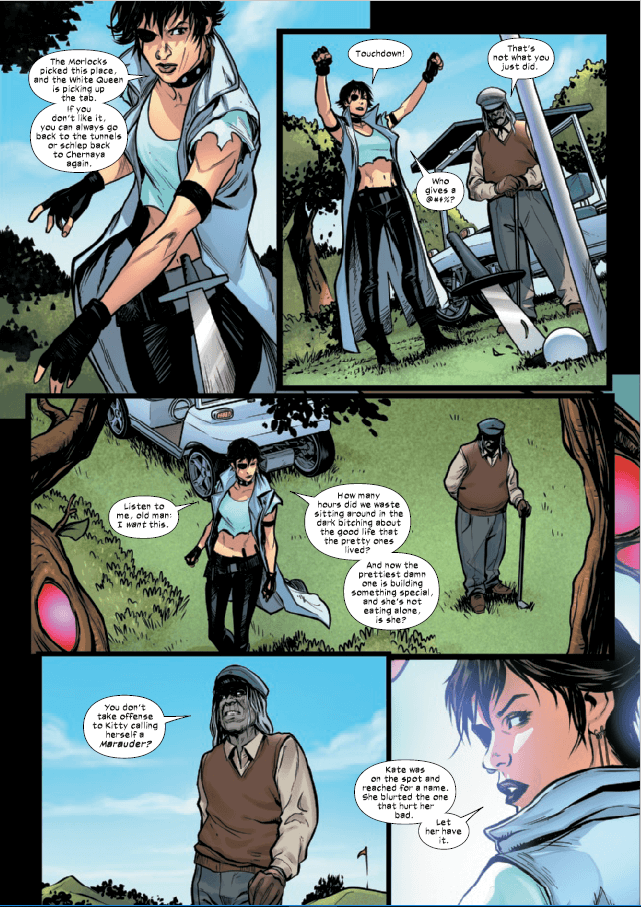 Marauders #7, Gerry Duggan, Edgar Delgado, and Stefano Caselli. February 5, 2020, Marvel Comics
With Callisto in the fold, there's a lot of the Morlocks' history we may see addressed in the future. I think of the complexity of Sinister's role on the council despite his crimes. I think about his responsibility for the suffering and deaths of so many Morlocks and how Xavier's need for the resources he provides absolves Sinister. There's a scene between Masque and Callisto, where you see some of this complexity begin to bubble up. Masque is understandably reticent about what an arrangement with the X-Men means. Masque points to the paternalism implicit in the arrangement, referring to the X-Men's support as an "allowance." Emma asks Callisto to represent Krakoa to mutants who don't trust the X-Men, but what would it take to build this trust? We know that Emma gave the Morlocks their own land, but were they offered a place on Krakoa? Are they being funded by Emma while still being alienated from the heart of this emergent mutant culture? What if the Morlocks don't want to live there at all?
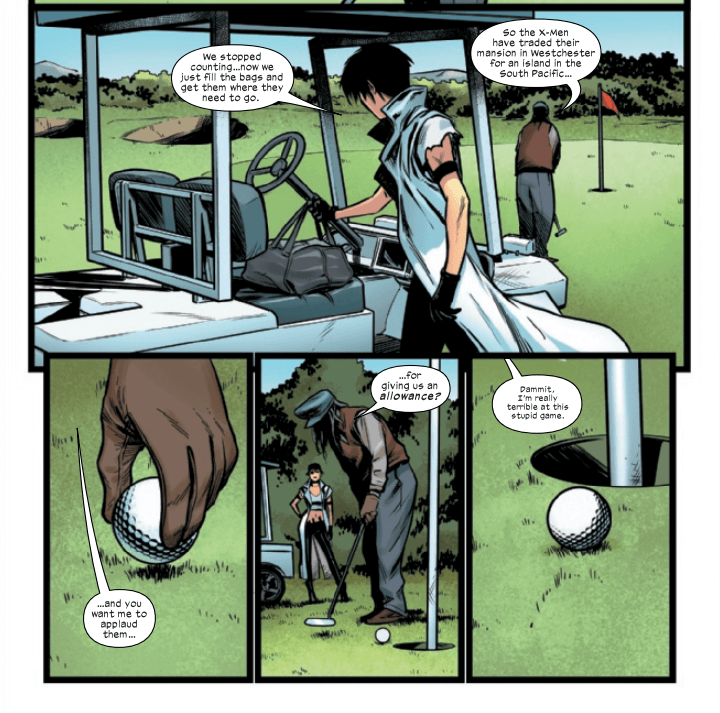 Marauders #7, Gerry Duggan, Edgar Delgado, and Stefano Caselli. February 5, 2020, Marvel Comics
Masque has one line that carries a lot of history: "So the X-Men have traded their mansion in Westchester for an island in the South Pacific, and you want me to applaud them for giving us an allowance?" This line reads as "too little too late" in some sense. Only now, when it's the easiest and most advantageous to their goals, do they bring the Morlocks into the fold. And what are they given? They get their own land, but are they welcomed into Krakoan society? And given the scale of their resources, how much are the X-Men really even sacrificing? And this deal puts them into alliance with a group carrying the name of the "Marauders," which for the Morlocks is associated with pain and trauma.
Emma Frost represents the life that the Morlocks have longed for. Callisto even says as much in her conversation with Masque. What lies in the subtext is the knowledge some readers may have about what it cost Emma to gain those means and privilege. Sure, Emma passes, but that has in no way meant her life has been easy, given all that she has suffered through and lost. She is empathetic, compassionate, and fierce and she fights for mutants with an intensity matched by few. If anybody on Krakoa should be the advocates of the Morlocks, I can think of few more qualified than her. Particularly because of her complex relationship with the X-Men. We have seen her at odd with them, calling their choices into question, at times acting as a direct antagonist to them. Often Emma is the only one calling into question some of more toxic choices made by the X-Men. She does not hold herself above the Morlocks, she approaches Callisto as an equal, though they come from entirely different lives. Despite Masque's assertions, her deal is not patronizing, it's empowering. She uses her privileges to empower and protect more vulnerable segments of the mutant community, much as X-Factor sought to do. I'd speculate she's going to continue leveraging her privileges to secure the Morlocks at least one seat on the council, given them a platform that none of the X-Men have ever extended to the Morlocks.
As of Marauders #7 there are more questions than answers and the state of the passing metaphor represented in the Morlocks is left in the air. Will non-passing mutants establish a new body politic that unveils passing as a privilege that can be experienced within the mutant population? I hope we get stories that push against utopia to address the inequity between the X-Men and Morlocks. Because there certainly is inequity within the trans community that remains unaddressed, and until tackled a complex tension of passing-politics will continue to divide us.