The Fighting First Lady: Red Sonja in the 1970s
Added 2020-05-28 12:55:12 +0000 UTCBy Doris V. Sutherland
Back in the 1970s, comic covers hailed her as “Fantasy’s #1 Fighting Female” and “the Fighting First Lady of Swords-and-Sorcery”. Decades later, she retains iconic status even among people who would have trouble identifying her by name. She is an archetype, embodying a specific type of fictional woman.
She is clad in chainmail armour – but it is armour adapted to fit the pattern of skimpy late twentieth-century swimwear. She is ostensibly an animalistic warrior, her life built upon the visceral pleasures of besting her foes in battle – yet she has time to don eye make-up and keep her legs free of hair. Her name, of course, is Red Sonja.
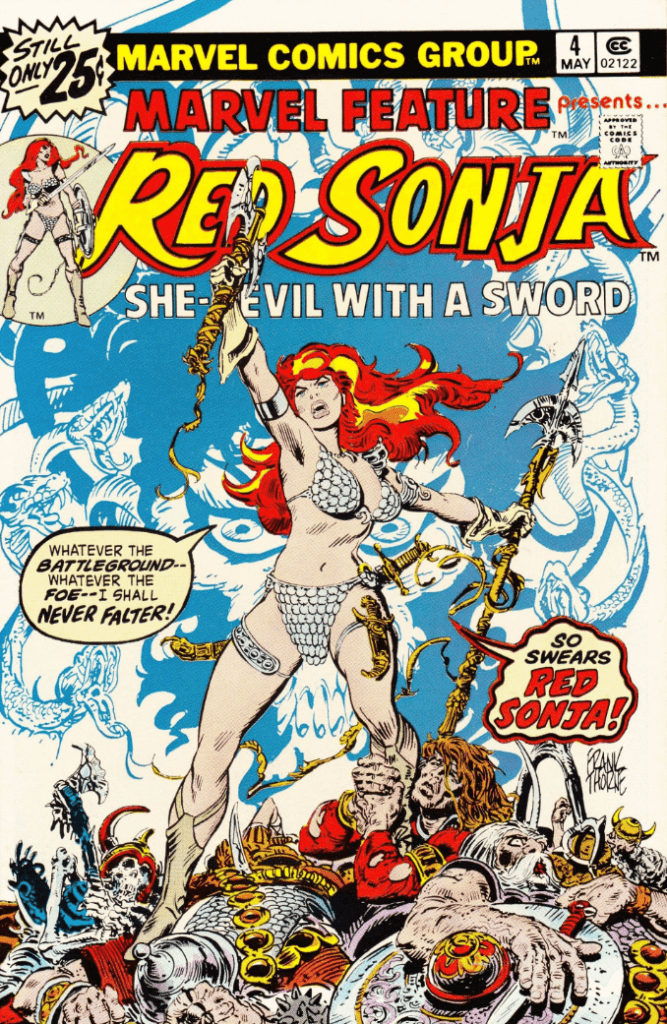
It has always been easy to scoff at Sonja, to dismiss her as representing two of the laziest approaches to creating a female comic protagonist: one, by tailoring the character to fit adolescent boys’ sexual fantasies; and two, by spinning her off from a popular male lead (in this case, Conan the Barbarian). But is that really all there is to Red Sonja? Could the character have lasted for decades, her adventures created by a range of artists and writers (including women, as well as men) were her appeal so superficial?
As a character concept, Red Sonja is brash, unsubtle and unapologetic – but then, as both a sword-and-sorcery protagonist and a denizen of four-colour comics, she comes from an intersection of two genres built upon the brash, unsubtle and unapologetic. The fact that she has survived when so many of her would-be competitors have fallen into obscurity makes it worthwhile to look back at the context of her creation and better understand her workings.
Red Sonja’s Pulp Background
Red Sonja made her comics debut in the 1970s, a decade that saw a gold rush for heroic fantasy, with the work of authors from past ages being disinterred and reinvented. Dungeons & Dragons introduced a means for readers to enter worlds modelled on those of various popular genre writers. Ballantine’s Adult Fantasy line, which started with paperback editions of Tolkien’s novels in the 1960s, was still going strong. And, of course, Marvel introduced a comic series based on the Conan stories of Robert E. Howard.
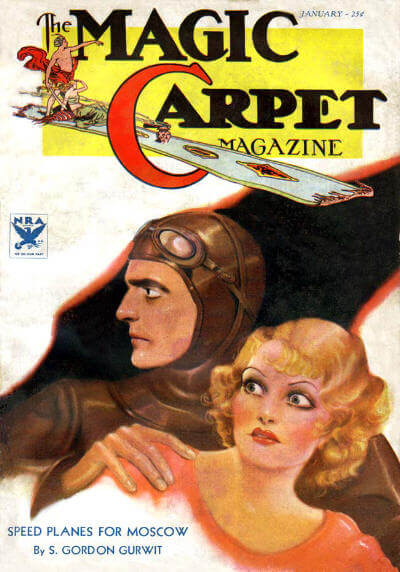
As far as Red Sonja is concerned, the most relevant Howard tale is “The Shadow of the Vulture”, a short story published in the January 1934 issue of The Magic Carpet Magazine. The tale’s main character is Gottfried von Kalmbach, a sixteenth-century knight who once struck a blow against Sultan Suleyman the Magnificent himself – wounding both the body and the pride of the Turkish ruler. Pursued by Mikhal Oglu, an assassin sent by Suleyman’s Grand Vizier to avenge the Sultan, Gottfried finds shelter in Vienna, only for the Turkish forces to lay siege to the city. During the conflict, the knight receives meets a woman known as Red Sonya of Rogatino:
A cheer went up from the towers, and the woman called Red Sonya yelled with a sincere joy and did the steps of a Cossack dance.
Gottfried approached, eying in open admiration the splendid swell of her bosom beneath the pliant mail, the curves of her ample hips and rounded limbs. She stood as a man might stand, booted legs braced wide apart, thumbs hooked into her girdle, but she was all woman. She was laughing as she faced him, and he noted with fascination the dancing sparkling lights and changing colors of her eyes. She raked back her rebellious locks with a powder-stained hand and he wondered at the clear pinky whiteness of her firm flesh where it was unstained.
In the heat of battle, Red Sonya provides vital assistance to Gottfried:
It was Red Sonya who had come to his aid, and her onslaught was no less terrible than that of a she-panther. Her strokes followed each other too quickly for the eye to follow; her blade was a blur of white fire, and men went down like ripe grain before the reaper. With a deep roar Gottfried strode to her side, bloody and terrible, swinging his great blade. Forced irresistibly back, the Moslems wavered on the edge of the wall, then leaped for the ladders or fell screaming through empty space.
Red Sonya would have been a figure worthy of medieval romance, were it not for her lack of courtly manners. “Oaths flowed in a steady stream from Sonya's red lips and she laughed wildly as her saber sang home”, the story tells us. "Hell to you, dog-soul!" remarks Sonya to one of her foes. "The devil can stir your broth for you!" Gottfried, too, receives rather short treatment from the swordswoman:
Gottfried approached Red Sonya, who was cleansing her blade, swearing softly.
"By God, my girl," said he, extending a huge hand, "had you not come to my aid, I think I'd have supped in Hell this night. I thank—"
"Thank the devil!" retorted Sonya rudely, slapping his hand aside. "The Turks were on the wall. Don't think I risked my hide to save yours, dog-brother!"
And with a scornful flirt of her wide coattails, she swaggered off down the battlements, giving back promptly and profanely the rude sallies of the soldiers.
"Eh, she's a devil, that one!” says one of the other warriors to Gottfried, after Sonya has departed. “She drinks the strongest head under the table and outswears a Spaniard. She's no man's light o' love.”
Sonya, it turns out, is the sister of the Sultan’s consort Roxelana. Also known as Hurrem Sultan, Roxelana is a real-life historical figure, born in Rohatyn (modern Ukraine) and sold into slavery, eventually ending up as a prominent member of Suleyman’s harem. Little is known of Roxelana’s background – even her birth name is uncertain – leaving Howard room to invent a fictional sister for her.
Fighting together, Gottfried and Sonya are able to survive both the onslaught in Vienna and the assassin’s attempts to murder Gottfried. The story ends with the Sultan, prematurely preparing a victory celebration, receiving a gruesome gift from both warriors: the severed head of the Vizier’s hired killer.
Most of the elements that make up the character as we know her today are present and correct in “Shadow of the Vulture”, with one significant exception. With her backdrop of sixteenth-century military history, Howard’s heroine has no connection to Conan and his Hyborian Age of magic and monsters. Come the 1970s, it fell upon Marvel to make the requisite transplantation, and that story begins when Roy Thomas – author and editor of the Conan comic series – came across “The Shadow of the Vulture” and its heroine.
Red Sonja Comes to Marvel
As he relates in his afterword to Dark Horse’s collection The Chronicles of Conan Volume 4, Thomas first learnt of the story in the critical anthology The Conan Swordsbook. One of the essays, written by Allan Howard (no relation to Robert), described Red Sonya as “a red-headed Russian she-cat who would have made a fit companion for Conan. In fact, she might have been a bit too much for him.” This was enough to pique Thomas’ interest and he obtained a copy of the story from Glenn Lord, literary agent for Robert E. Howard’s estate.
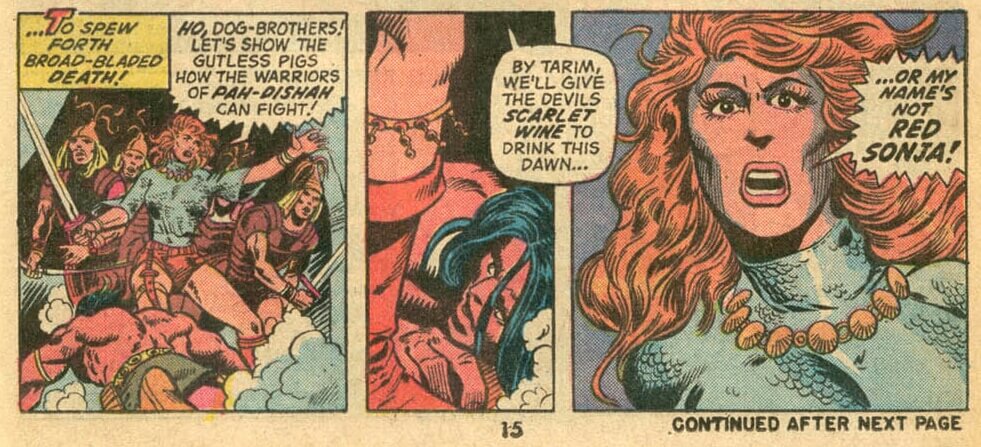
The comic adaptation of “The Shadow of the Vulture” ran in the February 1973 issue of Conan the Barbarian, scripted by Thomas and pencilled by regular artist Barry Windsor-Smith. In reworking the story, the creative team moved the narrative from its historical setting to the Hyborian Age: Gottfried von Kalmbach was naturally replaced with Conan, while the established villain Prince Yezdigerd took the place of Sultan Suleyman.
This sort of character-swapping was already standard practice where Howard’s creations were concerned. The first Conan tale to see publication, “The Phoenix on the Sword”, was a reworking of a rejected story about another hero, King Kull of Atlantis. When Gnome Press began publishing collections of Howard’s work after his death, a number of non-Conan stories were similarly rewritten so as to star the barbarian protagonist. “Robert E. Howard’s heroes were mostly cut from the same cloth”, noted L. Sprague de Camp, the author tasked with these posthumous revisions. “It was mostly a matter of changing named, eliminating gunpowder, and dragging in a supernatural element.” (This process is discussed, in a rather sardonic manner, by Mark Finn in his biographical work Blood & Thunder: The Life and Art of Robert E. Howard).
Aside from the change of setting, and the inevitable compression that arises from being re-worked as a single comic issue, Roy Thomas’ version of “The Shadow of the Vulture” is a reasonably faithful adaptation. But where Red Sonya’s character is concerned, a number of differences have crept in. Most obviously, she has undergone a minor name-change to Red Sonja . “I felt Conan’s new comrade and sometime sparring-partner should not be quite 100% the same one as appeared in ‘Shadow,’” notes Thomas, “so I changed the spelling of her name”.
Barry Windsor-Smith dresses her in decidedly hip 1970s-flavoured duds, her outfit consisting of a pair of hot pants, a polo-necked shirt formed from chainmail, and a large, loose necklace. Howard’s description of “the splendid swell of her bosom beneath the pliant mail” is adapted faithfully, but her overall appearance has clearly been contemporised.
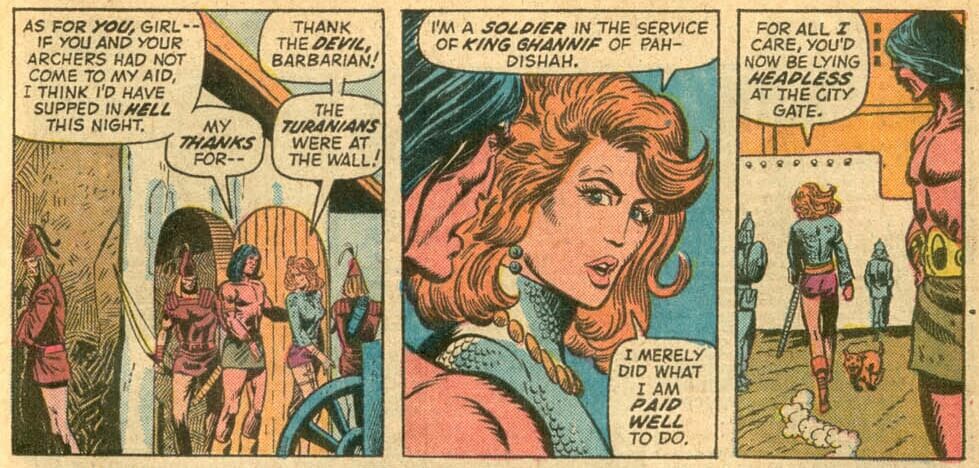
In the original story, Gottfried takes a more passive role when Sonya is on-stage; this is clearest when Gottfried actually ends up crying (“don’t sit and blubber like a spanked schoolgirl” says Sonya, kicking him). But Conan is far too prideful a character to put up with such treatment, and so he and Sonya are portrayed as roughly equal fighters; indeed, when they first meet Sonja proclaims that “no one fights all my battles for me – least of all a wench who should be tending a hearth somewhere!” That said, Thomas does retain Howard’s climactic scene in which the captured male protagonist is rescued by his flame-haired female counterpart.
The adaptation also removes the detail of Sonya’s sister. The original story depicts Sonya flying into a rage when Roxelana is mentioned, and implies that her fight against Suleyman’s forces is motivated at least in part by sibling rivalry. But Roxelana has no counterpart in the Marvel version, and so, this aspect of Sonja’s personality is left out. The absence of her family connections leave Red Sonja with considerably less material as a character, and she ends up very much as a supporting player in the issue. She appears in only six of the comic’s twenty-one pages, discreetly slipping away to deal with some henchmen before Conan takes centre-stage to tackle the main villain (assassin Mikhal Oglu, transplanted from the Howard story intact).
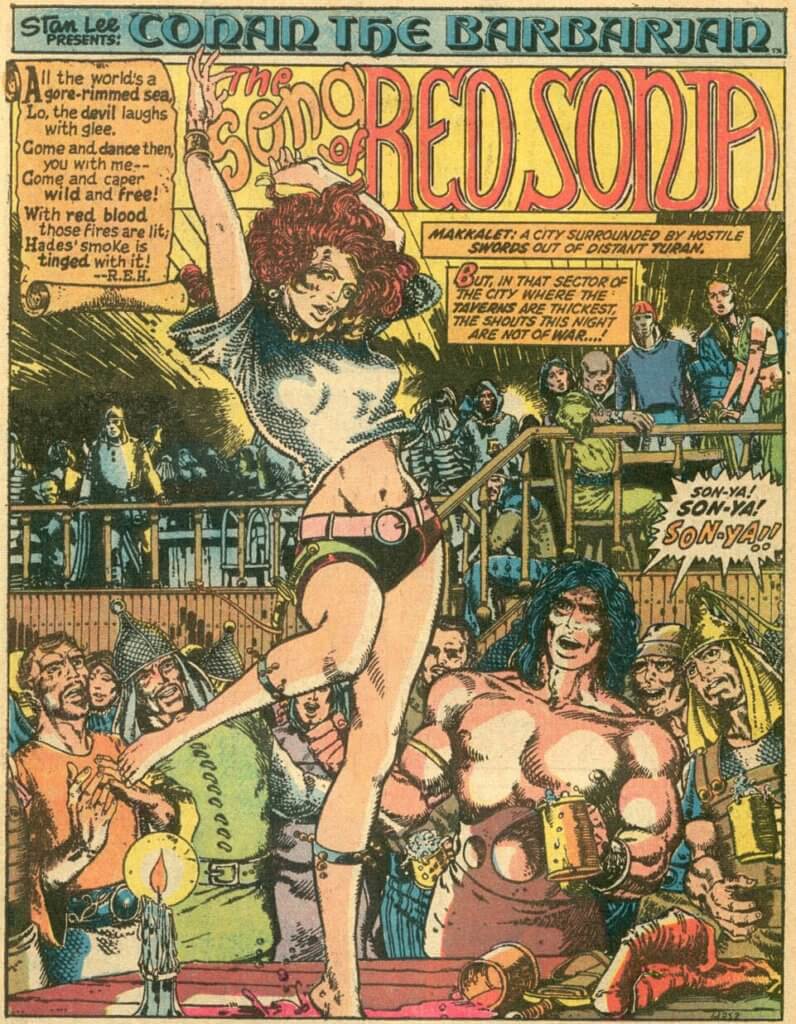
Sonja’s next appearance was the following issue’s story, “The Song of Red Sonja”. Here, Thomas did not adapt a Howard text and instead wrote an original story, albeit one that draws heavily on Howard’s stock situations: the plot sees Conan on a mission to break into a tower and plunder its treasure, only to be confronted by a monstrous serpent. But while Conan provides the story’s raw muscle, this time it is Sonja who dictates the framework and much of the narrative’s personality.
The issue opens with Sonja dancing barefoot atop a tavern table – the hippy-chick ambience is palpable – while a mass of male soldiers gaze up at herr. The soldiers get into an all-out fight when one of their number gets amorous (“Let the wench finish her dance”, says Conan; “Look, Cimmerian — I’ll fight my own fights!” retorts Sonja). Away from the brawl, the two take a dip in a nearby pool, resulting in a raunchy scene that pushes the Comics Code to its limits. Sonja goes topless, ostensibly to make it easier for her to swim, and gets Conan’s attention: “What are you staring at? Oh… now I see. We’ve no time for that, you big barbarian oaf!” Conan is left frustrated, and a sizeable waterspout emerges from the region of his submerged groin.
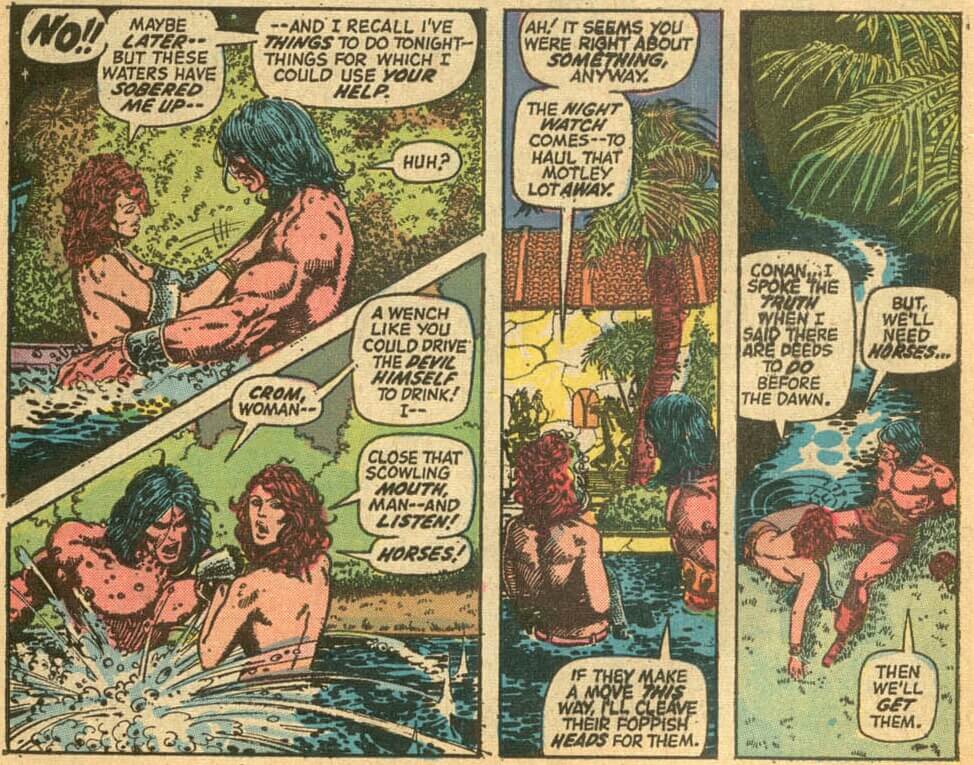
The two continue to spar as they head off to raid the tower (“By Crom, girl – I’ve killed men for less than that!” “For what? For not letting you kiss them?”). It is Sonja who recruits Conan for the task, his reward being the possibility of romance afterwards. Through narrative captions, we learn that Sonja has a story of her own: she is working at the behest of ruler, who desires an item of treasure from the tower for his own purposes. The outwardly simplistic story turns out to have three layers, with Conan’s straightforward quest for plunder and sex on the surface, a courtly drama at the bottom, and Sonja’s own story stuck in the middle.
The two see off the giant snake together, Sonja distracting it while Conan deals a fatal blow. The story ends with Sonja playing a prank on Conan, burning his escape rope so that he leaves the tower in an undignified tumble. She then flees on horseback instead of providing the expected payment: “No man’s lips shall ever touch mine, Cimmerian – save those who has defeated me on the field of battle – and that, even you shall never do!”
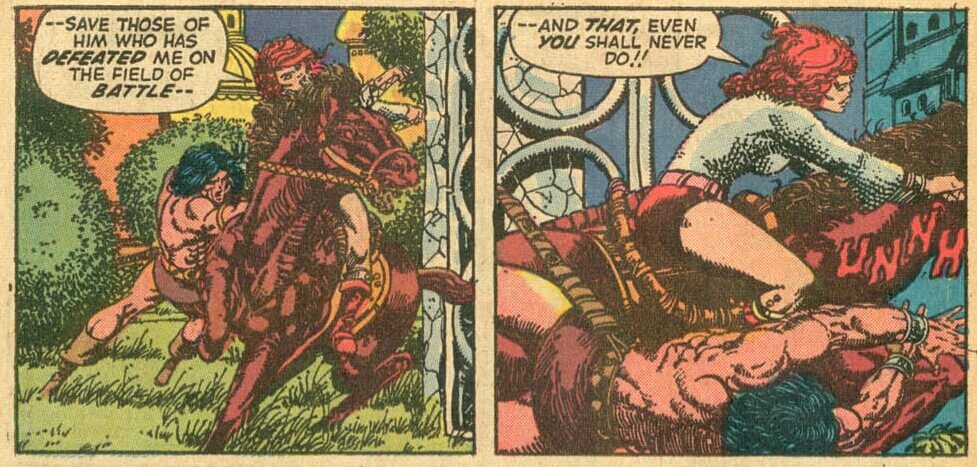
“No, not goodbye, wench”, replies Conan as he watches her gallop into the distance. “We’ll meet again, some bright day. Or some dark night.”
Sonja was not without precedent in the Conan canon. Howard had given his hero female side-characters who could serve as Conan’s sparring partners, physically or verbally: Belit in “Queen of the Black Coast” and, to a lesser extent, Valeria in “Red Nails”. But these stories are set later in Conan’s fictional career, and so the respective heroines were not due to appear in Marvel’s adaptations until further down the line. With Red Sonja, Roy Thomas and his collaborators had a character free from the confines of the Howard canon, with boundless room for new adventures.
Enter the Bikini
In 1974 Marvel‘s Curtis Magazines imprint debuted The Savage Sword of Conan, the first issue of which debuted a new-look Red Sonja. The painted cover art by Boris Vallejo shows both Sonja and Conan in battle, while the contents include a ten-page story – entitled simply “Red Sonja” – that was pencilled and partly inked by Spanish illustrator Esteban Maroto. Here, Sonja trades in her hot pants and mail shirt for something rather more revealing.
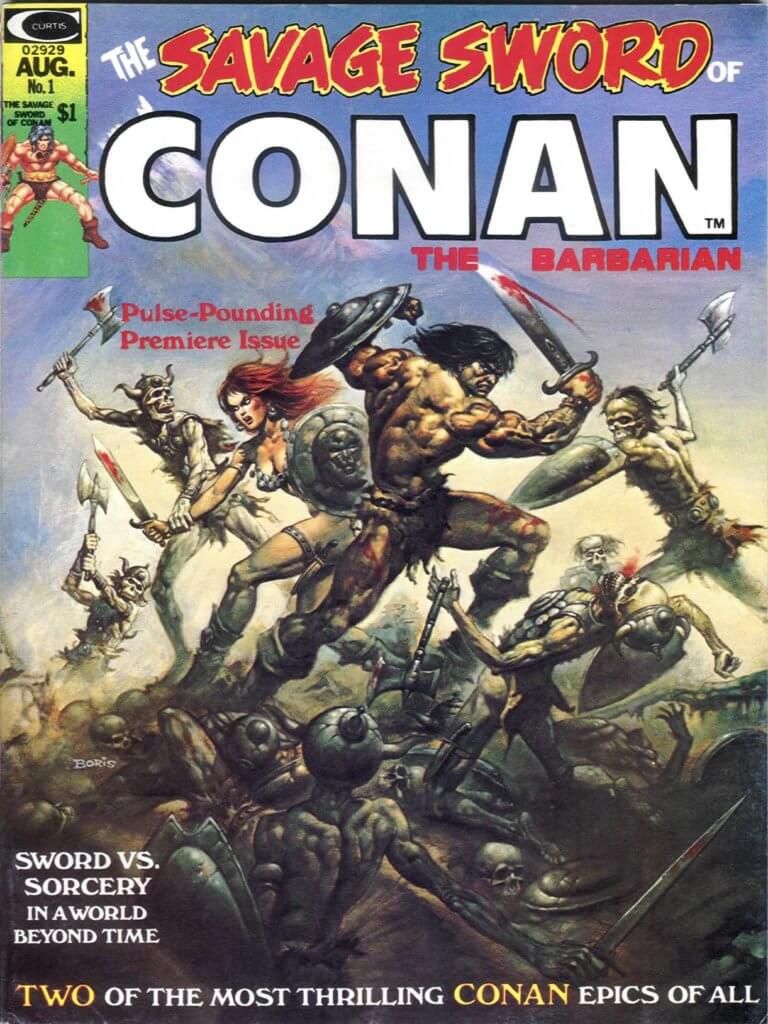
In his introduction to Dynamite’s first trade paperback collection of the early Sonja stories, Roy Thomas credits Maroto with this development: “Esteban Maroto had recently sent me from Spain, unasked, a drawing of Sonja which had her in rather skimpy armor – an illo I printed in Savage Sword #1, and which led to Esteban’s drawing a solo Sonja story in that issue.” And so, the chainmail bikini was born.
This garment had a certain pedigree in sword and sorcery iconography. Back in the 1930s, Weird Tales illustrator Margaret Brundage depicted Conan’s world as one populated by women resembling silent film vamp Theda Bara, wearing skimpy harem-style outfits that make Sonja’s bikini look relatively modest by comparison. During the 1960s, Frank Frazetta’s covers to the Conan paperback editions likewise furnished the women of the Hyborian Age with revealing two-piece outfits.
[gallery size="large" columns="2" ids="125164,125229"]
Unlike Brundage, who typically left Conan out of her covers altogether, Frazetta also put male flesh on display, creating a marked contrast in the process. Frazetta’s musclebound, battle-scarred men were given active roles, while his women were shown in states of extreme passivity, lying on a sacrificial altar awaiting rescue in Conan the Avenger or – to cite Frazetta’s most iconic illustration – clinging to Conan’s leg in Conan the Adventurer.
While Red Sonja exists in this world of mostly-naked male killing machines and mostly-naked female objects of desire, she crosses a boundary between the two roles. She needed an outfit which, similarly, bridged the gap between barely-there harem costume and minimally-functional barbarian warrior attire. A chainmail bikini was an entirely natural, perhaps even inevitable choice.
Sonja’s solo story in Savage Sword of Conan #1 is a direct sequel to “The Song of Red Sonja”, detailing what happens after she returns the treasure to the king in the hopes of gaining a reward. The duplicitous monarch promptly has her apprehended and forced into his harem (“I vowed to give you the most precious gift it lay within my kingly power to bestow… you simply failed to comprehend that the proffered gift was… myself!”)
Forced to swap her armour for diaphanous harem garb, Sonja cosies up to the king – allowing her to steal his knife and throw it into his neck. She then does battle with the king’s hunky bodyguard (who was clearly unfit for purpose) and manages to slash him in half with a sword stolen from a nearby palace guard.

The issue also gave Sonja a co-starring role in “Curse of the Undead-Man”, a story scripted by Roy Thomas and drawn by John Buscema and Pablo Marcos. Once again, this was repurposed from one of Howard’s non-Conan tales: the source was “Mistress of Death”, a story set in sixteenth-Century France that pitted swordswoman Dark Agnes (a recurring character who appeared in two other Howard adventures) and Scottish exile John Stuart against an undead wizard.
The original story dealt with Agnes overcoming her “womanly fears”, but the comic version gives Sonja a less passive role – indeed, she actually corresponds to Howard’s male lead John Stuart, with Conan receiving Agnes’ part in the narrative. While Howard made Agnes and Stuart new acquaintances, Roy Thomas acknowledges that Conan and Sonja share a history, even making reference to the fact that Sonja had a different outfit the last they met. “I like your armor – what little there is of it”, remarks Conan. “An Ophirean pikeman said the same thing to me the other day, just before he made a grab for it”, replies Sonja. “I hope he can learn to wield a pike left-handed.”
Red Sonja’s Origin Story
In 1975, the short-lived Kull and the Barbarians – another Howard-derived title from Curtis Magazines – ran two Red Sonja stories as backup features, each written by Roy Thomas and illustrated by Howard Chaykin. The first is a routine affair in which Sonja fights a werewolf in a sinister tower; but the second, co-written by Doug Moench, is more significant as it gives Sonja an origin story.
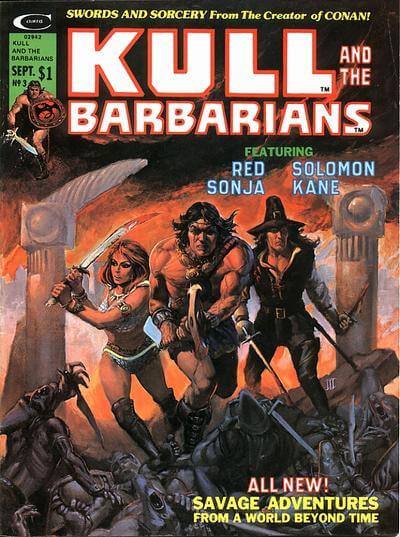
“The Day of the Sword” opens with Sonja in a typical adventure, slaying a band of robbers who made the mistake of underestimating their female opponent. In the process she rescues their captive – and is shocked by his identity. From here, the story segues into a flashback to Sonja’s teenage years:
She remembers the image of her father, seated patiently, coaching her brothers in the skills of the sword. She remembers, too, being allowed to watch… but no more. Still, it was more than her identity as a girl which denied her the skills her younger brothers were encouraged to pursue. For Sonja’s mother, in a quiet way, disapproved of such activity even for the boys… and disliked making play of grim business which had maimed her husband and left an entire family poor.
But Sonja had not been content with a lot of cooking and mending garments, so, by night, she would steal outside… and whether due to admiration of her father or jealousy of her brothers, she would practice at that which had been forbidden. But the mere lifting of her father’s unwieldy blade seemed beyond her strength.. and once, she even cried.
We then see a band of mercenaries marching upon Sonja’s home, and asking her father for aid in a new military campaign. When he refuses, pleading that he has only one leg, the mercenaries murder him and the rest of Sonja’s relatives. Sonja herself is raped by the mercenary leader, a scene that – despite being focused on the characters’ faces, the graphic details left off-panel – nonetheless manages to be harrowingly brutal.
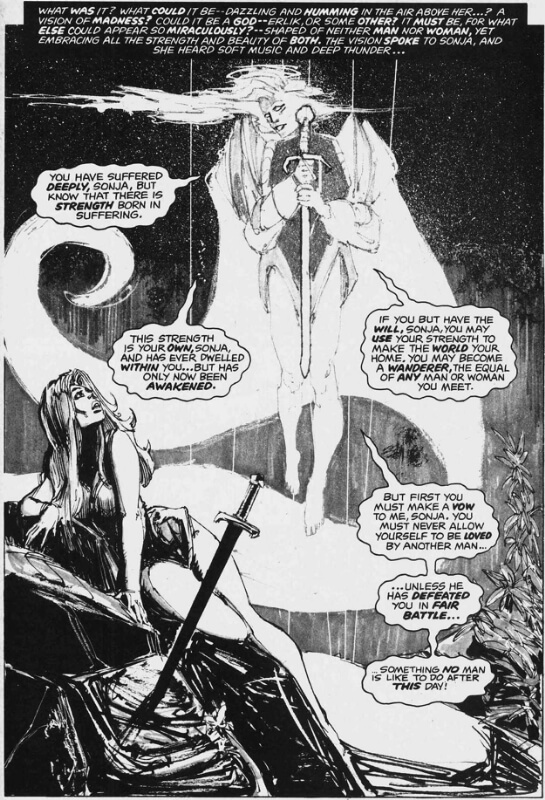
The departing mercenaries set fire to the family cabin, but Sonja escapes. Outside, she is visited by an apparition. “Could it be a god – Erlik, or some other?” asks the narrative caption. “It must be, for what else could appear so miraculously?” The figure is androgynous in appearance, and described as being “[s]haped of neither man nor woman, yet embracing all the strength and beauty of both”. The vision speaks to Sonja:
You have suffered deeply, Sonja, but know that there is strength born in suffering. This strength is your own, Sonja, and has ever dwelled within you… but has only now been awakened. If you but have the will, Sonja, you may use your strength to make the world your home. You may become a wanderer, the equal of any man or woman you meet.
But first you must make a bow to me, Sonja. You must never allow yourself to be loved by another man, unless he has defeated you in fair battle, something no man is like to do after this day!
Sonja swears this oath, and the vision touches its sword-blade upon her shoulder. It then vanishes as one of the mercenaries returns; taking her dead father’s sword, Sonja does battle with him (“it seems you’ve been sent to test a vow, dog–! Know that I mean to keep that vow") and is triumphant (“the sight of blood no longer sickened Sonja”). The story ends with Sonja vowing to kill the mercenary captain – who, of course, is the captive she found amongst the bandits in the story’s prologue – but the reader never learns exactly what punishment she meted out upon him.
This backstory strikes a number of awkward notes, particularly when read today. The origin-story rape scene has since become a cliché for comic heroines, one that has been extensively criticised by feminist commentators. Her vow that she will enter a relationship with a man only if he beats her in battle is really a holdover from her earlier role as Conan’s co-star and potential love interest, and has often been ignored or contradicted in later stories. Gail Simone openly dismissed the plot point when she commenced her 2013 run on the character (“Red Sonja is not a prize at a carnival, for one thing. We’re not having that stuff”) but even in the 1970s the creative team seldom acknowledged this part of her story.
Indeed, it is not even clear exactly what Sonja gained in return for her vow. The story makes the curious decision to leave things ambiguous as to whether her strength and skill were granted by the divine apparition: when she kills her foe, a caption ask if this was “a savage thrust—learned by watching her father—by long practice under darkness…? Or was it, perhaps, a skill granted to her… by a vision?”
Whatever the story’s flaws, it was an origin story – and therefore a vital piece of the narrative for any comic hero. As 1975 approached its end, the time had come for her to get her own series.
Red Sonja’s Starring Role
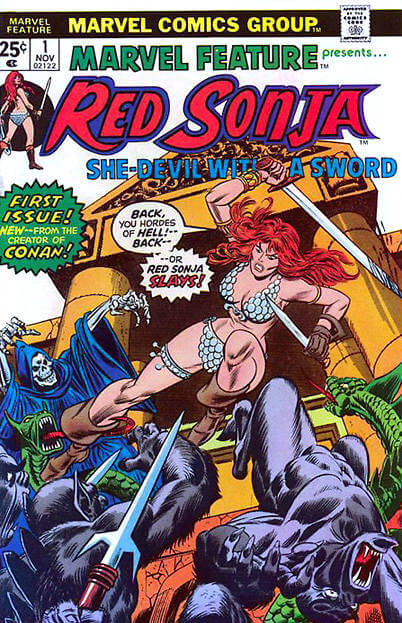
Although the comic was officially entitled Marvel Feature Presents – a name inherited from a revolving-lead superhero series published earlier in the decade – the cover of each issue made it clear who the star was: Red Sonja, She-Devil with a Sword. The first issue, cover-dated November 1975, ran a colourised version of Sonja’s solo adventure from Savage Sword of Conan #1 alongside an eight-page back-up feature written by Roy Thomas and drawn by Dick Giordano. This was again an adaptation of a Howard story that originally starred a different character: “The Temple of Abomination”, left unfinished by Howard and completed by Richard L. Tierney, starred a male pirate named Cormac Mac Art.
For the remaining six issues of Sonja’s Marvel Feature Presents run, Frank Thorne took over as artist while Thomas shared writing duties with Bruce Jones. Between them, the creative team pitted Red Sonja against a deceased king whose spirit inhabited a giant mechanical statue; a village of witch-hunters; a monstrous bear-god; and various animal-headed men under the command of the dark deity Set. Standard foes for a sword and sorcery protagonist of any gender, then; but in their more dialogue-driven moments, these early Sonja tales sometimes play up the novelty of their female lead.
In “Blood of the Hunter” Sonja forms an uneasy alliance with a one-legged boy. “How is it a woman of such obvious physical development spends all her time chafing it in chain mail and parading about the country like a man?” he taunts. “Have you always been this confused about your sex? Perhaps it isn’t confusion at all! Perhaps your father wanted a son – and you’re determined to be one! Or did you get him with your sword, too?” Sonja draws her sword at these provocations. “That’s right, swear like a man!” exclaims the boy. “Run me through like a man! Perhaps if you’re lucky, someday the great got Mitra will make you a man!”
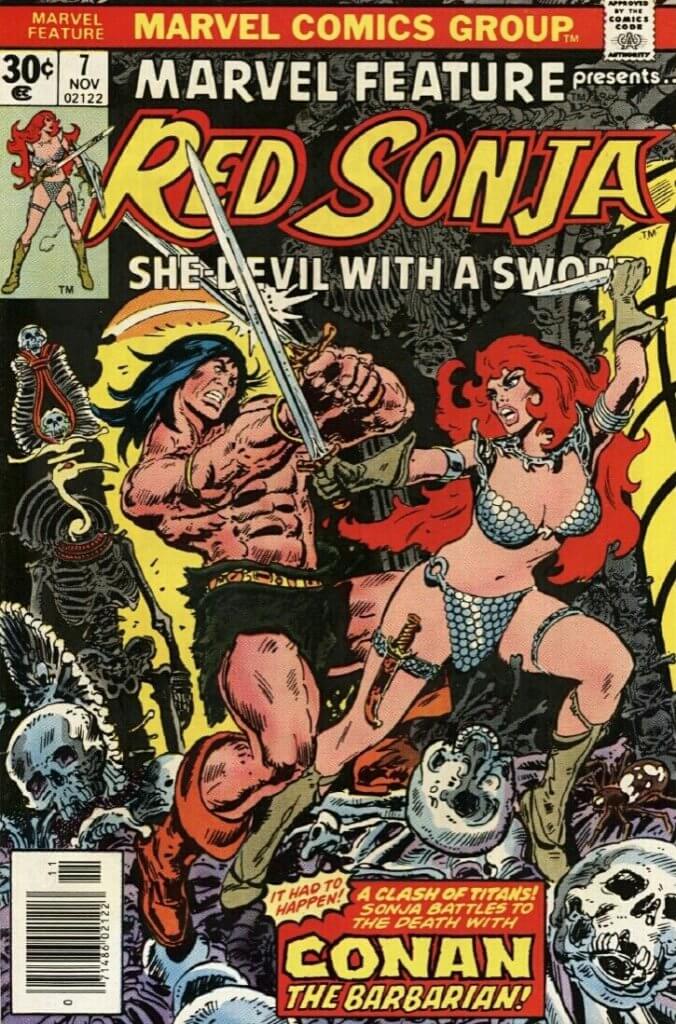
Meanwhile, Sonja’s relationship with Conan hovers over her adventures like a cloud. In “Balek Lives!” one scene has the heroine suffering what she believes to be a fall to her death: “This is it, then! This is how it ends! Conan… I never… let you…” Conan is also mentioned in the snippet of introductory text that the series begins using with its second issue, variations of which are still used in the Red Sonja comics today:
Know also, O prince, that in those selfsame days that Conan the Cimmerian did stalk the Hyborian kingdoms, one of the few swords worthy to cross with his was that of Red Sonja, warrior woman out of majestic Hyrkania. Forced to flee her homeland beause she spurned the advances of a king and slew him instead, she rode west across the Ruranian Steppes and into the shadowed mists of legendry.
As it happens, Sonja and Conan do cross swords in the final issue of the series, part of a crossover story that also includes Conan the Barbarian issues #66-8. As per Marvel tradition, the two heroes initially fight one another prior to joining against a common foe; while Conan has the superior size and strength, Sonja benefits from a ruthless streak, taking a slash at Conan when he offers to end the fight peacefully.
The pirate-queen Belit, who had by that point been introduced as Conan’s love interest, is also along for the adventure. This creates something of a love triangle: Belit refers to her new rival as a “Hyrkanian hussy” while Sonja responds with an epithet that is discreetly censored by the story’s narrator. However, the storyline ends with Belit realising that Sonja is no competitor for Conan’s affections; by extension, the narrative affirms that since Belit is the main woman in Conan’s life, Red Sonja is her own protagonist, no longer a mere co-star.
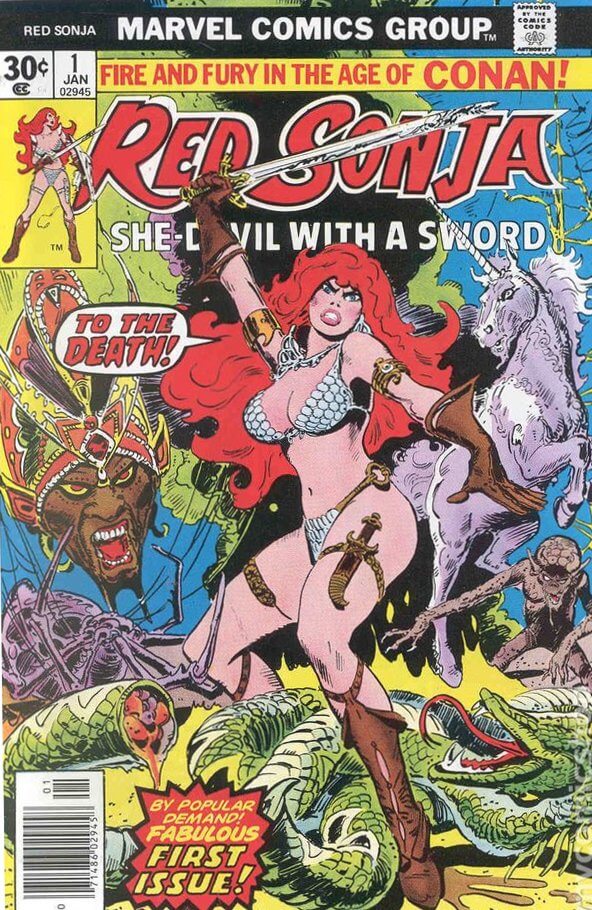
Come 1977 Sonja was granted another series, one that dropped the “Marvel Feature Presents” business and instead started with the first true Red Sonja #1. This time Roy Thomas was joined by co-writer Clair Noto, the first woman to write for the character; in the letters columns of the comic itself, along with his introductions to the modern trade paperback collections from Dynamite, Thomas has credited Noto with handling the bulk of the scripts during their collaboration, with Thomas providing editorial oversight. Frank Thorne resumed art duties, and the three formed the core creative team for most of the series. But despite the continued presence of both Thomas and Thorne, this latest Sonja series marked a departure from its predecessor.
The Marvel Feature Presents series made heavy use of plot elements from Howard’s stockpile, and when it moved away from this material, the results tended to be stodgy and literal-minded. Take “Eyes of the Gorgon”, a Bruce Jones story from Marvel Feature Presents #4, in which Sonja encounters villagers terrified of being turned to stone by a snake-haired Gorgon. Sonja goes on to expose the culprit as a woman in a mask, who had been carrying out a wildly implausible Scooby-Doo plot that involved abducting people and replacing them with statues. Howard might have had fun with the story’s off-the-shelf pieces of Gothic melodrama (the mob of fearful villagers, the villain’s hunchbacked assistant) but he would have placed a genuine supernatural threat at the centre – and he would have come up with something more original than Medusa.
The 1977 series has a different tone. This can be attributed in part to Clair Noto joining the team, but the most obvious changes can be found in Frank Thorne’s artwork. In comparison to his work on the previous series, Thorne’s illustrations now show a distinct art nouveau influence, something that stretches from the stories’ settings to the very panel layouts. The backgrounds are more ornate and arabesque, the fantasy creatures seemingly formed from wisps of coloured smoke, the natural world sparkling with flowers and butterflies.
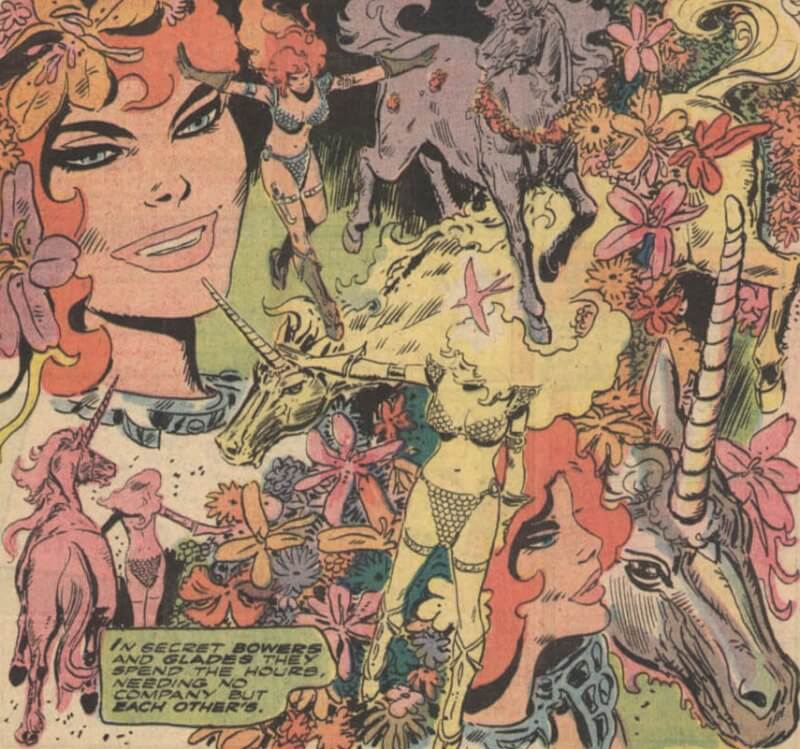
The first issue, in which Noto and Thomas worked from a plot provided by one-time contributor Ed Summer, must have come as a shock to readers who expected conventional Howardian blood and thunder. The story sees Sonja befriending a unicorn, and in one panel worthy of Lisa Frank, is shown skipping merrily beside her new steed with flowers in her hair; in the end she must bid farewell to the unicorn, tears in her eyes, as she resumes her lonesome journey. This is all wildly different to the Frank Frazetta-derived iconography that had, for some time, been the default for sword and sorcery. If anything, the Thomas/Cato/Thorne Red Sonja has a kinship with the psychedelia-tinged fantasies of underground and alternative comic creators like Vaughn Bode, Jeffrey Catherine Jones – or, for that matter, Wendy and Richard Pini, whose Elfquest would debut the following year (indeed, Wendy Pini co-wrote one issue of Red Sonja).
None of this is to say that Sonja had gone soft, as the stories retain all of the blades and battles, armies and arenas that are to be expected from the genre. And our heroine is as ready for a scrap as ever: typical dialogue involves her opponents scoffing at the idea of a woman joining a battle (“Hah! I’ve never met the female whose blade could frighten a mayfly!” “What’s this? Do the Zotozian pigs send women after us now?”) before expressing dismay that a woman has beaten them in battle (“What sort of female is this, who battles like an angered stag?”). However, the threats faced by Sonja in this series are just that little bit weirder than last time around.
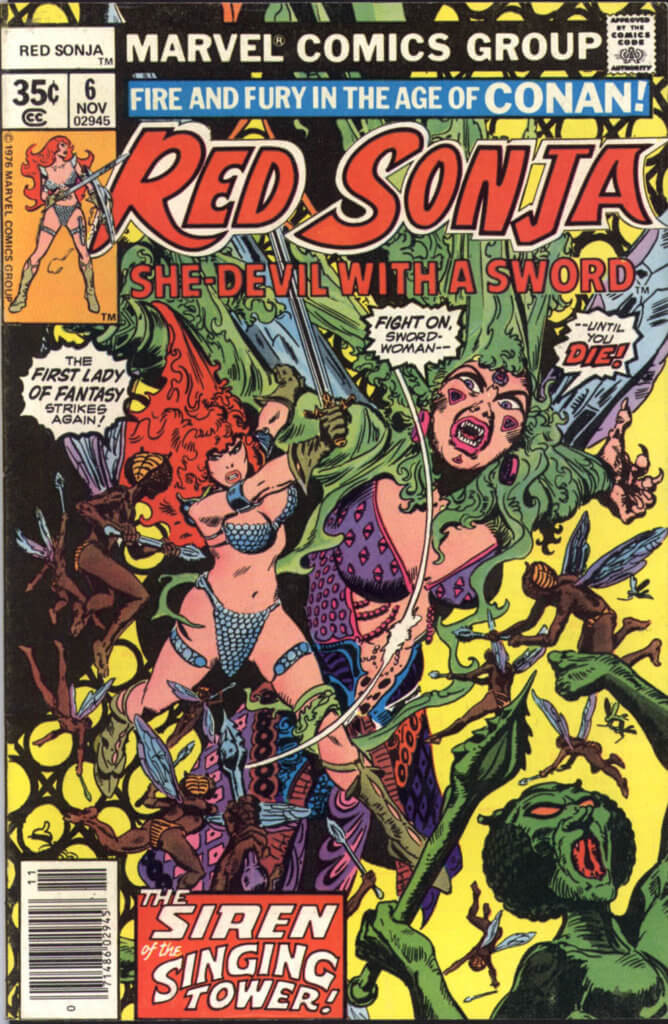
In issue #4, Sonja goes up against a race of amphibious beings that turn out to be travellers from another planet. While extra-terrestrial life is not unheard of in the Howard canon – his short story “The Tower of the Elephant” has Conan meet a strange creature “from the green planet Yag, which circles for ever in the outer fringe of this universe” – the idea of pitting a sword and sorcery hero against aliens is something that a pastiche author would typically shy away from. Issue #6’s Wendy Pini collaboration is stranger still, as Sonja meets a tribe of tiny bee-people whose unwilling queen is a giantess glued to the hive-wall.
Notably, Conan is absent from these exploits, the crossover in 1976 having served as something of an exorcism: the new series allowed Sonja to shine without her erstwhile co-star. So, when the time came for Sonja to receive a male foil, a new character was necessary. The first attempt was Mikal, a mysterious wanderer who joins Sonja in issue #3, before being written out in issue #6 when he is revealed to be the rightful ruler of a kingdom; he takes up his throne, while Sonja turns down his offer to serve as queen and carries on her travels. Mikal is an unmemorable character, but this is perhaps an issue with the source material: Robert E. Howard’s sword-wielding heroines tended to overshadow their male co-stars. There is, after all, a good reason why Gottfried von Kalmbach never got his own comic series.
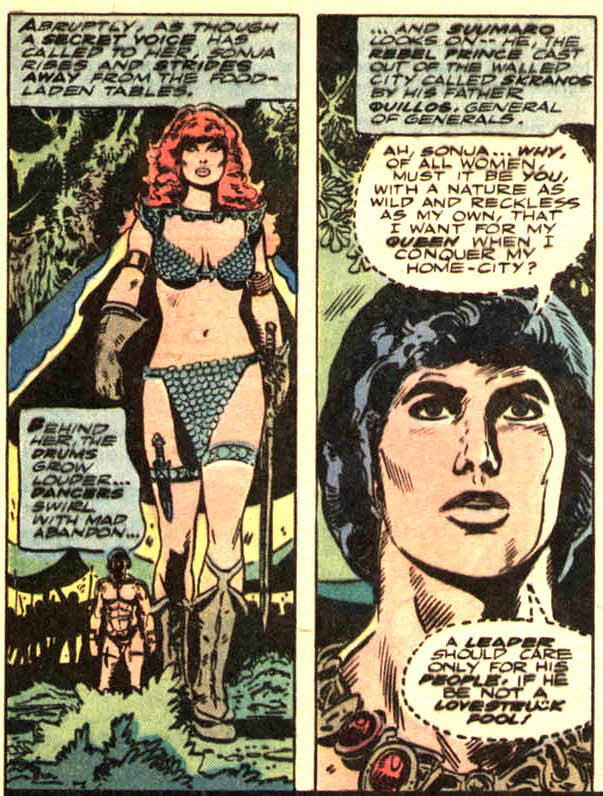
Issue #7 introduces a new male lead in Suumaro, a comparatively interesting creation. Resembling a more classically handsome version of Conan, Suumaro is an outwardly heroic figure who turns out to have a shadier side. Although his first major act is to rescue Sonja from being hanged, his motives are not altruistic: “Though you may or may not belong to another now, I’ll free you… and make you mine!”
During a quiet moment in their exploits together, Suumaro makes an advance on Sonja. She turns him down, in the series’ only reference to the oath she took in her origin story: “I… have taken a vow, Suumaro. A sacred oath. No man shall–“
“I shall!” interrupts Suumaro, grabbing her. “I want you, Sonja – and I’m a man accustomed to getting what he wants!” Sonja responds by pushing him away: “I am like no man you have ever met”, she says. “I’ll cut you down, if ever you touch me again against my will!”
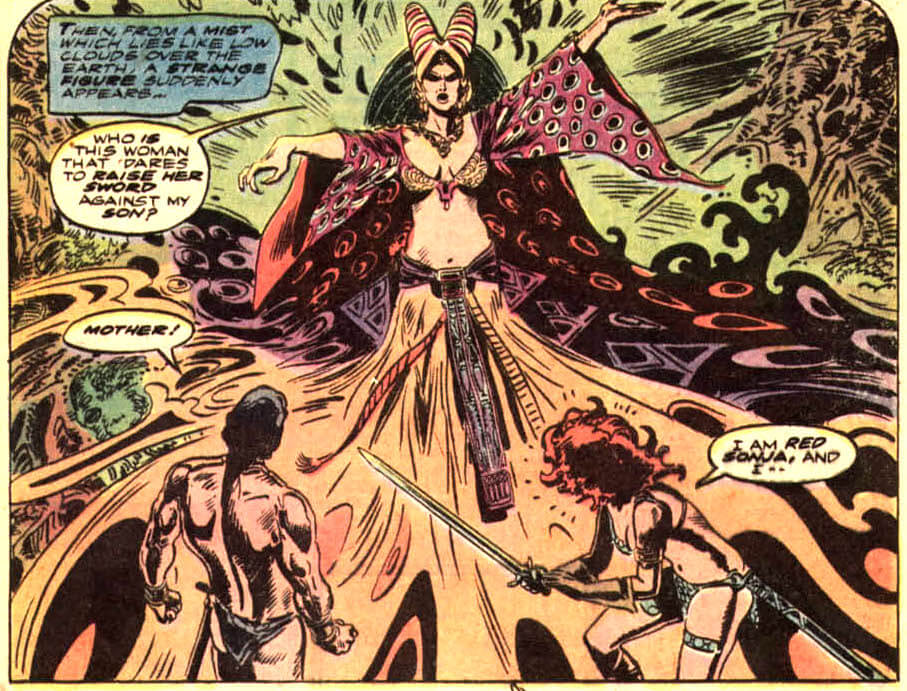
As well as a dying father and a villainous half-brother, who has taken control of his home town, Suumaro has a sorceress as a mother. Named Apah Alah, she serves as the main antagonist for a stretch of the comic, as Sonja and Suumaro do battle with her various weird creations: gargoyle-like beasts in one issue, flesh-eating flowers in another. Suumaro grows and matures over the course of these adventures, and he becomes a more viable love interest for Sonja. The will-they-won’t-they aspect of their relationship is given a certain degree of texture by the prospect of Sonja ending up with such a formidable mother-in-law as Apah Alah.
Sonja’s exploits with Suumaro conclude in much the same manner as her stint with Mikal. Suumarro inherits his father’s throne, his evil brother having been defeated, but Sonja declines the opportunity to become his queen. Significantly, however, there is no mention this time of Sonja’s oath; instead, she attributes her decision to her love of adventure. “I’d make no man a good wife; it’s not what I was born for, it seems” she explains. “Perhaps, one day, when the wanderlust leaves me… there’ll be time for a husband… for children… but that time is not now, I fear.”
A Rise and Decline
All in all, the comic had come up with a winning combination: high adventure, a touch of weird menace, and enough character-driven drama to ensure that Sonja was more than a mere pin-up.
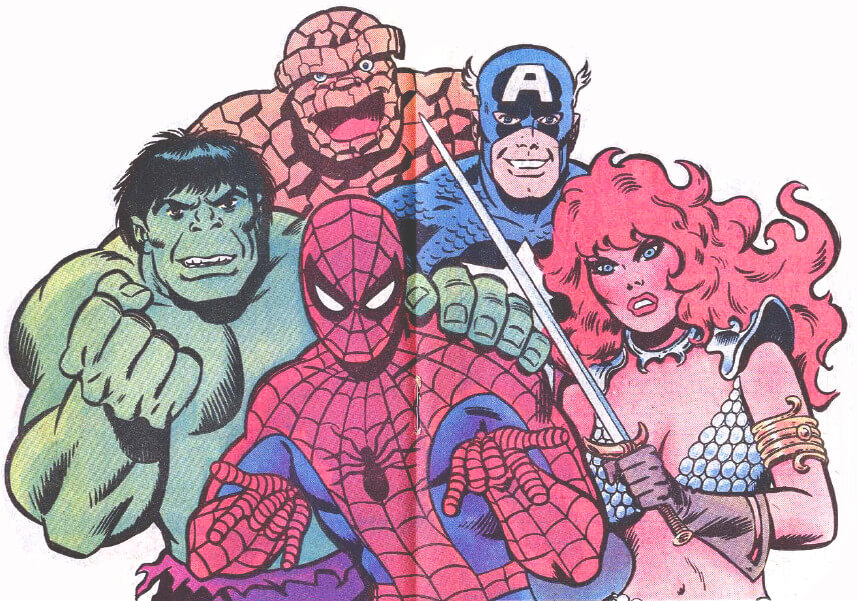
The success of Red Sonja is best appreciated when we consider that Marvel had previously struggled to produce a truly iconic heroine. That Sonja had come to fill a gap in Marvel’s output is emphasised by an incident from 1977, when the manufacturers of Clark chocolate bars ran a comic-themed competition with two adverts, one for DC and one for Marvel. Each showed a crowd shot of the publisher’s heroes; in the Marvel version, the group consisted of Spider-Man, Captain America, the Hulk, the Thing – and Red Sonja. The advert’s makers had apparently desired a token woman (a role which, in the DC version, went to Wonder Woman) and decided that Red Sonja was a more viable candidate for first lady than the Invisible Girl, Black Widow or any of the female X-Men.
But whether things would stay this way is another matter.
Towards the end of the Suumaro storyline, Red Sonja saw a shake-up in its creative team. Clair Noto stepped away from the comic, leaving Roy Thomas to turn her plot ideas into scripts. Meanwhile, Frank Thorne departed; replacing him as artist was Joe Buscema, along with a circle of assistants (and, in one issue, a stand-in: his younger brother Sal Buscema) who brought a less stylised, more naturalistic aesthetic. Buscema had been one of Thomas’ main collaborators on Conan, and their work together on Red Sonja was of a predictably high level of quality – but the series had lost its unique flavour from the Thomas/Noto/Thorne run.
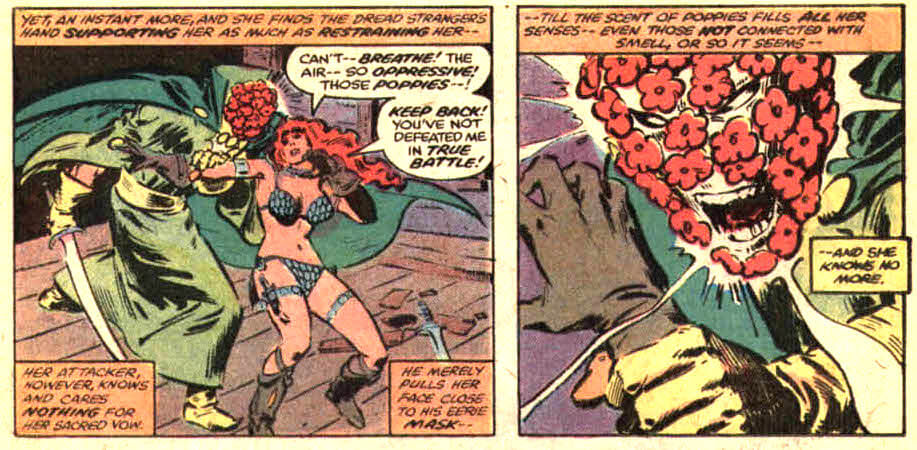
The Suumaro story arc was followed by a pair of done-in-one tales, sharing a formula between them: each sends Sonja on a relatively routine exploit, before throwing in an element of the bizarre as the climax nears. “An Evening on the Border” returns to familiar Greek mythology for inspiration, with Sonja accompanying a ghoulish ferryman to an underworld where she eventually encounters – of all things – a giant monstrous clam. In “The Tomb of Three Dead Kings!” Sonja spends the first half of the issue fending off typical tavern letches, before going up against a swordsman whose face is enshrouded in poppies, the scent of which send Sonja unconscious; a trio of vampires and a Swamp Thing-like plant man also turn up, for good measure.
And then, having racked up fifteen issues from January 1977 to March 1979, Red Sonja ended. Roy Thomas recounts the circumstances of the comic’s cancellation in the Dynamite collection The Adventures of Red Sonja Volume III:
Just as [issue #15] went to press, however, I got a phone call out of San Pedro, California, from artist Mike Vosburg, who was scheduled (if I recall right) to pencil an issue. He told me that Marvel had informed him that Red Sonja was cancelled. No one had had the courtesy to inform me yet of that fact, so you can imagine my reaction. Both frustration – and fury. Events like this pointed the way toward my leaving Marvel, a year or so later, after 15 years of steady and faithful employment.
There was still a place for Sonja, though, thanks to Savage Sword of Conan, the anthology having continued to run her adventures as occasional back-up material. “Wizards of the Black Sun”, published in Savage Sword #23 back in 1977, is a story by Thomas, Noto and Thorne with all of the carefree strangeness typical of their run on the main title. In it, Sonja encounters a skeletal antagonist with a fondness for games of chance, characters appropriated from The Hunchback of Notre Dame, and a talking three-legged goat that may or may not be a deity (“By the seven dark steeds of Erlik! A goat — from whose rough throat comes a melodic voice”?
“The Wizard and Red Sonja Show”, appearing in issue #29, is a decidedly offbeat story written and drawn by Frank Thorne. A wizard of the traditional pointy-hat-with-stars variety tries to summon Red Sonja from the Hyborian Age into his own time. To his surprise, however, he conjures up five red-haired women in armour, each purporting to be the real Sonja. The wizard comes to realise that he has summoned five different aspects of Red Sonja, which he identifies as her body, humour, spirit, mind and soul – but on a metafictional level, the five Sonjas also different ways in which a writer (or artist) might approach the character.
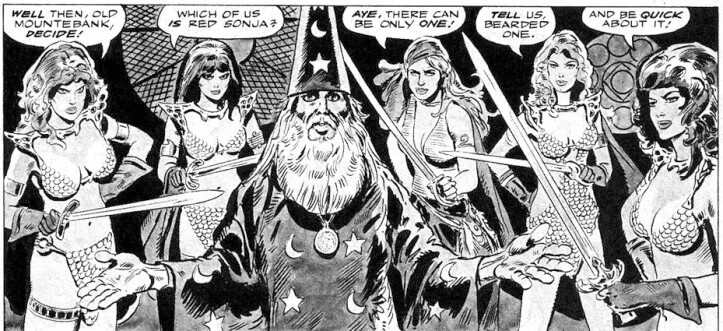
The first Red Sonja is the brash sword-fighter, eager for battle. The second is Sonja as pin-up fantasy, more flirtatious than fearsome (“Honey, just tell me about my future, I already know about my past!”) The third is the character as envisioned by Robert E. Howard: Red Sonya of Rogatino, with belts and britches rather than bikini. The fourth Sonja is a figure of self-aware humour, wearing a suit of armour pragmatically adapted to obscure her weak points (“I went to the Hyrkanian armorer who forged my original suit, and commissioned him to cover the perfect target of… my belly button”). The fourth is Sonja the feminist, who has little time for the wizard’s antiquated opinions on gender roles (“Who are you? Who is any man to say how a woman must carry herself through life?”) The story ends with the five Sonjas chasing the magician away, before preparing to go out for an ale together.
People surprisingly, this story is semi-autobiographical: during the late 1970s, Thorne sometimes performed at comic conventions dressed as a wizard alongside Red Sonja cosplayers -- one of them Wendy Pini.
The End of an Era
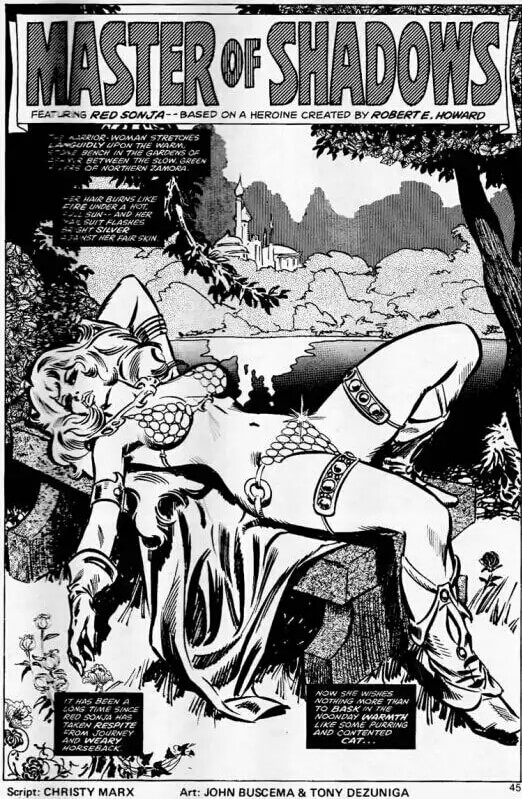
“The Wizard and Red Sonja Show” might have made a fitting punchline to Sonja’s exploits, but there was life in the heroine yet. Savage Sword of Conan #45, published months after the main Red Sonja series ended, saw artists John Buscema and Tony Dezuniga team up with new writer Christy Marx for a Sonja tale entitled “Master of Shadows”. Unusually, the story forgoes supernatural threats and instead opts for a mood of oppressive paranoia: Sonja is targeted by a clan of assassins who lurk in every shadow with an array of tricks and traps, ranging from poisoned food to throwing stars. Sonja manages to succeed in turning her pursuers’ traps against them, and retires to a sunny glade for a nap. So ends the story – and the decade.
During the 1980s Red Sonja would be granted her own comic again – indeed, by the end of the decade she had starred in three comic series, a film, a set of paperback novels and a Dungeons and Dragons module, and was even homaged in the music video to Kate Bush’s “Babooshka”. But that is a story for another time: with the end of 1979, we reach the end of Sonja’s formative period.
Although created to a template from the 1930s, Sonja was unmistakeably a product of the 1970s, embodying the ways in which the legacy of Robert E. Howard had been joined by a range of new influences, from the underground comics scene through to the rise of the feminist movement. The 1970s were a stimulating period for swords and sorcery – and Red Sonja may well be the genre’s most iconic creation from that era.