Infinite Crisis: Fifteen Years Later
Added 2020-11-21 16:39:39 +0000 UTCBy Doris V. Sutherland
This year marks the fifteenth anniversary of DC’s Infinite Crisis event, which itself was published to coincide with the twentieth anniversary of Crisis on Infinite Earths. That notorious series, published between 1985 and 1986, saw the DC heroes band together against the evil Anti-Monitor in a battle that destroyed a multiverse, leaving only one universe – and one continuity – for DC’s superhero line.
Infinite Crisis was the sequel, and aimed to provide a similar level of impact across the DC Universe. But times had changed since 1986, and Infinite Crisis reflects this fact. A decade and a half since it was published, now is as good a time as any to take a look back at the event and see what it has to say about superhero comics in the twenty-first century…
Countdown to Infinite Crisis
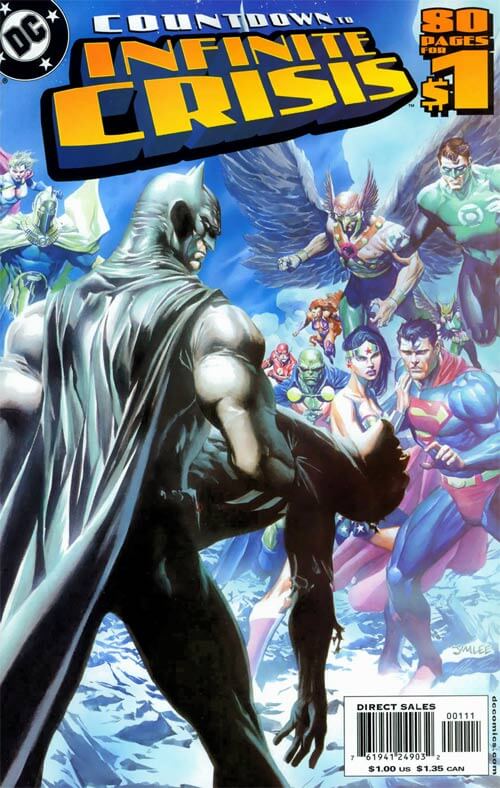
No twenty-first century superhero event comic can be as straightforward as a single miniseries. Infinite Crisis proper was preceded by four miniseries and a one-shot, all published under the umbrella of Countdown to Infinite Crisis (which was also the title of the one-shot). Most of these, in turn, followed on from the events of Identity Crisis, scripted by Brad Meltzer and published in 2004.
Both Identity Crisis and Countdown to Infinite Crisis were impacted by a development that had occurred after the publication of Crisis on Infinite Earths, something that altered the face of comics: the publication of Alan Moore and Dave Gibbons’ Watchmen, which was completed in 1987. After that, the pulp science fantasy of Crisis on Infinite Earths became insufficient. For a superhero story to have any claim to landmark status, it must make some effort to grapple with moral issues.
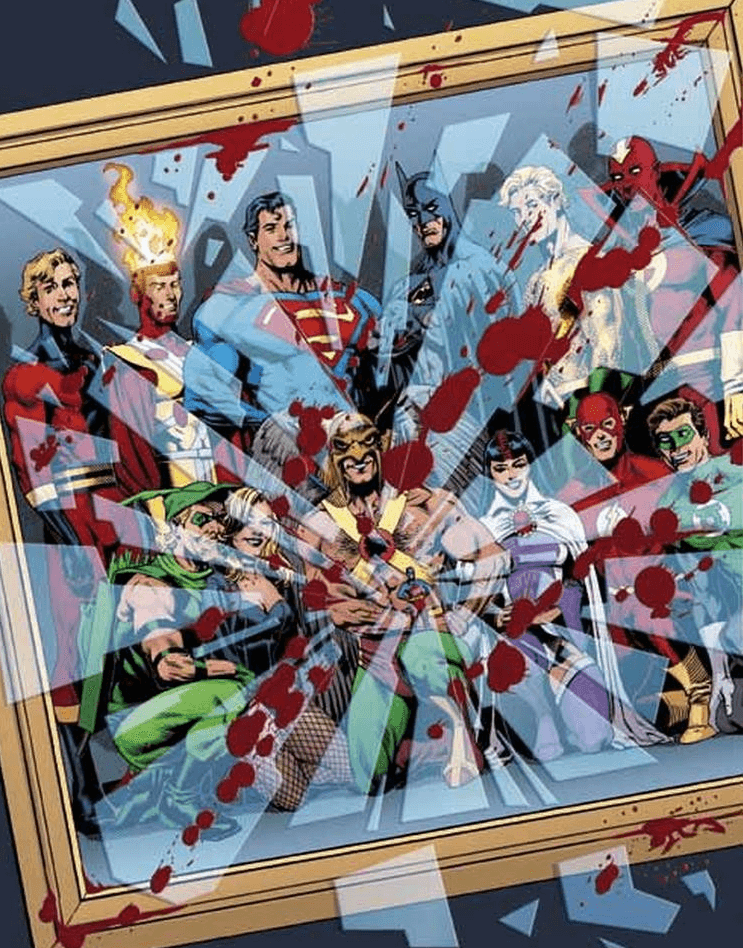 An iconic image from Identity Crisis
Like Watchmen, Identity Crisis opened as a murder mystery, its plot kicked off by the killing of Elongated Man’s wife Sue Dibny by an unknown culprit. Controversially, the story revealed that Sue had previously been raped by the villain Dr. Light, paralleling Watchmen’s revelation that Silk Sepctre had been raped by her fellow crime-fighter the Comedian. The Justice League punished Dr. Light by wiping his mind; when Batman objected to this move, his memory was erased, recalling how the costumed heroes of Watchmen covered up the rape committed by the Comedian. In short, Identity Crisis was a clear effort to capture some of Watchmen’s moral ambiguity within the confines of the DC Universe.
The Countdown to Infinite Crisis one-shot, which kicks off the event, likewise shows a distinct Watchmen influence. The story – penned by Geoff Johns, Greg Rucka and Judd Winick – chooses as its main character Blue Beetle, a superhero who in his Silver Age incarnation was the model for the Watchmen protagonist Nite Owl. The comic has Blue Beetle and Booster Gold reminiscing about their past in Justice League International, depicted as a bygone era of more colourful, innocent superheroics that has since been intruded upon by gritty realism – rather similar to Nite Owl’s nostalgia in Watchmen.
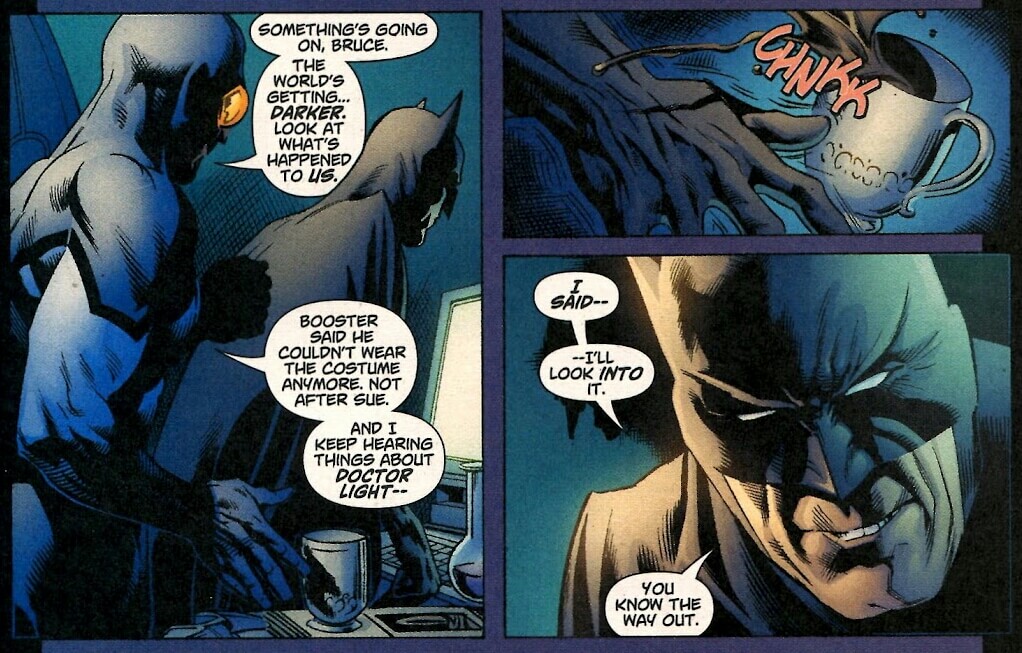
“Your best days in tights are behind you,” says sometime Justice League associate Maxwell Lord to Booster and the Beetle; “you need to stop looking backward, and start looking toward the future.” At the very end of the issue Lord pulls out a gun and shoots Blue Beetle dead, paving the way for the main event. As with the Comedian in Watchmen and Sue Dibny in Identity Crisis, Countdown to Infinite Crisis uses a character’s death to establish that not even superheroes are immortal.
Of course, taking place in the DC Universe, the story has far more restrictions than Watchmen ever did. It can kill a less franchise-favoured character like Blue Beetle, but every reader will know that the likes of Superman and Batman could never meet such a fate. The story is also restrained by its reliance on canon. A major plot point and emotional beat derive from the revelation that Booster Gold’s robot companion Skeets has been destroyed – but as Skeets is never shown before this scene, the moment will lack impact for readers unfamiliar with the characters in question. Watchmen, which used an original cast (albeit one loosely based on old Charlton characters) did not suffer from this problem.
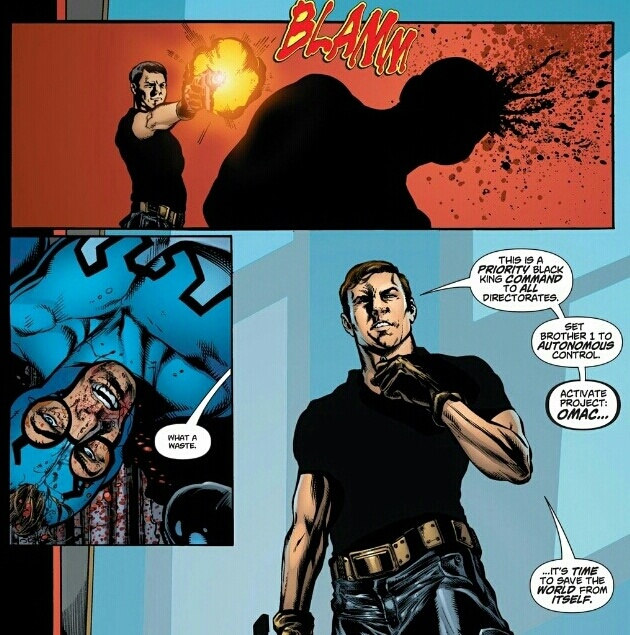
Identity Crisis was an entirely appropriate name for the story that preceded Infinite Crisis, as this was a time in which superhero comics were indeed having something of an identity crisis. Any new publication – particularly something as high-profile as Infinite Crisis – would be faced with the question of how to react to changing times and changing tastes. In the case of the Countdown to Infinite Crisis one-shot, the answer to that question was to try and emulate Watchmen. But the four miniseries that followed each offered a different answer…
The OMAC Project
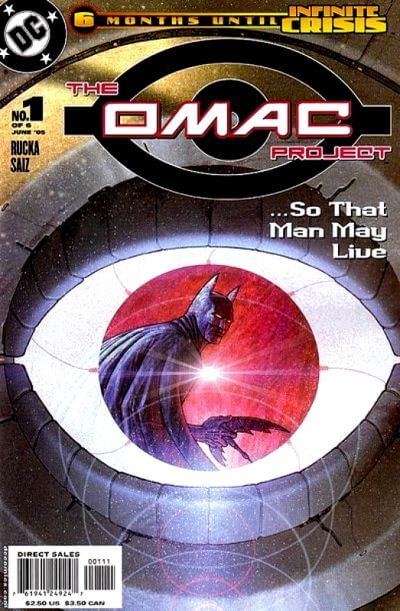
The plot of the Countdown to Infinite Crisis one-shot was continued in The OMAC Project, a miniseries written by Greg Rucka. This series found the simplest and most succinct way of building upon the themes established in both Countdown and Identity Crisis: by moving away from the superhero genre and towards the more fanciful end of the spy genre.
Granted, the story has superheroes in it. Indeed, Maxwell Lord – still the main villain – is motivated by his hatred and distrust of superheroes, neatly severing the story from any real-life geopolitics. But on the whole The OMAC Project is concerned with cover-ups, espionage technology, rogue agents and other stocks-in-trade of spy fiction. That some of its characters shoot lasers rather than magnums and wear spandex instead of tuxedos is a superficial detail.
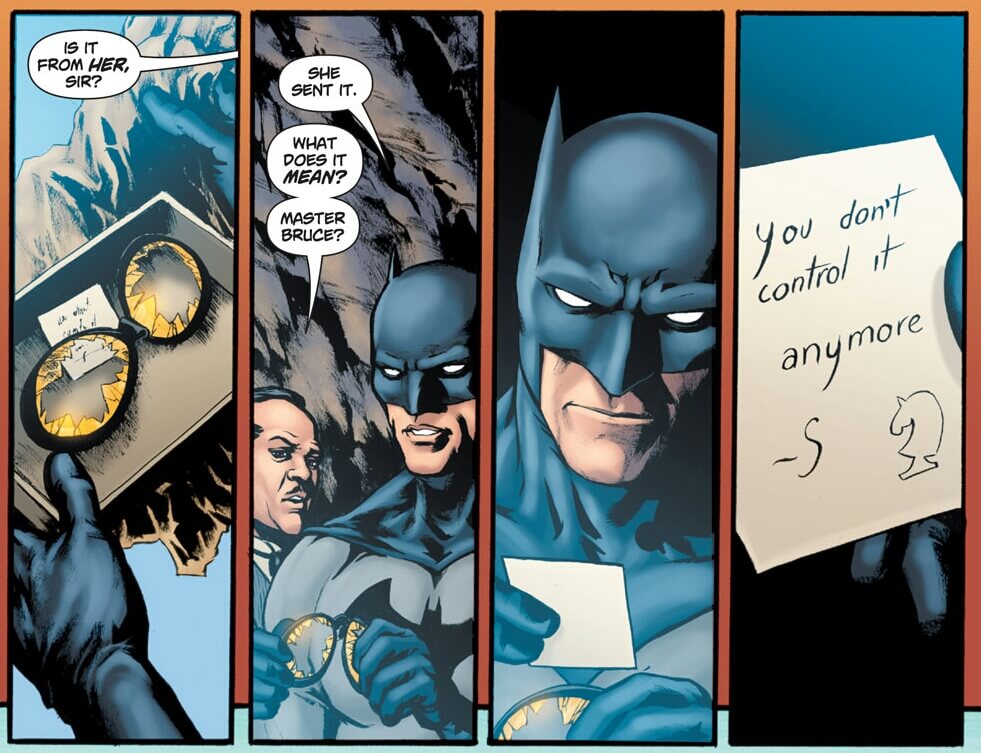
It is only natural that the story gives a prominent role to the household-name superhero who can be most easily inserted into spy fiction’s world of gadgetry and intrigue: Batman. The OMAC Project establishes that, after learning about how the Justice League had interfered with his memories to remove his knowledge of the Dr. Light incident, Batman resorted to some subterfuge of his own. His plan involved constructing a spy satellite called Brother Mark I to keep tabs on his teammates without their knowledge.
“And did you consider how we’d feel about this?” asks Superman after finding out about the satellite’s existence. “What we might think of you spying on us?”
“They stole my mind from me”, replies Batman. “You think I give a damn whose feelings get hurt? I wasn’t going to let anyone else cross the line.”
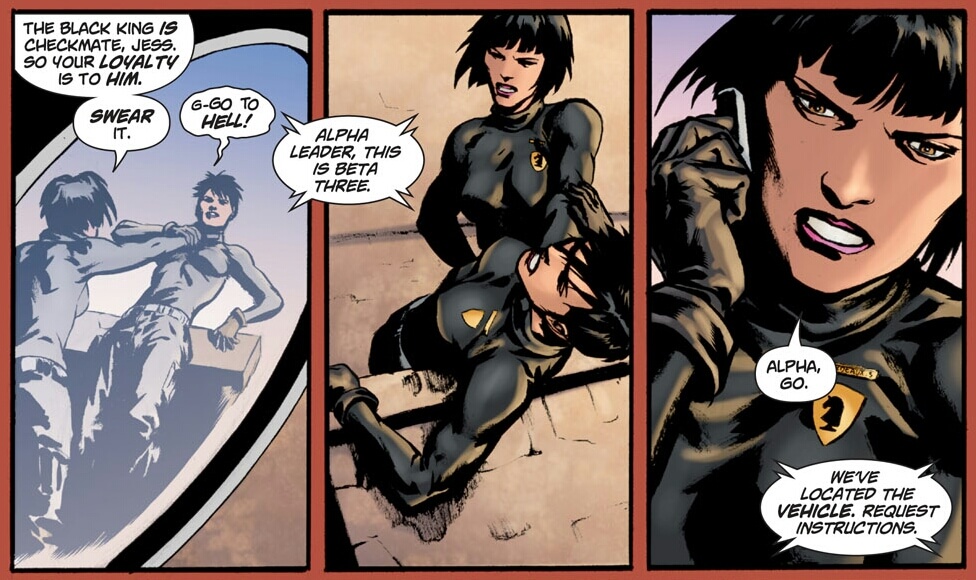
But by the time the story begins, Maxwell Lord has taken control of Brother Mark I and, for his own sinister ends, twisted it into the malevolent Brother Eye. but not everyone in his spy organisation Checkmate is on board with their leader’s actions: Sasha Bordeaux, a Checkmate agent who narrates much of the story (and serves as a love interest for Batman) begins plotting against him.
Despite its ultimate allegiance to spy fiction, The OMAC Project does make two major concessions to the superhero genre.
The first of these is its crossover with the “Sacrifice” storyline, also written by Rucka, that was serialised over the Superman and Wonder Woman comics. The climactic instalment of this, printed in Wonder Woman #219, was later included in the OMAC Project trade paperback as a “chapter 3.5” of the miniseries. This issue is taken up primarily by a fight between Superman (under Maxwell Lord’s mind control) and Wonder Woman, with all of the over-the-top superpowered action to be expected from such a battle.
Along the way, it restates Lord’s motivations: “Superman, Wonder Woman, the rest of them, they’ll kill us all… if we don’t kill them first” he says, after a double-page spread of a massive crater left in a road by the wrestling superfolks. But the very end of the issue brings things back down to earth: after a fight that includes heat vision, icy breath, flight and more, Wonder Woman frees Superman by snapping Maxwell Lord’s neck – bringing an abrupt and dramatic end to fantasy and taking us back to a more down-and-dirty form of fictional heroism.
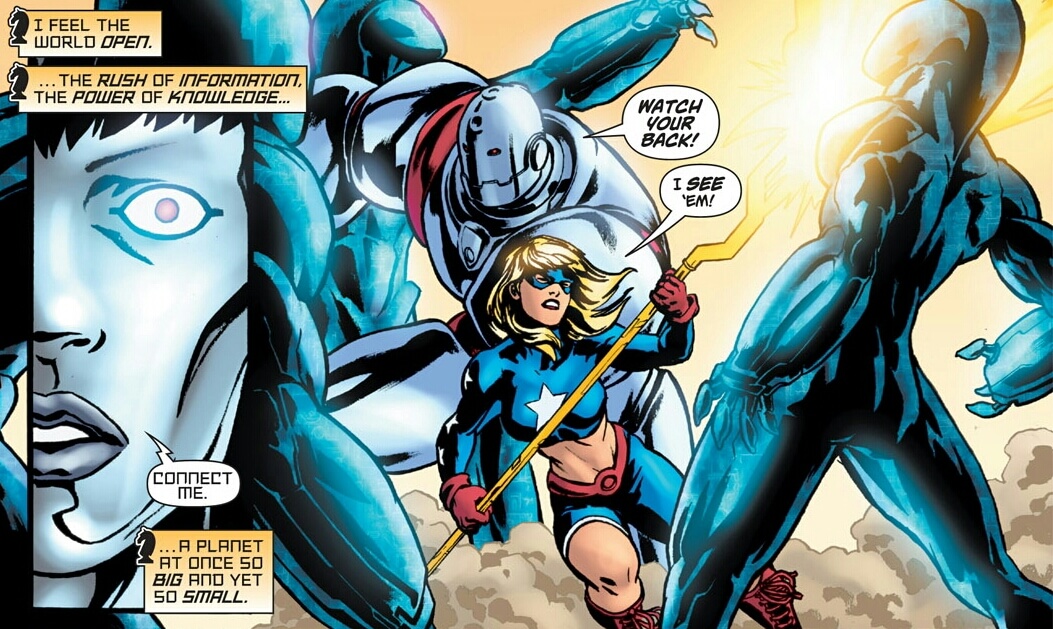
The series’ next substantial superhero component is its climax. Throughout the story, Brother Eye is shown controlling various apparently robotic beings called OMACs (a concept derived loosely from the seventies Jack Kirby series OMAC: One Man Army Corps). As the series reaches its conclusion it is revealed that the OMACs are human beings enhanced with nanotech, and – in a plot twist owing something to paranoid science fiction films like Invasion of the Body Snatchers and They Live – more than a million people around the world are OMAC sleeper agents, poised to be turned into nanotech cyborgs by Brother I. All of this leads to a spectacular climactic fight between the superpowered heroes and the vast army corps of one-man army corps.
Although it attempts to be something slightly different from a typical superhero adventure, The OMAC Project nonetheless realises that the superhero genre provides a convenient means of structuring a story. The miniseries hits the expected beats of a superhero event book, including the death of a second-string hero (namely Rocket Red), the introduction of a new superperson (when Sasha is affected by OMAC technology and becomes a noble cyborg) and, finally, the shocking twist that gets fans talking and promises raised stakes.
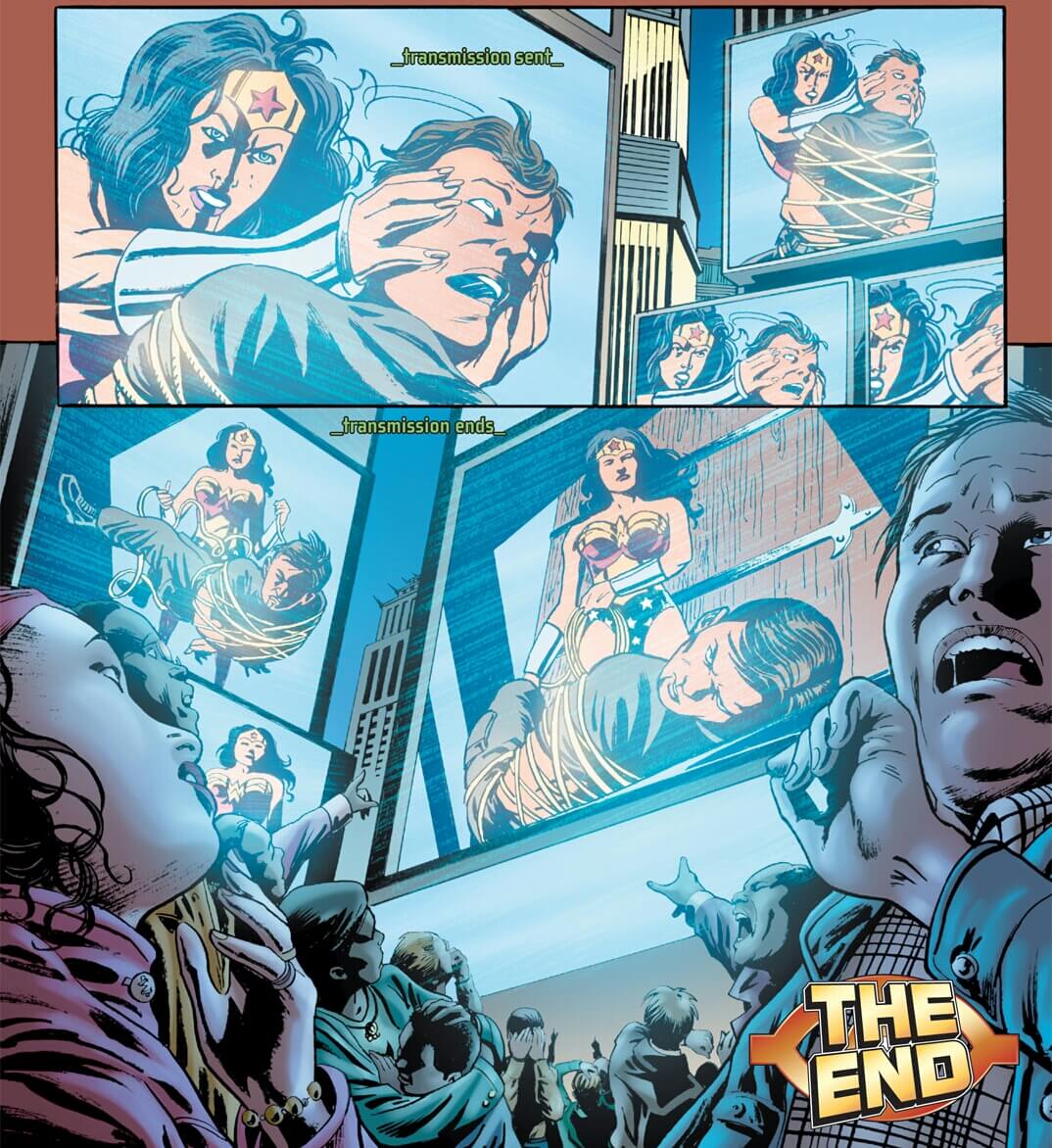
The miniseries ends with Wonder Woman’s killing of Maxwell Lord being broadcast via video to the public, who are disgusted; and so the stage is set for Infinite Crisis’ exploration of old and new forms of superheroism. It is notable that, out of the main three DC heroes, Wonder Woman should be placed in this position. Superman and Batman’s codes against killing had been well-established: having one of them kill Lord would have carried more weight, but also been considerably riskier (witness the negative response to Superman snapping Zod’s neck in Man of Steel). But Wonder Woman had generally been less consistent as a character, her values and ethos changing substantially from era to era. Diana, then, was the natural choice to commit this act of justifiable homicide – and The OMAC Project, a story that plays with the cold violence and moral ambiguity of spy fiction, was the perfect miniseries for the scene to occur.
Day of Vengeance
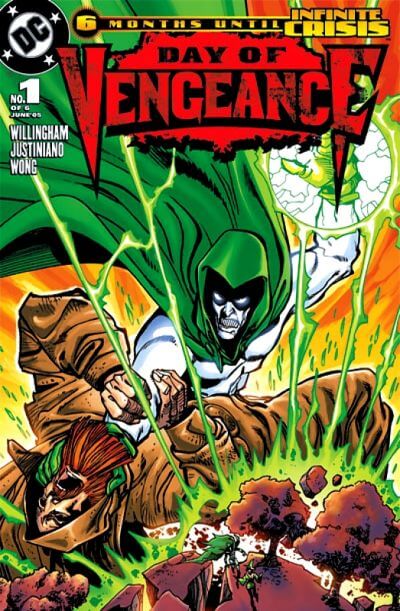
Debuting on the same day as The OMAC Project was the Bill Willingham-scripted miniseries Day of Vengeance. This itself had a prelude in “Lightning Strikes Twice”, a three-part storyline written by Judd Winick that ran across the main Superman titles. Between them, the two stories are a case study in how DC’s superhero comics were still grappling with the influence of Vertigo and its literary approach to comics, particularly comics about the supernatural.
After a prologue (in which Captain Marvel receives a foreboding-but-vague message from his wizardly mentor Shazam) "Lightning Strikes Twice" introduces three characters, each of whom is given a potted biography via narrative captions before being committing suicide. A singer with a troubled career electrocutes himself onstage (“his last thoughts vacillate from rage to pure bewildered confusion”), an audience member whose date night is ruined by the singer’s death sets himself on fire (“David’s last thought is terror as his anger slides away to pain”), and a resentful divorcee with no immediately obvious connection to the other men suicide-bombs a train (“Malcolm’s last thought is hate”).
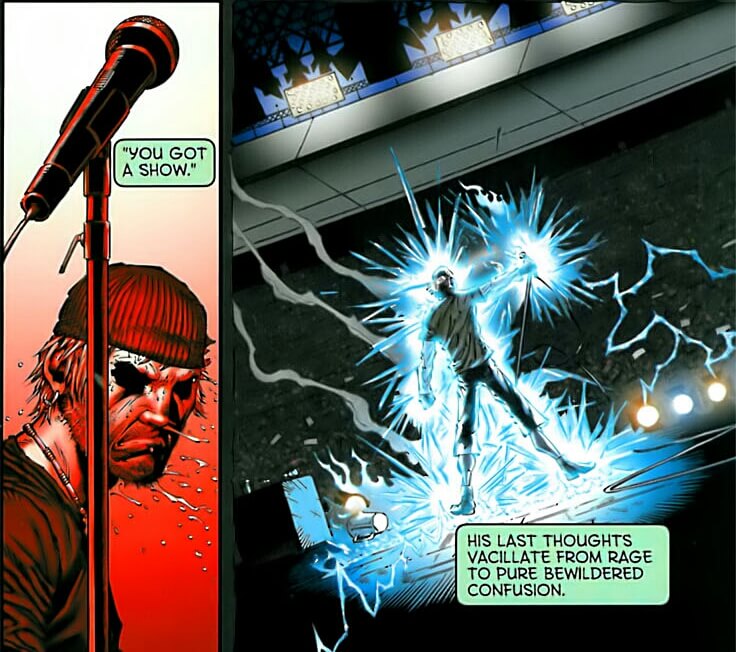
This sequence appears to have been influenced, directly or indirectly, by one of the canonical works in the establisment of comics as literature: Neil Gaiman’s The Sandman. In terms of subject matter it is similar to “24 Hours”, an early Sandman story in which various people around the world – from a children’s television presenter to the customers at a diner – fall under the influence of Dr. Destiny’s occult machinations and begin committing acts of random violence. In terms of execution it recalls the very first issue of The Sandman, when Dream’s capture causes multiple people to fall into coma-like states for many years. There, we are introduced to four victims – a Canadian child being read a bedtime story, a Jamaican boy in his father’s inn, a soldier in France, an English woman dreaming of the Sandman himself – who appear in vignettes, not impacting the plot themselves but instead illustrating the effects of the supernatural goings-on.
But rather than the literary world of Vertigo, “Lightning Strikes Twice” takes place in Metropolis, where Superman is on hand to save the day. After protecting bystanders from the bombing, he returns to his role as Clark Kent to find the connecting factor behind the three cases. It turns out that the suicides were all caused by Eclipso, an established supervillain with the ability to possess the bodies of those consumed with anger. Eclipso has since taken the body of a scientist named Jeanine Tracey, and through her gained access to a giant robot suit.
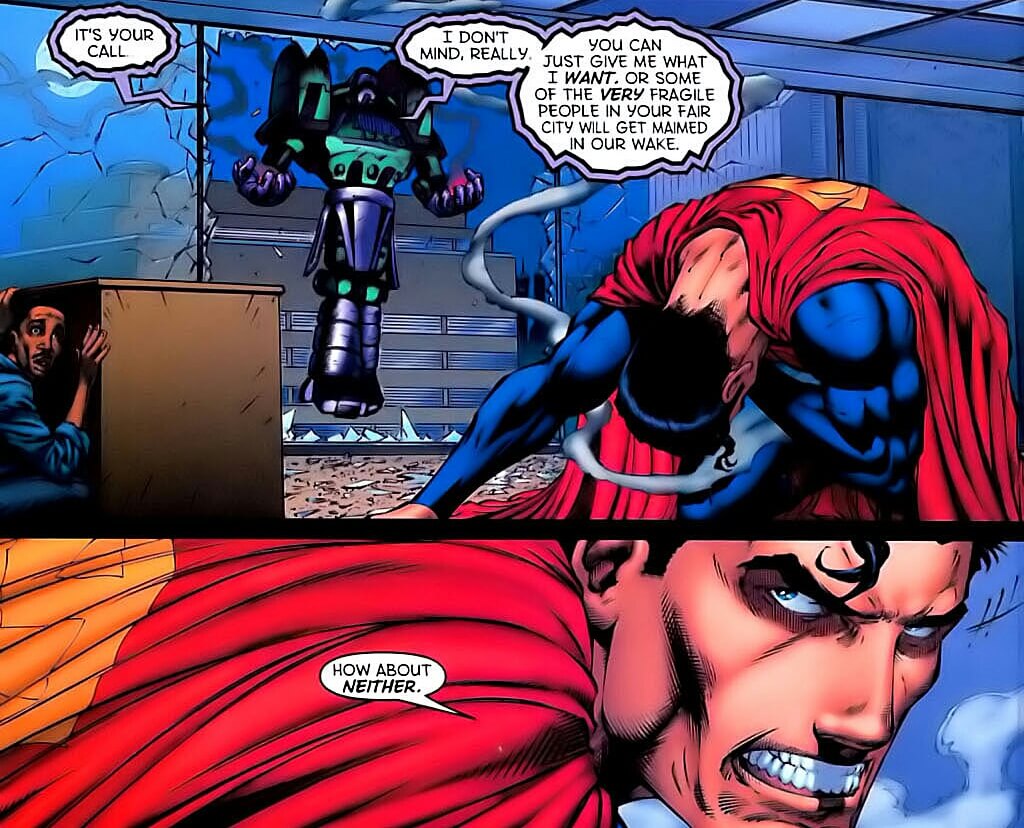
For the most part, “Lightning Strikes Twice” is content to be a conventional superhero comic. The confrontation between Superman and the robot-suited Eclipso that takes up most of part 2 is a standard hero-villain battle, and when Eclipso eventually achieves his aim of possessing Superman (“Finally, a body worthy of Eclipso”) he runs into Captain Marvel – which, in turn, leads to part 3 being taken up by another conventional superhero fight. The one point at which the story goes anywhere near the moral issues raised by Identity Crisis is a scene in which Lois Lane accuses Superman of irresponsibility, expressing concern that she will end up like Sue Dibny: “We all take chances being associated with you, of course. I hope I do better than the Elongated Man’s wife.” But three pages later we find that Lois is being controlled by Eclipso, her words no more than a ruse to provoke Superman’s anger.
The plot thread of Eclipso’s machinations continues into Bill Willingham’s Day of Vengeance, which presents itself as a nominal sequel to Identity Crisis by having Eclipso possess that story’s antagonist Jean Loring. However, the shadow that falls over the series is not that of Identity Crisis and its Watchmen-influenced moral ambiguity but – once again – that of Vertigo’s horror titles. Day of Vengeance explores the occult and supernatural areas of the DC Universe, an area that received the most substantial development from the likes of Alan Moore and Neil Gaiman.
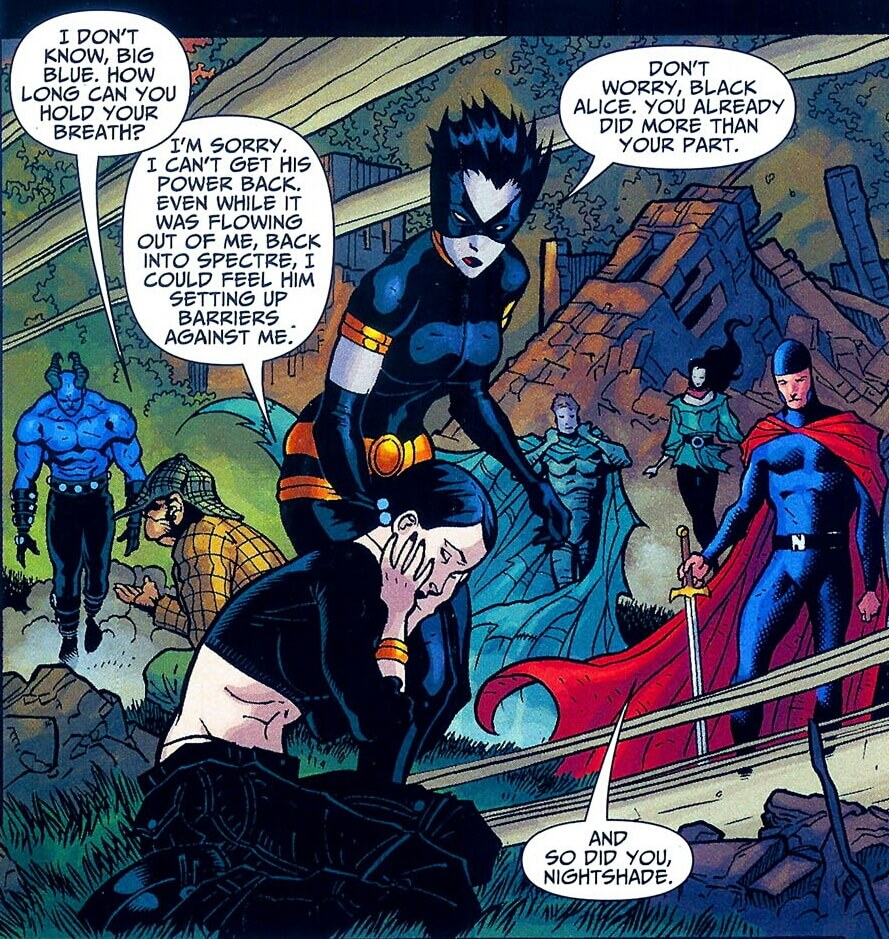
In what now feels like a prototype for the later Justice League Dark, the series depicts a number of supernatural heroes and anti-heroes banding together. The six main characters are a group called Shadowpact, comprised of Blue Devil, Enchantress, Nightmaster, Nightshade and Detective Chimp – each one narrating a different issue – with the recruitment of a seventh character, Black Alice, a major plot point. Many other characters turn up in the series mostly in cameos.
In the antagonists’ corner we find Eclipso and the Spectre. The story establishes that the Spectre has broadened this sinner-punishing remit, now issuing the death penalty for petty crimes: he has stabbed a man with a giant pen for cheating on taxes, strangled a woman in her bedsheets for adultery, and smothered a child with coins for stealing loose change. This newfound brutality is implied to be due the Spectre’s time spent away from a human body. “Without a host, my memories fade in and out”, he says in the conclusion to “Lightning Strikes Twice”. “Only my instinct survives. My purpose.”
Eclipso takes advantage of the Spectre’s confused state by persuading him that magic is the root of all evil, and that to serve his purpose, he must slay all magicians; as a result, various magic-users from across the DC Universe are either dead or facing death.
Day of Vengeance, portraying magical characters being slaughtered en masse with the out-with-the-trash ethos beloved of superhero event comics, captures a certain tension between genres. Superhero comics, although having little to do with real-world science, are given shape and structure by a sort of paper-scissors-stone logic: Superman is harmed by Kryptonite but healed by sunlight, and always will be. When the supernatural is introduced, however, this logic starts to break down. Magic that is bound by a neat set of rules is no longer magical.
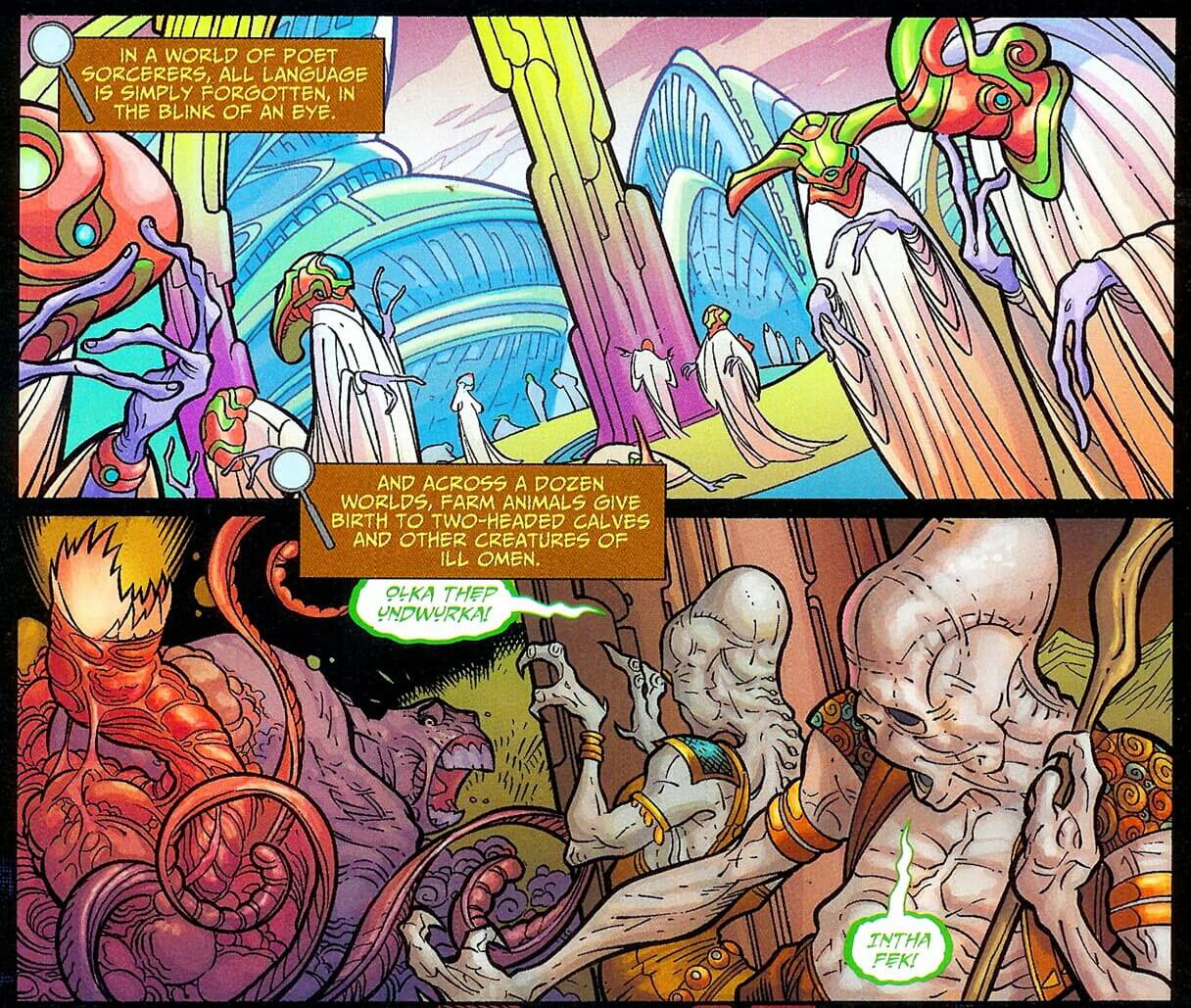
Like many Vertigo titles, Day of Vengeance makes an effort to recreate the intangible, surreal element of weird fiction – albeit in the margins of the main narrative. For example, look at Detective Chimp’s description of the fight between the Spectre and Captain Marvel:
The shock of their battle resonates across a wide spectrum of magical dimensions. In a world of cities in the sky, the spells keeping them aloft are sundered, causing them to crash into the sea. In a world of poet sorcerers, all language is simply forgotten, in the blink of an eye. And across a dozen worlds, farm animals give birth to two-headed calves and other creatures of ill omen. Maybe I’m prejudiced, but I think the sacrifice is well worth it, because—look at this—our guy is winning!
Compare this to the collateral damage of the fight between Morpheus and Dr. Destiny in The Sandman #7:
And the sleeping all over the world screamed and whimpered and moaned. They thrashed and called out, as if caught in the darkest of nightmares… and in dream s John Dee spewed his hate and laughter onto the emerald winds, Eve stares out from her cave at the erupting dreamscape. Her raven caws unkindly at the havoc. The quakes and lights send the keepers of the stories scurrying for cover. Their monsters hide with them, under the bed. In the garden of forking ways, Destiny finds himself (perhaps for the first time) hesitant to turn the next page in his book…
Shadowpact eventually defeats Eclipso using superheroic paper-scissors-stone logic: learning that Eclipso is vulnerable to sunlight, Nightshade teleports the villain into the sun’s orbit. Meanwhile, Spectre heads elsewhere and gets into a fight with the wizard Shazam at his home, the Rock of Eternity; this ends with the death of the wizard, the destruction of the Rock and more throwaway magical strangeness (“Some of the debris was blasted thousands of miles away. One small bit vaporized a young girl in Bethlehem, Oklahoma, on her way home from the playground. Her headless ghost screamed foul prophecies for thirteen minutes, before it faded.”)
The story is concluded in the one shot Day of Vengeance: Infinite Crisis Special. Here, Shadowpact battles occult heroes who have become possessed by the spirits of the Seven Deadly Sins let loose by the Rock of Eternity’s destruction; this is largely played for laughs, with such scenes as Rex the Wonder Dog becoming too lazy to join the fight after being possessed by Sloth. But there are still stakes: Nightshade becomes Shadowpact’s one casualty, while Nabu (the godlike being associated with Dr. Fate) battles the Spectre for the fate of the universe.
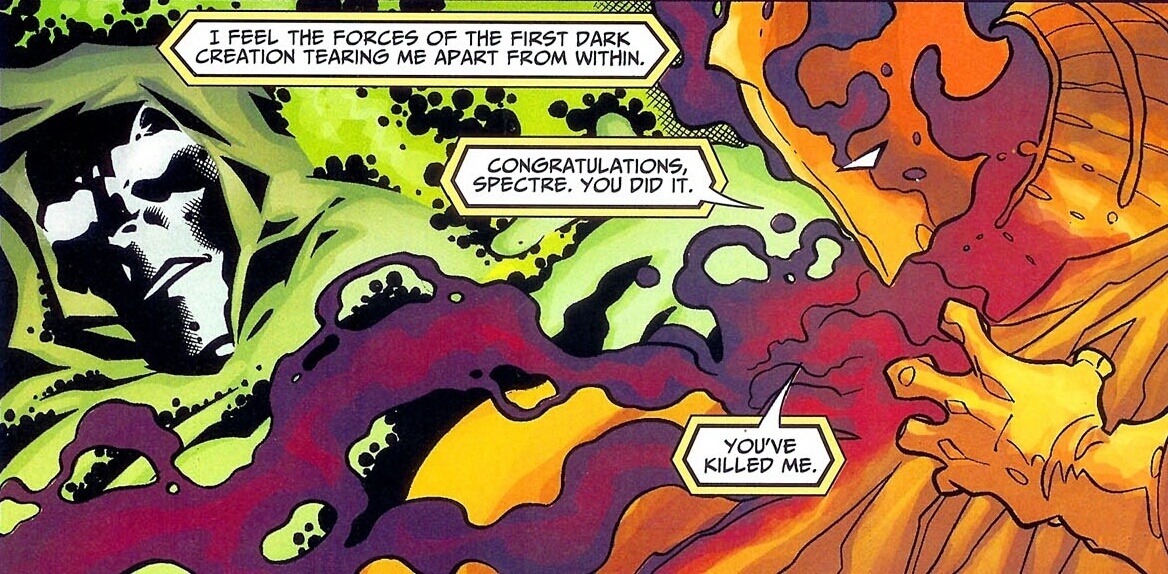
This cosmic conflict ends with the Spectre being called back by the “higher authority” to which he ultimately answers. “So that was your plan all along?” asks Detective Chimp of Nabu. “Make the barking dog bark a lot louder, so its master will wake up and put a leash on him?” Meanwhile, Nabu himself is fatally injured, and predicts that the magical slaughter committed by the Spectre will produce a “tenth age” in which magic is rewritten.
What this “tenth age” amounts to is a more coherent definition of how magic works within the DC Universe – a reconciliation, perhaps, between the Vertigo and superhero modes. However, all of this has little bearing on Infinite Crisis, instead coming into play with the follow-up series 52.
Rann-Thanagar War
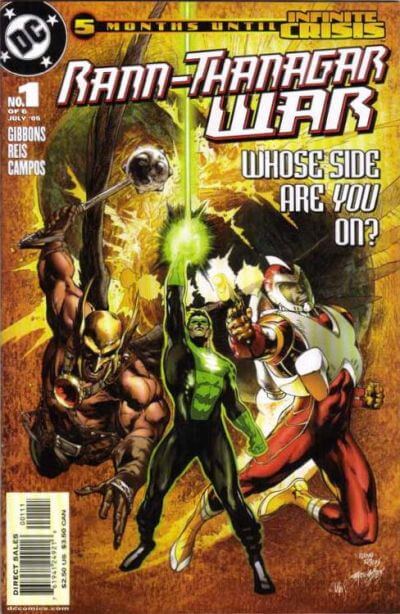
With espionage and the occult having been covered, the next genre to be tackled by the Infinite Crisis lead-in miniseries was space opera. Rann-Thanagar War ran the risk of being the most impenetrable entry in a line-up that was already steeped in DC lore: a typical superhero comic will expect familiarity only with a few denizens of Metropolis or Gotham; but a space opera requires the reader to memorise a network of fictional planets and species. Even the title of the miniseries is meaningless to anyone unaware that Thanagar is the homeworld of Hawkman and Rann the setting of Adam Strange’s origin story.
The comic starts off by continuing plot threads from recent Adam Strange and Green Lantern titles. Thanagar is destroyed and Rann is unjustly blamed, resulting in a war between the planets’ two humanoid species. This conflict implicates a vast chunk of DC’s spacefaring characters: by the time the series reaches its conclusion in Rann-Thanagar War: Infinite Crisis Special, the battle has expanded to include Starman, Captain Comet, Supergirl, Starfire and her sister Blackfire, Tigorr of the Omega Men and several Green Lanterns, amongst others.
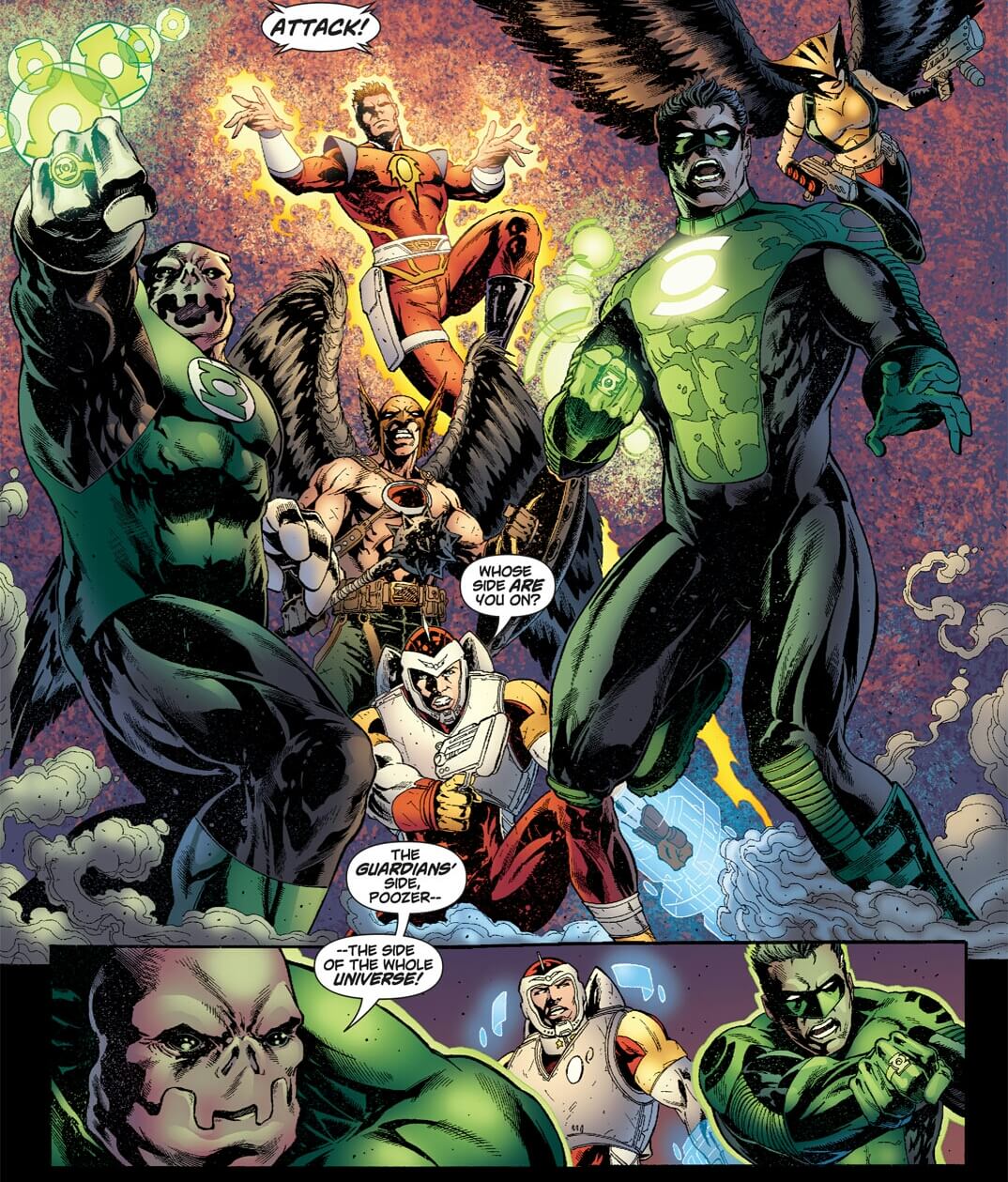
Yet as confusing as it could have been, Rann-Thanagar War holds together, largely by working on a fundamentally visual level. Writer Dave Gibbons – best known for drawing Watchmen – clearly composed his scripts with an artist’s eye, structuring the scripts not around technobabble dialogue but through bold, iconic scenes.
During the course of its narrative, the miniseries develops from a space opera to a superhero comic that happens to be set against a starry backdrop. The various alien civilisations and their alliances turn out to be less important than a handful of superpowered folks in suits, and the climax of the story is a battle between the assembled heroes and the gigantic figure of space-demon Onimar Synn.
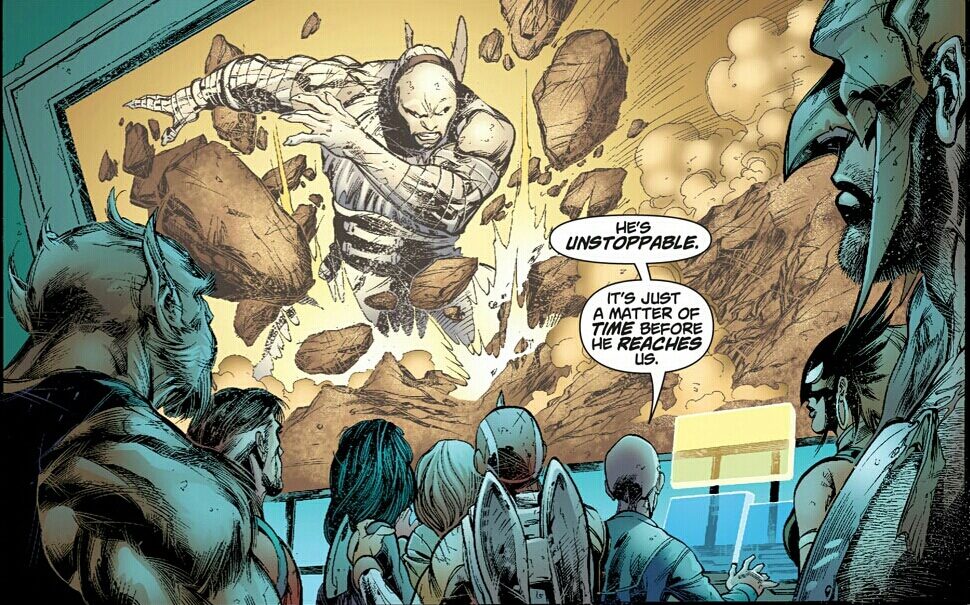
Inevitably, the battle has fatalities. The first of the deaths is that of the Silver Age Hawkgirl Shayera Hol, whose passing is treated in a distinctly stiff-upper-lip manner by the survivors (“Warriors die”, says Tigorr to Hawkman. “Ya haveta let her go, my friend). Next on the block is Jenny, daughter of the original Green Lantern Alan Scott. We are told that although her physical form is destroyed, her spirit lives on; in practical terms this means that Green Lantern Kyle Rayner gets a power boost, a new costume and starts calling himself Ion.
As with Day of Vengeance, the events of Rann-Thanagar War impact 52 more than they do Infinite Crisis, and it seems largely unconcerned with the wider event. Its proposed solution to the identity crisis of contemporary superhero comics, meanwhile, is perfectly straightforward: the genre can survive by leaving Earth altogether and giving the readers a big, bold spectacle.
Villains United
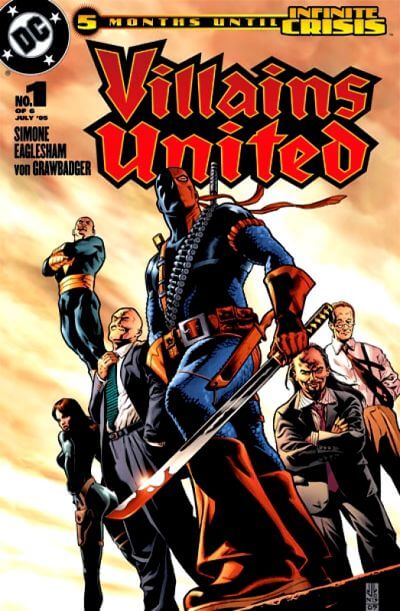
In the Villains United miniseries, writer Gail Simone looks at how the supercriminals of the DC Universe responded to the events of Identity Crisis and the revelation of Dr Light’s mind-wipe: by banding together en masse in a group called the Society. “Only in great numbers may we prevent Earth’s ‘heroes’ from committing such an atrocity again”, says one of the group’s representatives.
But not all villains are on the same page. The main characters in the story are six criminals – Deadshot, Catman, Ragdoll, Parademon, Scandal Savage and Cheshire – who for their own reasons decide against joining the Lex Luthor-fronted Society. Instead, they form their own group, headed by a mysterious individual known only as Mockingbird, and end up right in the middle of a brewing war between heroes and villains.
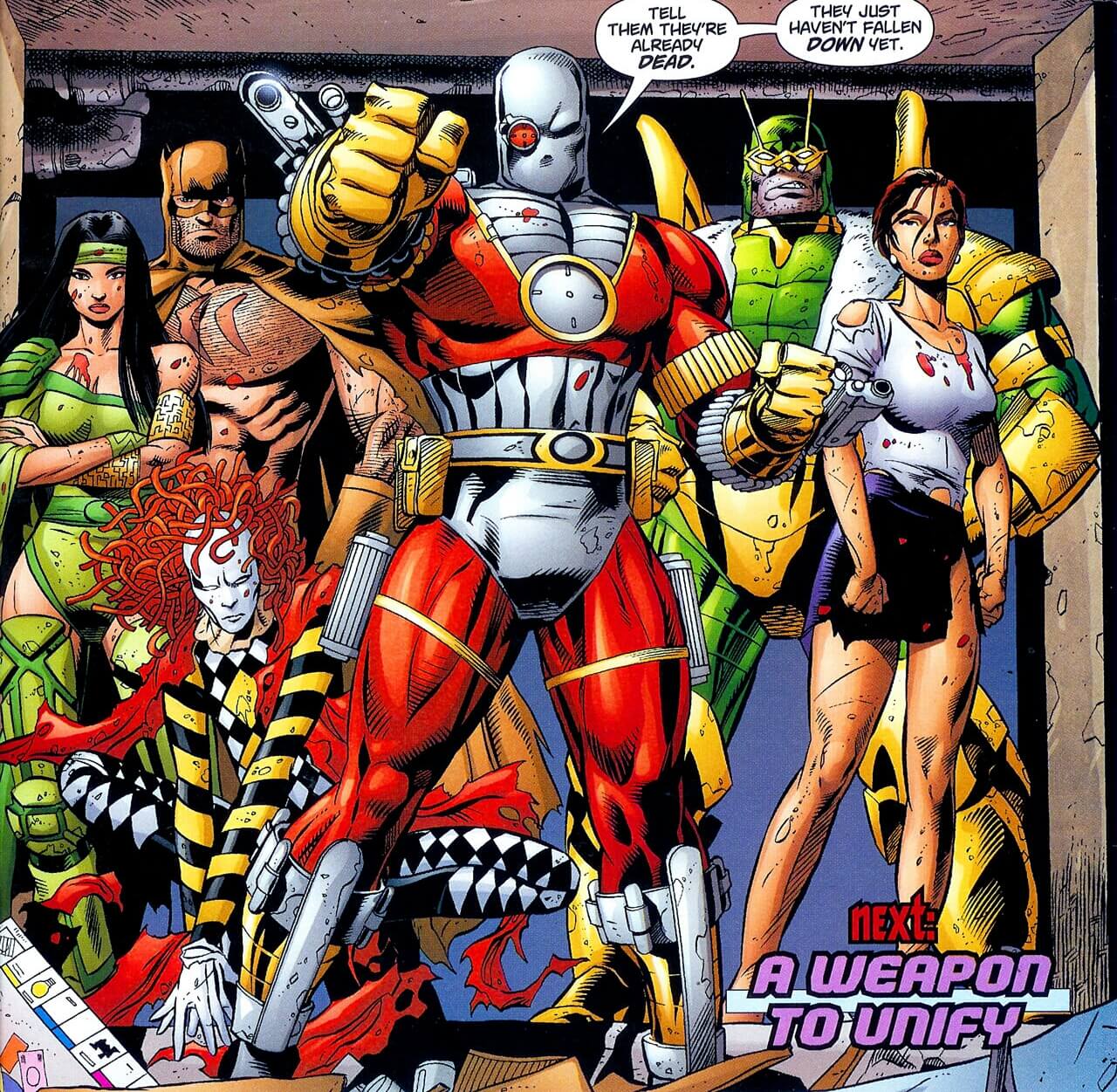
Where the other three miniseries explored other genres, Villains United is an unabashed, squeezed-into-spandex superhero story. Granted, it makes the fairly unusual decision to focus specifically on the bad guys – but given that the story ultimately pits a team of likeable villains against a team of less-likeable villains, this turns out to be a minor variation on formula.
Structurally, the comic is similar to Day of Vengeance in that it showcases an expansive cast of mostly-little-known DC characters while picking out a small band of mismatched protagonists for centre stage over the course of its six-issues-plus-special. But unlike Willingham’s series there are no cosmic stakes, no battles between godlike beings. This leaves the story with considerably more room to flesh out its characters.
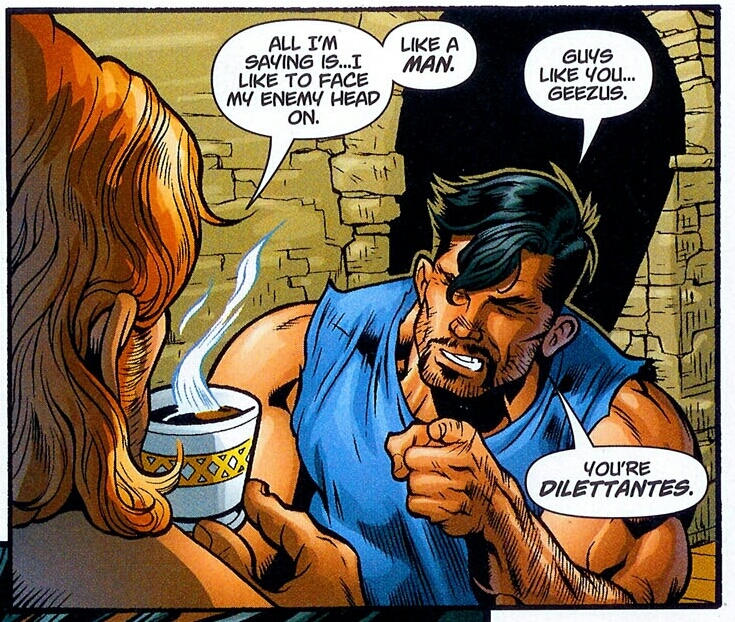
Character-driven plotting has always clashed with sprawling-cast superhero event stories. Crisis on Infinite Earths had some effective emotional moments but struggled to give them proper pay-offs: a good example is the scene in which Batgirl feels despair at her failure to respond to the apocalyptic threat, followed by shame at brooding while her friend Supergirl keeps on fighting – a sequence that carries weight, but is never mentioned again. The effect of this is rather like finding a few tasty morsels floating in an otherwise rather watery stew.
The Infinite Crisis event, despite being spread across multiple series, runs into similar problems. Look no further than the moment in Day of Vengeance where Ragman reacts with shocked disgust after Blue Devil forces him to use condemned souls as weapons – a substantial piece of both character drama and worldbuilding, but one which (like Batgirl’s woes years beforehand) is never mentioned again.
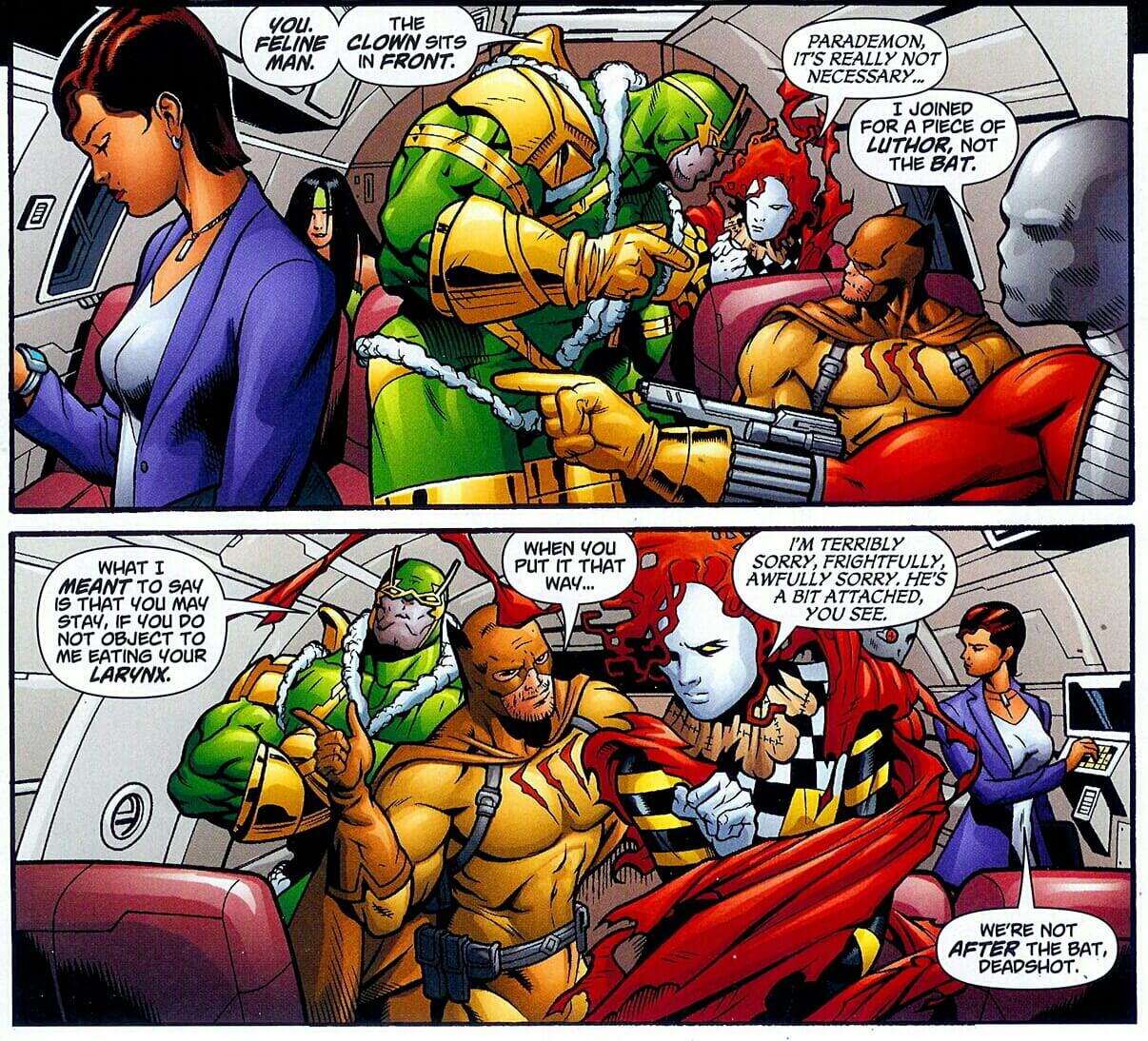
Villains United is different. It positively reverberates with Gail Simone’s love for the superhero genre as a vehicle for both colourful fantasy and strong character-based drama. Catman’s development from joke-villain to credible protagonist; Paradmeon’s touching protectiveness towards Ragdoll, something like a child’s affection for a pet; Ragdoll’s traumatic family background; the ever-deepening sleaziness of Deadshot; Scandal Savage’s rivalry with Talia Al Ghul, both of them daughters of established male villains; Cheshire’s manipulative relationship with Catman – each of these plot threads is developed with care and consistency. Not all of the six anti-heroes make it to the end of the story, but when a character dies, the result is more than merely a quick cast-culling to attract attention: it packs an emotional punch.
The plot of Villains United turns out to have little direct relation to either Infinite Crisis or 52. Yet, even though it is the miniseries with the least impact on the main event, it is the one with the longest-lasting influence on DC Comics as a whole. Simone continued the story in the spin-off series Secret Six, which in turn paved the way for the New 52 revival of Suicide Squad. Villains United laid out a viable template for how to write a twenty-first century superhero comic that remained a superhero comic.
Infinite Crisis: The Main Series
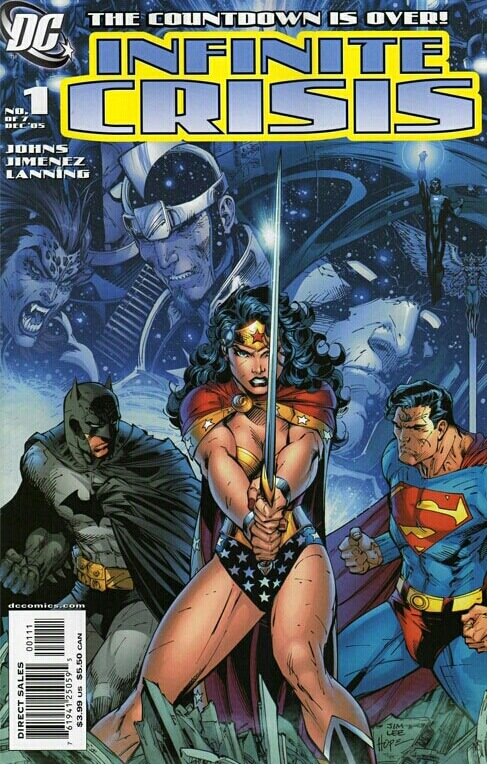
Finally, we come to the main Infinite Crisis series, scripted by Geoff Johns. The first issue touches upon the main threats introduced in the four miniseries – an army of OMACs, a rampaging Spectre, a union of villains, a war in space – but these are largely set-dressing with little direct impact on the plot. The actual drama arises from conflict within DC’s main superhero trinity: between Wonder Woman’s killing of Maxwell Lord and Batman’s questionable usage of a spy satellite, not to mention the still-lingering ramifications of Identity Crisis, the three are having trouble trusting one another.
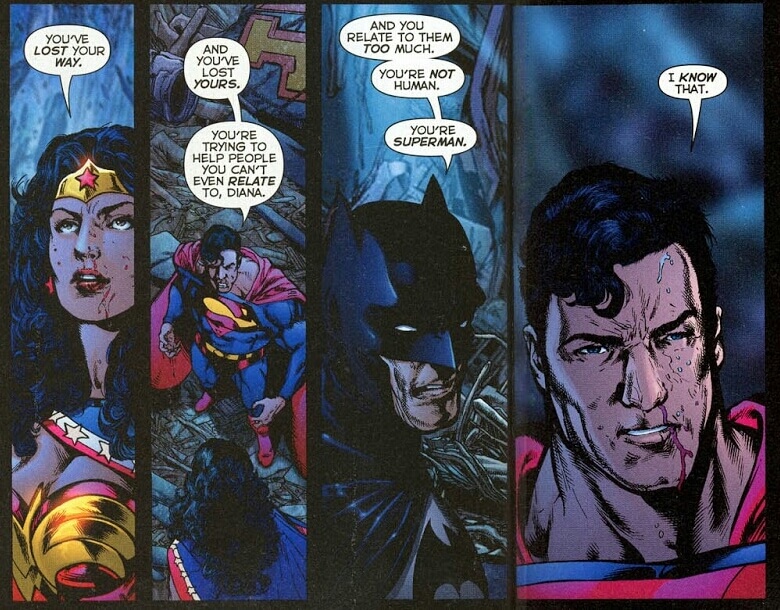
“You don’t belong here, Diana” says Batman to Wonder Woman on the second page of the first issue. “They’re scared of us because of you” adds Superman on the third. A later scene establishes the three characters’ main viewpoints. Diana is the pragmatist, who argues that she made the right choice in killing Lord: “the world is not as black and white as you and Kal see it”, she tells Batman. The other two heroes are both idealists, but with different perspectives – one a godlike alien, the other a mere mortal. Batman justifies his methods by stating that he is “trying to do everything I can” while arguing that Superman can work differently: “for you, it’s about setting an example […] they need to be inspired, and let’s face it, ‘Superman’ – the last time you really inspired anyone – was when you were dead.”
Crisis on Infinite Earths includes three versions of Superman among its main cast. One is the Earth-1 Superman – that is, the main Superman at the time of publication. Another is the Earth-2 Superman – the original Superman who appeared in the Golden Age comics; he is depicted as older than his modern counterpart, with a lined face and greying hair. The third is the Superboy of Earth Prime, whose origin is more complex. Earth Prime had been introduced as the real world, our world, and consequently lacking superheroes; but it was later established during the era of Crisis on Infinite Earths that the planet did in fact have one hero, namely a version of Superboy, who survives the destruction of his world (the implications of our Earth being wiped out by the Anti-Monitor are never explored).
[caption id="attachment_132278" align="aligncenter" width="1024"]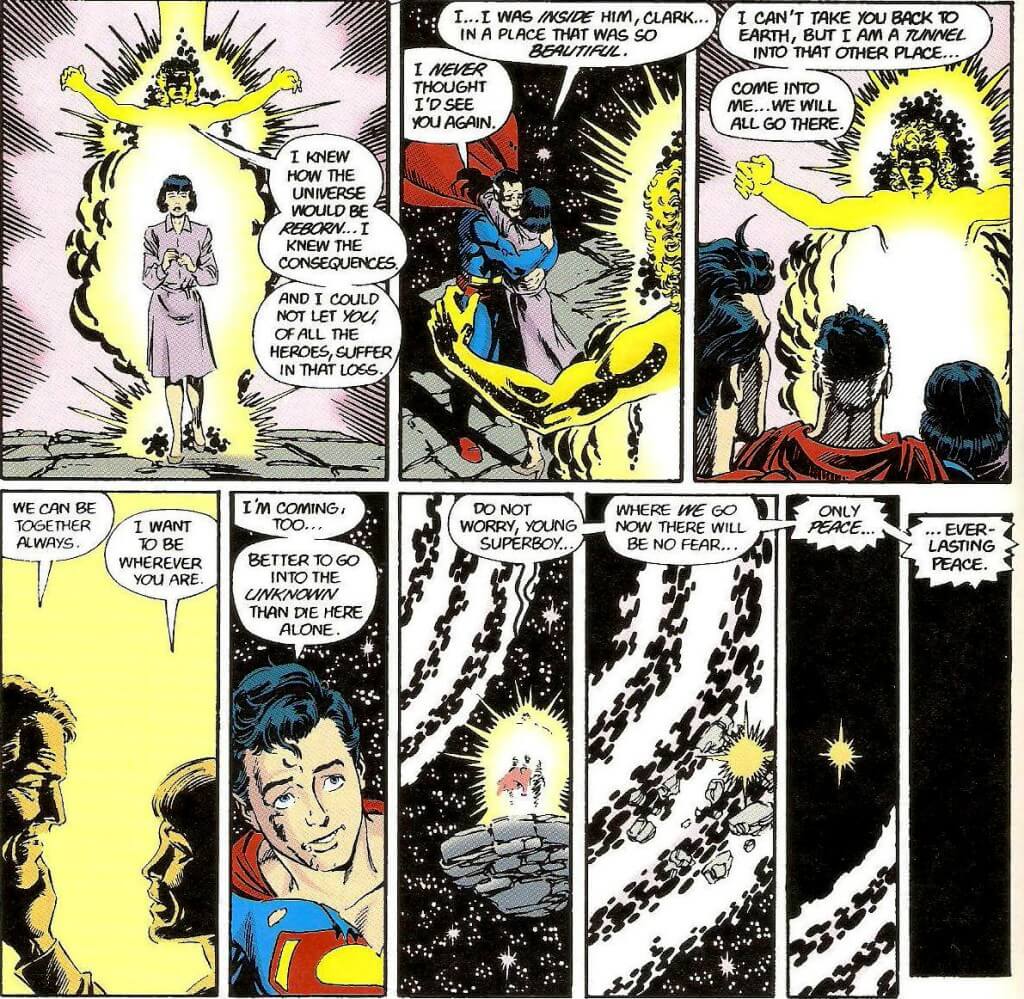 The conclusion to Crisis on Infinite Earths[/caption]
Through a cosmic fluke, the three Supermen are left co-existing in the newly-created world, but Earth-2 Superman is anguished by the loss of his own world and those who lived in it. It is then revealed that Alexander Luthor (the son of a benevolent Lex Luthor from Earth-3) has, through vaguely-defined means, managed to keep the Earth-2 Lois Lane alive and well in a space referred to variously as “that other place”, “a place that was so beautiful”, “the unknown”. Crisis on Infinite Earths ends with this couple – joined by Superboy Prime and Alexander Luthor – happily departing into this realm, which is hinted to be some sort of afterlife.
Notably, Crisis on Infinite Earths never takes part in any kind of commentary on how superhero comics had evolved between the Golden and Bronze Ages. It establishes that the Earth-2 and Earth-1 Supermen had different adventures, but not that they had different kinds of adventure, their comics being produced in different eras for different audiences. Not is there any acknowledgement of the irony in the Golden Age Superman and Lois Lane – the most famous couple from a more simpler and straightforward period in comic history – sharing their happily-ever-after with Superboy Prime and Alexander Luthor, two characters whose bizarre backstories mark them as products of a rather more convoluted time. The simple aim of Crisis on Infinite Earths was to tell an engaging story while wrapping up various decades-old plot threads – plot threads that had, themselves, been introduced purely to explain away inconsistencies that had built up over time.
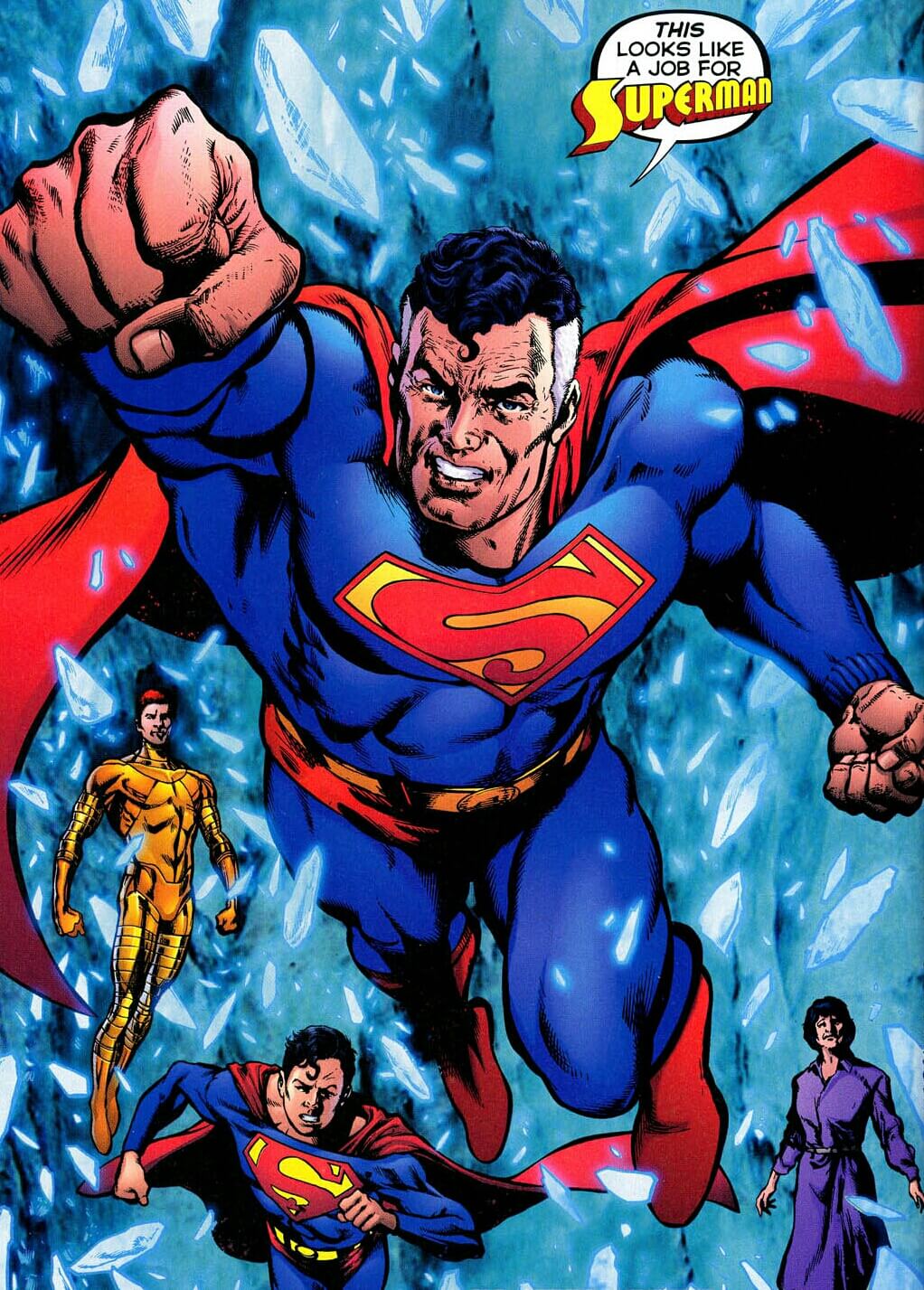
But Infinite Crisis arrived after the more analytical and deconstructive superhero stories of Alan Moore, Frank Miller, Grant Morrison and others had become genre cornerstones, while the readership would have also been familiar with such self-aware entertainment as Buffy the Vampire Slayer, Scream and Pulp Fiction. The story brings back the Golden Age Superman and pits him against the Superman of 2005, which it frames as a battle between different eras with different ideas as to what a superhero should be.
Infinite Crisis posits that the original Superman, along with the other denizens of Alexander Luthor’s techno-afterlife, have been keeping an eye on Earth and are unimpressed with what they see. A flashback shows them viewing a series of past plot points in DC continuity, with the initially hopeful aftermath of Crisis on Infinite Earths being followed by such events as the murder of Robin in 1988’s “Death in the Family”; the Man of Steel’s (temporary) passing in 1993’s “Death of Superman”; Bane breaking Batman’s back in 1994’s “Knightfall”; the Green Lantern becoming the evil Parallax in 1994; and the conflict between rival Wonder Women Artemis and Diana in 1995’s “The Challenge of Artemis”. After these come still more recent events: the deaths of Sue Dibny, Blue Beetle and Maxwell Lord.
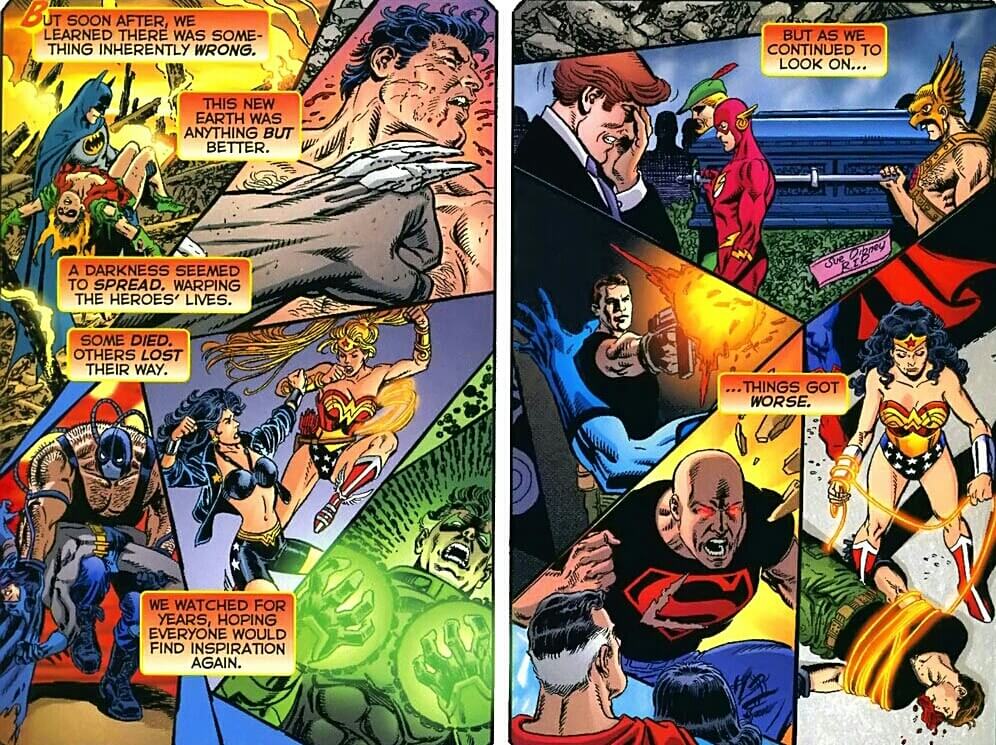
“This new Earth was anything but better”, says the older Superman. “A darkness seemed to spread, warping the heroes’ lives. Some died, others lost their way. We watched for years, hoping everyone would find inspiration again. But as we continued to look on – things got worse.” Having seen all of this, he concludes that Earth still needs him. So, too, does his version of Lois Lane, who is dying of old age as the techno-heaven weakens. His belief is that he can save Lois and bring new hope to humanity by restoring the Earth of the Golden Age.
In charting its battle between the Golden Age and the modern era, Infinite Crisis comes out on the side of the latter. It casts Superboy Prime and Alexander Luthor as outright villains who, as it turns out, are responsible for the atrocities seen in the four miniseries: it was they who corrupted Batman’s satellite, manipulated Spectre, united the villains and initiated the Rann-Thanagar war. All in all, an impressive rap sheet for two characters who, when last seen in 1985, had been good guys.
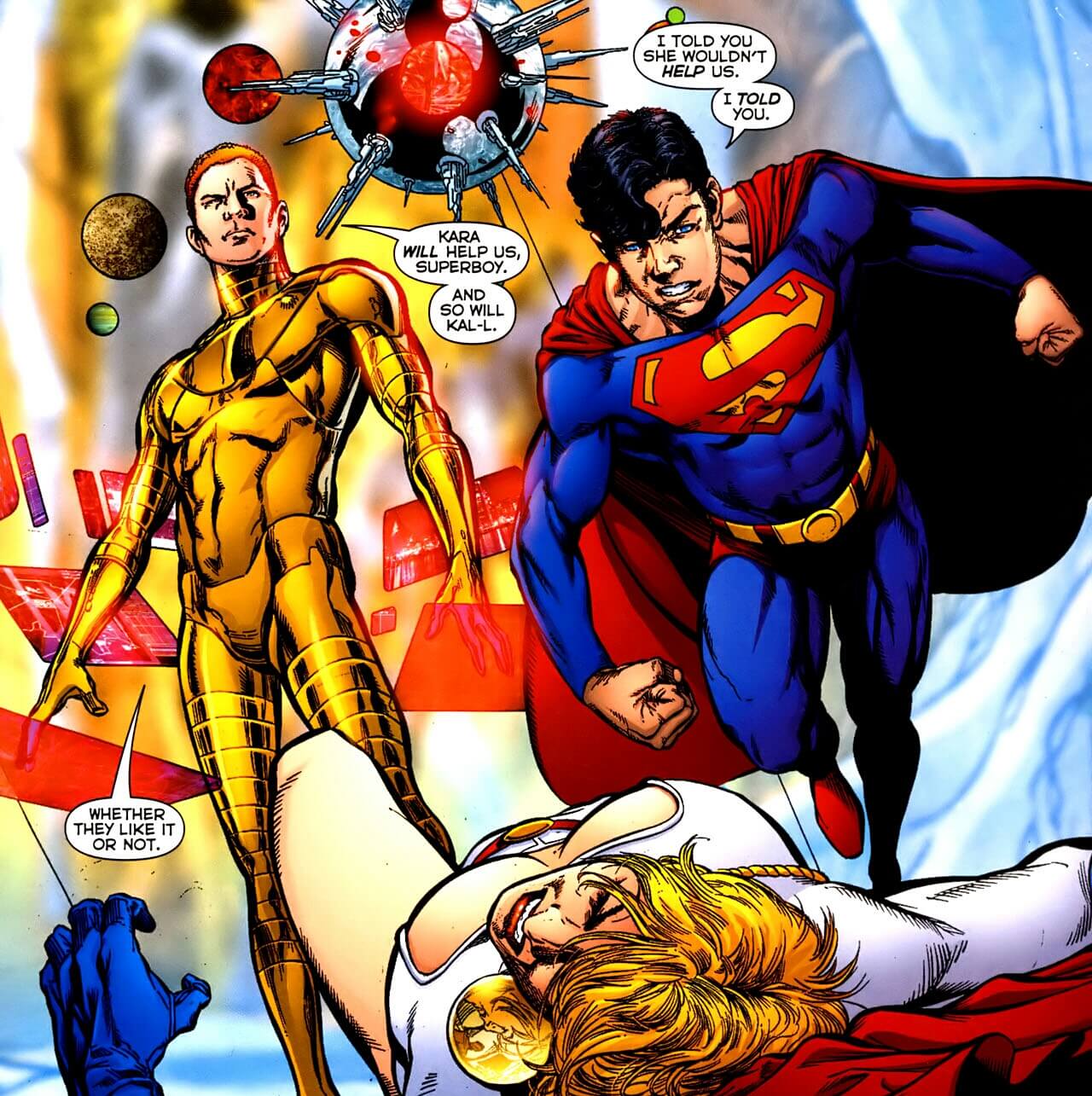
The Golden Age Superman – a product of a time when lines between good and evil were simpler – is oblivious to all of this, failing to notice what his two surrogate children – who originated in the era of Crisis on Infinite Earths, with all of its intricacies and inscrutabilities – have been doing behind his back.
The cast of Infinite Crisis extends well beyond this dispute between two superfamilies, and the series is not entirely free of the “tasty morsel” syndrome that blighted Crisis on Infinite Earths. One case is the scene in which Ragman asks Mr. Terrific how he can remain an atheist in a world crawling with demigods and divinities; another has Mr. Terrific and Black Lightning – both African-American superheroes – discuss why the latter felt the need to include “black” in his name. These scenes serve to tantalise rather than satisfy, offering glimpses of complexities that the story as a whole never explores.
For the most part, however, Infinite Crisis avoids this weakness by focusing on family dynamics. Families of one sort or another run through the comic, with almost all major or secondary characters defined by their family ties – or, in some cases, lack thereof. One subplot deals with the generational relationships between the multiple incarnations of the Flash. Another lends much-needed depth to Power Girl – a character often reduced to a boob joke – by examining her retconned history as the Earth-2 Supergirl, as she recovers her memories and is initiated into the family of the Golden Age Superman and Lois.
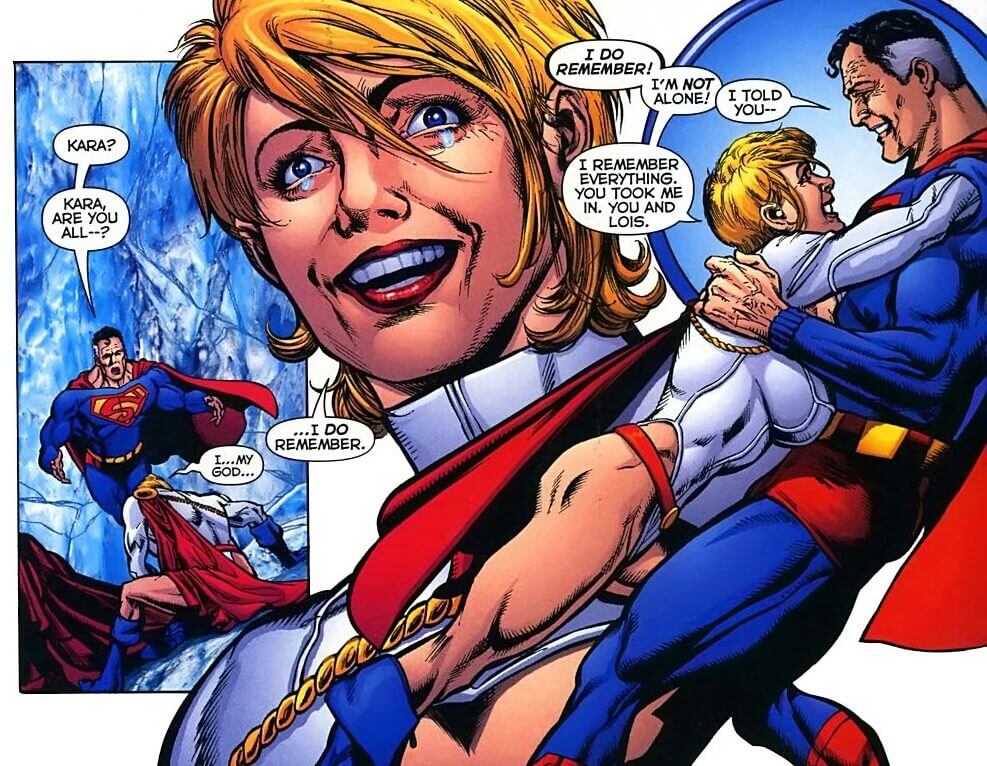
The older Superman – the grand patriarch of the family – is portrayed as fundamentally misguided, while younger generations are shown to be conflicted and unsure of themselves. The most level-headed characters, and the ones treated with the most respect by the story, are the two (grand)mother-figures: the Golden Age Lois Lane and Wonder Woman. The older Lois is given a touching send-off as she succumbs to old age, her death scene revealing that she has a clear picture of what is going on; this is preceded by a flashback to her heroic reporting in the forties, the only point in which Infinite Crisis that shows genuine fondness for the era of Golden Age comics.
After Lois dies, the Golden Age Wonder Woman turns up to meet her modern counterpart. This is a rare case of an elderly woman being cast as a superhero, and although the sequence has less substance than Lois’ death scene – much of it is spent filling in continuity gaps – it forms an important part in young Diana’s character arc, as she receives advise and reassurance from her older, wiser predecessor.
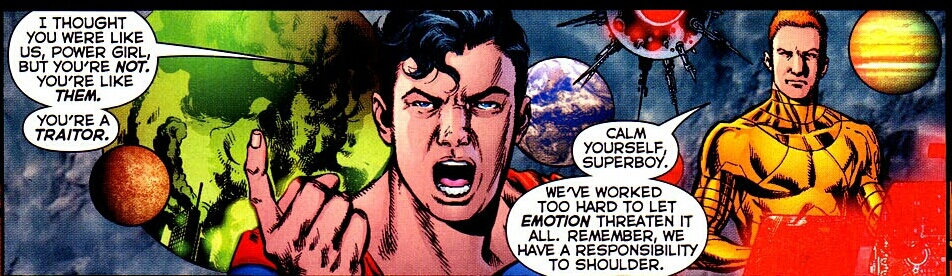
But the family is a dysfunctional one, and this is where the villains come in. Alexander Luthor and Superboy Prime are characterised as juvenile delinquents, between them embodying the two venerable youth stereotypes of the nerd and the jock. Luthor is cold, calculating, the brains of their scheme; Superboy Prime is impulsive, brash and bratty. Of the two it is Superboy Prime who gets the most character development – largely through contrast with the main Superboy, Connor Kent.
Connor is introduced into the story with the first issue. “A jaw clenches as he opens his shirt” says the narrator, who turns out to be the Golden Age Superman. “For a moment I see the man he could be instead of the boy he believes he us. But sadly, only for a moment.”
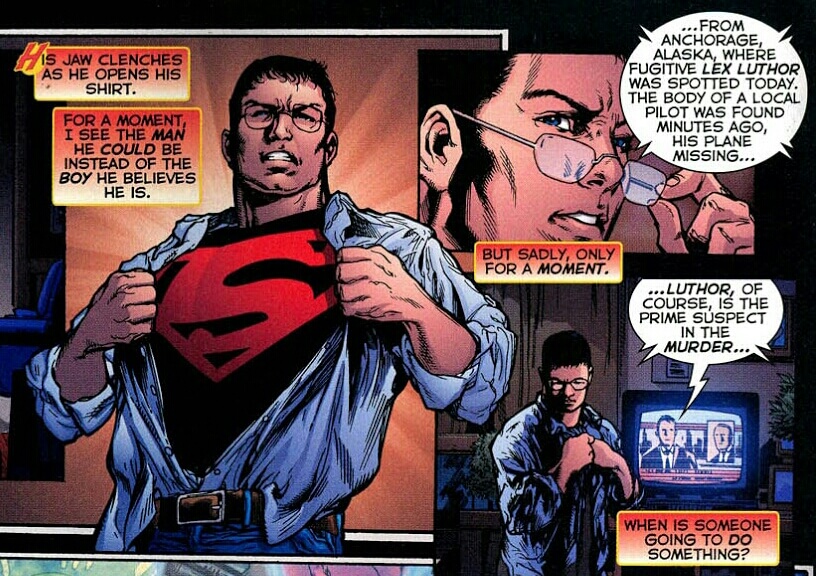
The rivalry between the two Superboys is established in issue 3. Superboy Prime, grilling Power Girl over her reluctance to bring back Earth-2, declares Earth-1 “a place full of… awful people. And their heroes are just as bad!” He then cites Connor as evidence, righteous indignation descending into petulance: “Especially him. Connor Kent has the life I always dreamed about. Parents and friends and a girl who loves him. And he’s not doing anything to help them! It’s not fair!”
In issue 4 – with Superboy Prime and Alexander Luthor having been established as villains – the two Superboys meet one another. After introducing himself to the Kent family as Connor’s replacement, Superboy Prime confronts his counterpart: “Admit that you’ve given up. Admit that it’s time for a Superboy who knows what right and wrong is… I’m the Superboy the world needs.”
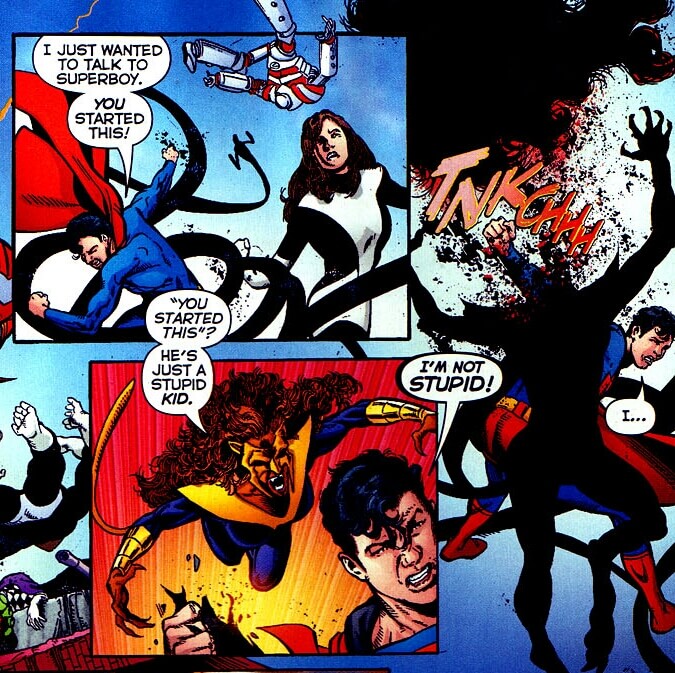
Connor receives backup from a crowd of other young superheroes, leading to a notorious sequence in which Superboy Prime – apparently unaware of his own strength – ends up decapitating Pantha, blasting Wildebeest and Bushido in half, freezing Red Star in ice and tearing off Risk’s arm. “You’re ruining everything!” he says during the carnage. “You’re ruining me! You’re making me like you!”
In a much later sequence, Superboy Prime gets a rematch with Connor: “Your time is over. We’re going to have good heroes again! When we bring back my Earth we’ll have real heroes! Heroes who are polite and brave and honest! And no one will ever know what I had to do to bring my Earth back.”
“I’m sick of this hypocrisy!” yells Connor. “What does that word even mean?” replies Superboy Prime. “You probably think you’re smart. You’re not.”
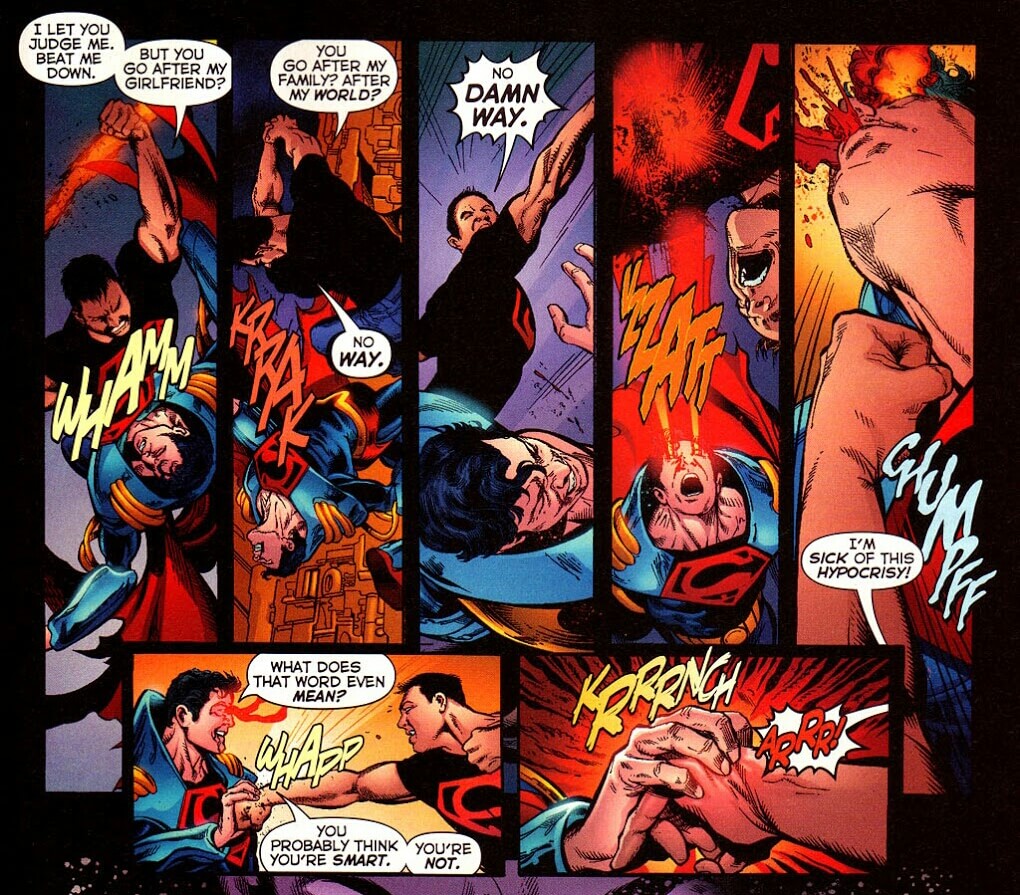
And yes, it is hard to argue that Superboy Prime is anything other than a hypocrite. After all, even though he blames his brutality on the corrupting influence of Earth-1, he is shown to have already committed multiple atrocities – even engineering an entire space war – before this corruption supposedly took place. In the conflict between Golden Age and Modern Age superheroes, Infinite Crisis completely sabotages the former party by associating it with the irredeemable Superboy Prime – a character who has little to do with Golden Age comics and is instead a pure product of the Modern Age and its love of brutality and shock.
Both Alexander Luthor and Superboy Prime receive power during the course of Infinite Crisis, largely thanks to technology left behind by the main villain of Crisis on Infinite Earths – the Anti-Monitor. Luthor, the super-nerd, has the scientific know-how to use this equipment and interfere with the multiverse, manifesting in various sequences simply as a giant pair of hands that manipulate planets – an obvious reference to a memorable scene in Crisis on Infinite Earths where aliens viewing the dawn of creation see two cosmic hands, presumably those of God, shaping the universe. The super-jock, on the other hand, wears the Anti-Monitor’s armour and gets a boost to his brute strength. Like Tetsuo in Akira, like the Regans, Damiens and Carries of horror fiction, these antagonists mark variations on the character type of the youth with inhuman powers and a lack of responsibility.
The final issue features an all-out battle between assorted heroes and the alliance of supercriminals from Villains United. Lesser heroes deal with lesser villains, as characters explain the continuity-alterations of the story (the current status of the Flash, the results of Alex Luthor’s tinkering with history). Meanwhile, the main heroes – Batman, Wonder Woman and the two Supermen – take on Superboy Prime and Alexander Luthor.
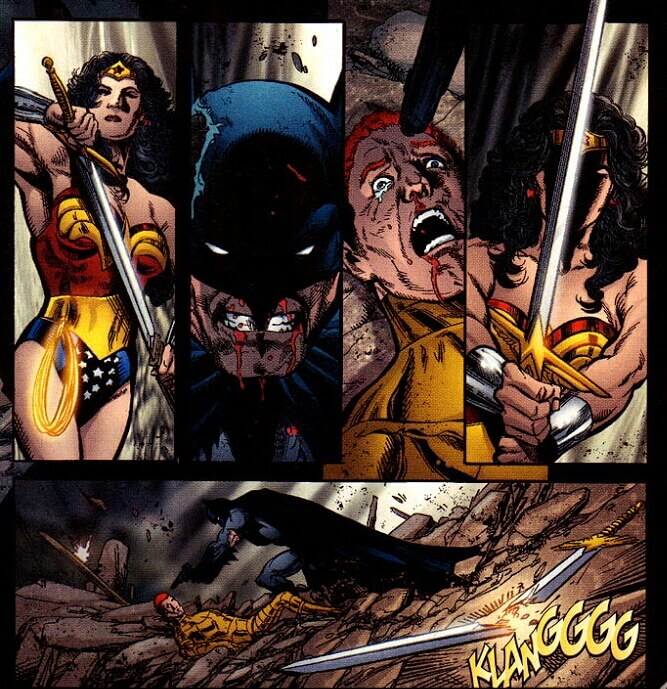
The family dynamics of the central characters remains paramount. Batman overpowers Alexander Luthor and holds him at gunpoint, ready to kill him; but then Wonder Woman arrives and symbolically breaks her sword before persuading Batman to spare the villain’s life. This is presented as the resolution of Wonder Woman’s character arc that began with her killing of Maxwell. Logically, the incident would not resolve her public image problems: the entire world saw Maxwell’s death, while only a few people in super-costumes saw Alexander being spared. But such concerns are irrelevant to Infinite Crisis: what matters is the bonding moment between Bruce and Diana, two foremost members of the Justice League family, as they mutually reaffirm their ethical code by sparing the villain. (Alexander is killed later on – but as it is the Joker who pulls the trigger, the heroes’ hands are left conveniently clean.)
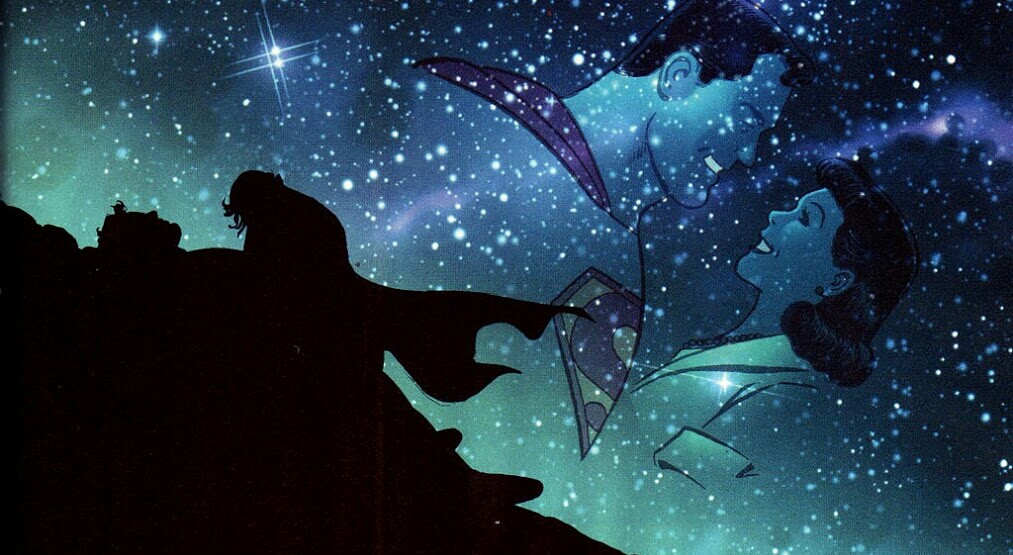
Meanwhile, the two Supermen take on Superboy Prime. The rogue son is defeated, but at the cost of the older Superman. His death is not played for gruesome shocks, however: the sequence ends with smiling, rejuvenated versions of the Golden Age Superman and Lois splashed out across the stars, indicating that the two have reached an afterlife higher than the faulty techno-heaven devised by Alexander Luthor.
The bittersweet deaths of the older Superman and Lois are aberrations in a series where character deaths are typically more brutal and callous. As well as Superboy Prime’s aforementioned killing spree, the story has Uncle Sam’s implicit death at the hands of a supervillain gang, Deathstroke impaling Phantom Lady, Bizarro murdering the Human Bomb, two shark-themed villains slaying Neptune Perkins, Spectre casually annihilating Star Sapphire, Black Adam gruesomely killing Psycho Pirate by punching his metal mask through the back of his head, along with various minor villains meeting their collective maker during the fight scenes.
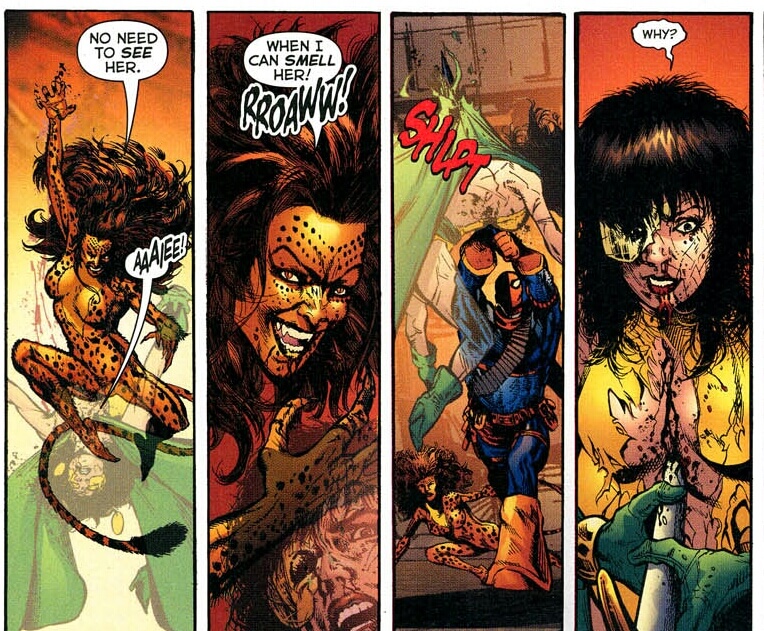
Crisis on Infinite Earths had a lot of death, as well, but – save for the Flash ageing to a skeleton at high speed – it was never so graphically macabre. Here, we see a clear example of how times had changed for superhero comics between 1985 and 2005. Writer Geoff Johns grew up in a more violent era of pop culture than the creators of Crisis on Infinite Earths, as Greg Rucka has acknowledged on his blog:
When I was working on 52, I half-jokingly asked Geoff Johns what it was with him and decapitations. If you’ve read his work, you’ll know what I’m talking about. Black Adam, in particular, had a penchant for removing the top, so to speak. His response was that he’d grown up playing Mortal Kombat. Fatalities were common, as he put it; a decapitation was de rigueur.
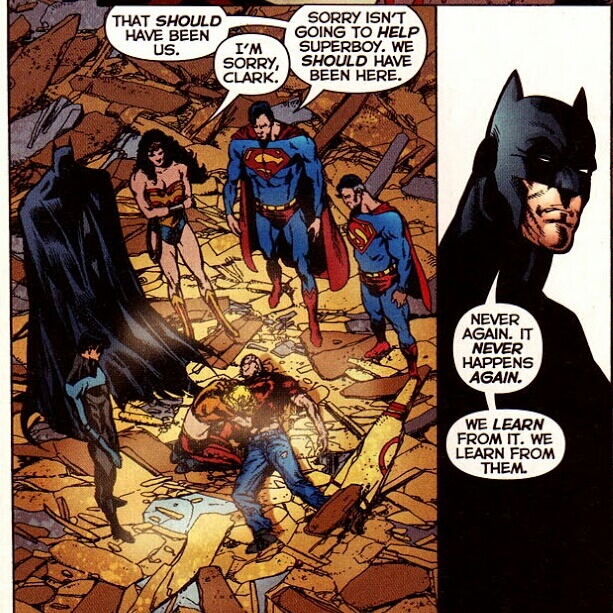
Amidst all of the death and destruction, of course, there is one passing that matters more than the others: the death of Connor Kent, who heroically sacrifices himself at the end of the penultimate issue in a fight with Superboy Prime, thereby proving himself the nobler of the two Superboys. The incident allows the surviving heroes a moment of reflection. “We should have been here”, says Superman. “Never again. It never happens again. We learn from it”, declares Batman. “I thought their Superboy was unworthy of the symbol I built”, muses the Golden Age Superman; “but I picked the wrong one to condone, and the wrong one to condemn.”
The death of Superboy is, of course, an attempt to recreate the death of Supergirl in Crisis on Infinite Earths, and it arguably improves on its model in terms of emotional weight. Given that Infinite Crisis is a family saga focused mainly on the Superman clan, and has an evil Superboy as one of its main villains, Connor Kent was the ideal character to be given a heroic last stand. On a more cynical level, Superboy was also something of a legal hot potato at the time, with the DC having been in a legal dispute with the heirs of Jerry Siegel over the character's ownership.
There are other endings in Infinite Crisis; some are brash and perhaps wasteful, like the destruction of Atlantis by the Spectre; others are melancholy, like Wonder Woman being forced to leave Themyscira behind forever (or, at least, until the next DC continuity shake-up). There are also new arrivals: Jaime Reyes takes over from the late Ted Kord as the Blue Beetle, while Crispus Allen becomes the new host for the Spectre. The series ends with Superman, Batman and Wonder Woman each deciding, for their own reasons, to retire from superheroics for a year – paving the way for 52, which follows the year without these three heroes.
Changes like these are part of any superhero event comic, and some are more superficial than others. With that in mind, what were the true changes represented by Infinite Crisis?
Crisis Averted?
In his introduction to the collected edition of Infinite Crisis, Dan DiDio relates the series to 9/11:
Remember, this story was crafted in a post 9/11 world at a time when most Americans were feeling vulnerable and in need of heroes. We saw a world were [sic] the human spirit was pushed to the limit, and against overwhelming odds, people persevered and heroes emerged – sadly, at he cost of their own lives. And although we work in fantasy, the question became “Should we expect less from comics’ greatest heroes?” The answer, of course, is “No.”
Certain sequences in Infinite Crisis, particularly Uncle Sam being beaten up and left for dead in the first issue, feel like conscious efforts to capture the post-9/11 mood. But on the whole, the event comes across as a response to a much smaller-scale occurrence in recent history: the shrinking profile of superhero comics.
When Crisis on Infinite Earths, was published, it had a substantial effect on the comics that were, in 1985, still the main home of the DC Universe. While superheroes had spread to films and television series, these were typically self-parodies (the 1966 Batman), written down for younger audiences (Superfriends), divested of the comics’ fantastic worldbuilding (the Incredible Hulk TV series) or appearing too sporadically to build a rich continuity (the Superman films), and most avoided character crossovers. The comics remained the only place to find a true DC Universe, and so the changes wrought by Crisis on Infinite Earths affected a significant area of pop culture.
But come 2005 things were very different. The television cartoons comprising the DC Animated Universe, from Batman: The Animated Series (1992-5) through to Justice League Unlimited (2004-6), had given the comics their first true rival in creating a fully-formed network of characters and storylines. For a large number of superhero fans, particularly millennials whose first exposure to many of these characters was through the cartoons, the definitive DC Universe was on television rather than comics.
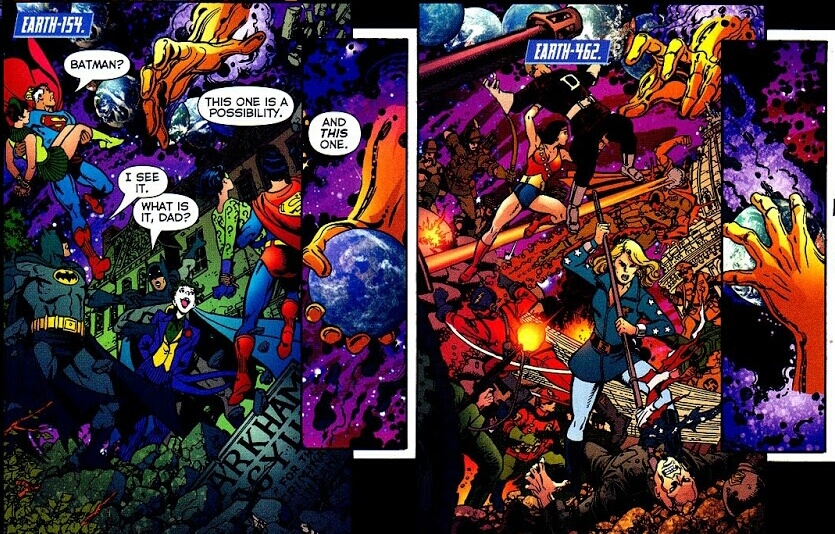
The point of Crisis on Infinite Earths was to make the DC Universe more appealing to new readers by abolishing the various alternate universes. Infinite Crisis, meanwhile, is about a plan to recreate the multiverse – and although that scheme appears to be foiled, the follow-up series 52 reveals that there are in fact dozens of other Earths, each with their own variation on the DC mythos. It could have been no other way: DC’s spread into film and TV, not to mention video games and prose fiction, ensured that there would always be multiple universes no matter what company editorial said.
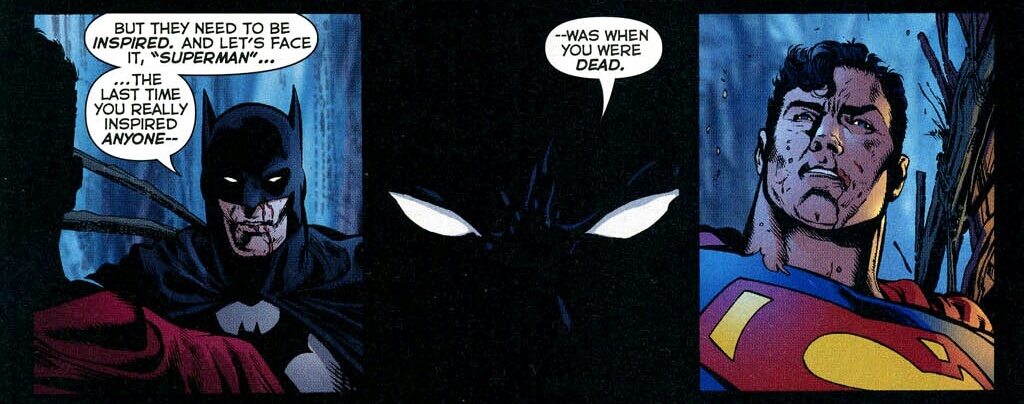
One of the most telling lines of dialogue in the series occurs when Batman claims that the last time Superman ever inspired him was when he was dead. In terms of the multimedia multiverse, this is an unfair conclusion: the animated Superman series that ran from 1996 to 2000 was well-received by its target audience, while Smallville was doing well enough in the ratings to be on its fifth season. But looking specifically at the comics, the assessment turns out to have merit. The “Death of Superman” event from 1993 may well have been the title’s highest point of cultural relevancy since the Silver Age.
The fight between the Modern Age and Golden Age Supermen is a red herring. The real reflected by Infinite Crisis is a conflict between DC heroes in comics and DC heroes in other media. On behalf of the former party, the series – and its attendant tie-ins – made a plea for survival. Through the Countdown to Infinite Crisis line-up, the event showcased a range of means that superhero comics might exist in the twenty-first century: by imitating Watchmen and Vertigo titles like Sandman; by shifting over to other genres including spy fiction and space opera; or by simply embracing colourful superheroics, as Villains United did.
Then came Infinite Crisis proper, with an answer of its own. It emphasised perhaps the only factor possessed by superhero comics that had not been successfully carried over into other media: generations’ worth of continuity – and the sprawling family saga that comes with it. But this comes at a cost, of course. Large chunks of Infinite Crisis will be impenetrable to readers who have not immersed themselves in DC continuity; if Crisis on Infinite Earths was meant to make the comics more appealing to newcomers, Infinite Crisis can be said to mark a complete reversal of this aim.
Whatever its merits or flaws, Infinite Crisis remains a pristine snapshot of superhero comics as they existed circa 2005: faced with an identity crisis, loaded with convoluted continuity, and yet still possessing a family of characters still maintaining their appeal decades after their creation.
Comments
Thanks for your comment and for catching that mistake. Fixed now!
2020-12-06 17:07:36 +0000 UTCThank you for this. I was out of reading comics by this point and have only gotten brief summaries of what happened. Now it seems what happened was that everything I liked about DC Comics was murdered and everything I loathe about current DC Comics and comics in general was promoted. Wow. This has cleared up so, so much. What an absolute disaster of a move in my opinion. Now I know why DC has basically rotted away to nothing. They took the developments of the 90's and early Image like style over substance, violence over reason, art over story, and anti-heroes over heroes and just went all-in on the decisions. They looked at Watchmen and apparently totally missed the point. They put Frank Miller's work on a pedestal so high it could never be questioned. I will never understand why they didn't see the success, redefining of the world, adoration from fans, and popularity of B:TAS, S:TAS, and Justice League/Unlimited and use that as their new model. I love the Golden Age, Silver Age, Bronze Age, and a very few select modern comics. This era, this decision is what poisoned the well for me. I would have killed for an Animated Series style universe makeover. Or a New Frontier one. Both had serious stories, fun stories, great direction, amazing art, and most importantly heart and stories to inspire and amaze. Infinite Crisis and its ilk? It just leaves me cold, empty and more shattered than DC's ensuing success or complete lack there of. I had some hopes for Rebirth... but they have faded and now Rebirth itself is dying. I truly hope that these things are seen as very painfully learned lessons by the new people in control and creators associated with the company and their properties. The money put into Snyder's visions doesn't give me a lot of hope though... (One slight issue I noticed. I believe these old heroes / new aliases are reversed: "There are also new arrivals: Crispus Allen takes over from the late Ted Kord as the Blue Beetle, while Jaime Reyes becomes the new host for the Spectre.")
Ivrione Moonshadow
2020-11-22 04:16:16 +0000 UTC