She Who Must Be Obeyed: Wonder Woman’s Secret Origin as Victorian Villainess
Added 2021-01-23 15:46:22 +0000 UTCBy Doris V. Sutherland
Somewhere in a remote corner of the world is a land known to outsiders only in legend. It is a matriarchy, ruled for thousands of years by a queen who has obtained the gift of immortality. The modern West eventually makes contact with this hidden land, leading to a clash of cultures. The matriarchy and its immortal queen have their own attitudes towards the concepts of power and obedience, towards the roles of men and women – attitudes that strike visitors from the outside as strange and different, yet also enticing.
This is the premise behind two influential pieces of fantasy fiction. One is the comic saga of Wonder Woman, which began in 1941; the other is H. Rider Haggard’s novel She: A History of Adventure, originally serialised in the 1880s. Each story was extremely influential, yet the two used their shared premise to opposite ends. Wonder Woman is a superhero who uses her powers to thwart evil forces; in Haggard’s novel, meanwhile, the immortal queen Ayesha is a cold-hearted and brutal despot known to her subjects as “She-who-must-be-obeyed” (an epithet that launched a thousand sitcom jokes).
Whereas Ayesha became the template for sundry villainesses, Wonder Woman remains one of the most enduring heroines of the popular imagination – but could the two seeming opposites be connected?
The Origin of Wonder Woman
The jump from Victorian fantasy antagonist to World War II superheroine is not quite as large as might first be thought.
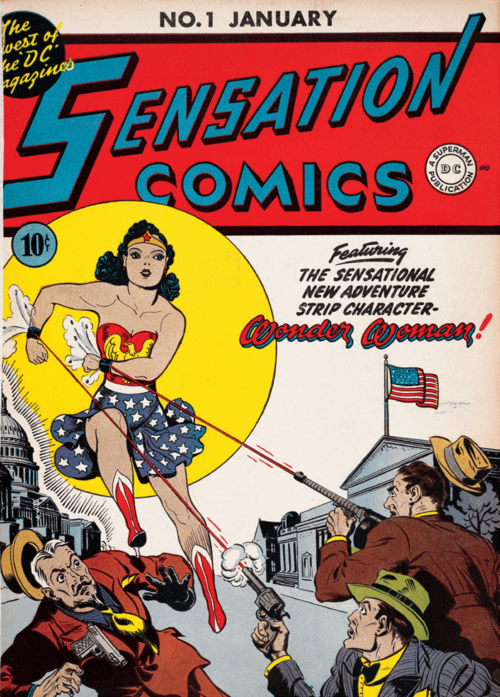
While comics of the Cold War decided upon radiation as the default origin for a superhuman, things were different in the Golden Age of the thirties and forties. Back then, superhero comics freely drew upon elements from myth, legend and fantasy literature as well as pulp science fiction to explain how their costumed protagonists came to be. Superman’s origin is a space-age update of Moses’ infancy. Captain Marvel’s role as a wizard’s apprentice echoes T. H. White’s stories of Merlin and the boy Arthur. The Green Arrow is a mash-up of Robin Hood and Robinson Crusoe. The Green Lantern originated as a crime-fighting Aladdin. Wonder Woman likewise emerged from a swirling pot of influences quite distinct from what we now think of as the superhero genre.
Wonder Woman’s costume – vaguely Grecian in aesthetic, but given a modern twist and finished off with the distinctly American motifs of an eagle and star spangles – owes something to propaganda imagery in which nations are personified as goddess-like women in classical attire (Columbia, Britannia and so forth). Her original illustrator H. G. Peters worked as a magazine illustrator during World War I, when such imagery was very much in vogue, and so would have been familiar with the tradition. Writer William Moulton Marston, meanwhile, will have had his own influences in creating the character, one obvious reference point being the Amazons of ancient Greek literature.
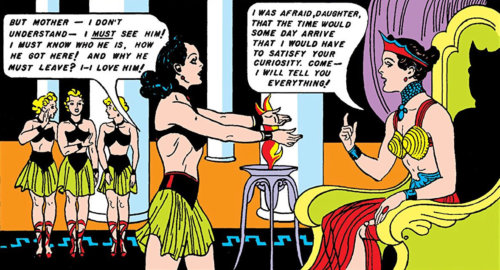
The first Wonder Woman story, published in All Star Comics #8, is in part a sequel to the most famous legend involving the Amazons: the theft of the Amazon queen Hippolyte’s girdle by Heracles. In Marston’s version of events the magic girdle granted strength to the Amazons, and without it they were sold into slavery. However, Hippolyte was eventually able to convince the goddess Aphrodite to return the girdle. Marston’s additions to Greek mythology culminate with the Amazons founding their own society away from men, where they live as immortals:
With the MAGIC GIDLE in my possession, it didn’t take us long to overcome our masters, the MEN—and taking form them their entire fleet, we set sail for another shoe, for it was Aphrodite’s condition that we leave the man-made world and establish a new wold of our own! Aphrodite also decreed that we must always wear these bracelets fashioned by our captors, as a reminder that we must always keep aloof from men.And so, after sailing the seas many days and many nights, we found Paradise Island and settled here to build a new World […] and as long as we remain on Paradise Island and I retain the MAGIC GIRDLE, we have the power of Eternal Life—so long as we do not permit ourselves to be again beguiled by men! We are indeed a race of Wonder Women!
Classical sources do not indicate that the Amazons have eternal life: Strabo’s Geographica states that they are forced to periodically meet with men so as to reproduce and maintain their number, while the Heracles narrative involves multiple Amazons being killed in battle. So, in depicting immortal Amazons secretly existing in a remote corner of the modern world, Marston was not drawing directly upon Greek mythology. It is entirely possible that he was instead taking inspiration from H. Rider Haggard’s She.
[caption id="attachment_133630" align="aligncenter" width="468"]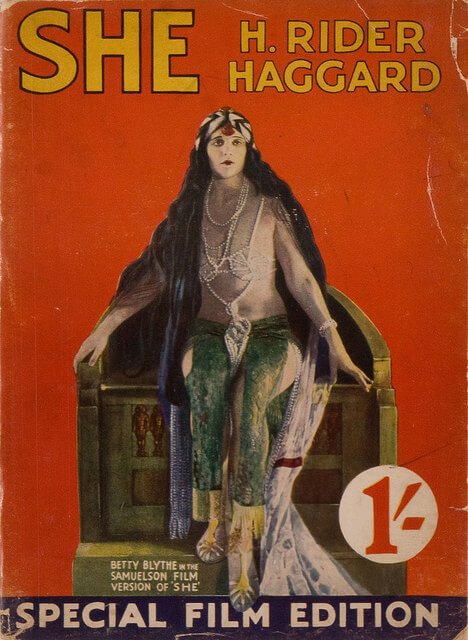 An edition of Haggard's novel published to tie in with the 1925 film version starring Betty Blythe.
After all, She was still very much part of popular culture when Wonder Woman debuted in 1941. The novel had long been a viable subject for films, with Haggard’s villainess having been portrayed by Marguerite Snow in 1911, Alice Delysia in 1916, Valeska Suratt in 1917, Betty Blythe in 1925 and Helen Gahagan in 1935. Haggard wrote three sequels, the last of which – Wisdom's Daughter – completed publication in 1924, and the series remained in print for decades. Pulp authors like Edgar Rice Burroughs and Robert E. Howard used Ayesha-esque antagonists in their stories: Tarzan’s second adventure sent him to a lost city ruled by the high priestess La, while Conan the Barbarian went up against the evil witch-queen Salome and the immortal villainess Akivasha. Universal’s 1932 film The Mummy is largely a gender-swapped reworking of Haggard’s story, with Boris Karloff as a male Ayesha. Even Disney’s Snow White and the Seven Dwarfs owes an indirect debt to Haggard, as its evil queen was clearly based upon Helen Gahagan’s portrayal of She-who-must-be-obeyed from two years earlier.
So, to get a fuller understanding of Wonder Woman’s origins, it will be a good idea to take a close look at She.
H. Rider Haggard’s She
In Haggard’s novel, a band of explorers – the principal members being narrator Horace Holly and his young companion Leo Vincey – travel to a country in southeast Africa populated by a people called the Amahagger. This society turns out to be matriarchal:
It then appeared that, in direct opposition to the habits of almost every other savage race in the world, women among the Amahagger are not only upon terms of perfect equality with the men, but are not held to them by any binding ties. Descent is traced only through the line of the mother, and while individuals are as proud of a long and superior female ancestry as we are of our families in Europe, they never pay attention to, or even acknowledge, any man as their father, even when their male parentage is perfectly well known.
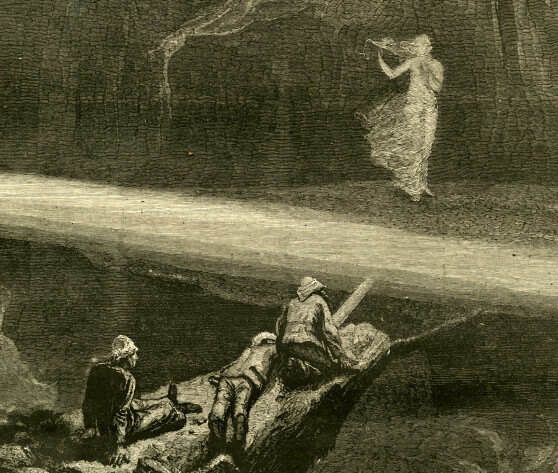
But unlike Paradise Island, this lost world is no utopia. From the start its woman-centric culture is uncomfortable to Holly, who describes himself as “a bit of a misogynist” – something implied have arisen from women spurning him for his ugly appearance throughout his life (in modern parlance he might be termed an incel). His companion Job similarly dislikes women, and Holly describes with amusement an incident in which Job is forcibly embraced and kissed by an Amahagger maiden. In a later scene another companion, Mahomed, receives what appears to be more affection from a native woman – but this time the effect is disturbing to the male observers:
Then came a pause, and I noticed, with horror and a rising of the hair, that the woman next to Mahomed began to fondle him, patting his cheeks and calling him by names of endearment while her fierce eyes played up and down his trembling form. I do not know why the sight frightened me so, but it did frighten us all dreadful, especially Leo. The caressing was so snake-like, and so evidently a part of some ghastly formula that had to be hone through.
It turns out that this routine is intended to lull the victim into a contented frame of mind while his captors place a red-hot pot onto his head, in preparation for a cannibalistic feast. Holly shoots the woman and accidentally kills Mahomed at the same time; he reassures himself that, in doing so, he saved his companion from a still worse death.
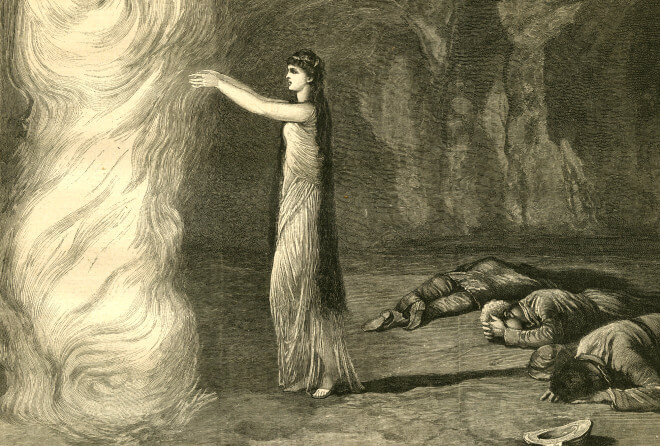
Billali, a native man, details what it is like for his gender in such a culture: “In this country the women do what they please. We worship them, and give them their way, because without them the world could not go on; they are the source of life.” Haggard – like his protagonist – appears to be at best ambivalent about the notion of a matriarchal society, and allows the male Amahagger a means of retribution should the women become too oppressive. This is revealed when Billali continues his account:
“We worship them,” he went on, “up to a point, till at last they get unbearable, which,” he added. “they do about every second generation.”
“And then what do you do?” I asked, with curiosity.
“Then” he answered, with a fant smile, “we rise, and kill the old ones as an example to the young ones, and to show them that we are the strongest. My poor wife was killed in that way three years ago. It was very sad, but to tell thee the truth, my son, life has been happier since, for my age protects me from the young ones.”
[caption id="attachment_133618" align="aligncenter" width="635"]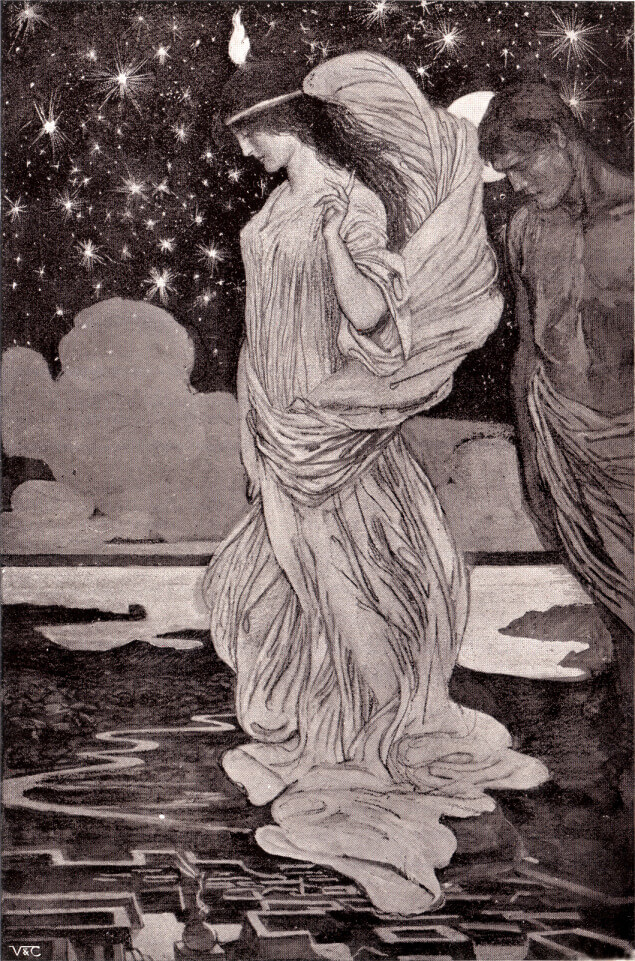 Ayesha, as depicted in the 1905 sequel Ayesha, The Return of She.[/caption]
The ruler of the Amahagger – the millennia-old queen, Ayesha, She-who-must-be-obeyed – comes to embody both the allure and the horror with which Haggard views the matriarchal society:
“Why art thou so frightened, stranger?” asked the sweet voice again—a voice which seemed to draw the heart out of me, like the strains of softest music. “Is there that about me that should affright a man? Then surely are men changed from what they used to be!” And with a little coquettish movement she turned herself, and held up one arm, so as to show all her liveliness and the rich hair of raven blackness that streamed in soft ripples down her snowy robes, almost to her sandalled feet.
“It is thy beauty that makes me fear, oh Queen,” I answered humbly, scarcely knowing what to say...
Holly falls upon his knees before She-who-must-be-obeyed (“I worshipped her as never woman was worshipped”). But it is his younger companion Leo who attracts Ayesha’s attention: she believes him to be a reincarnation of her ancient lover Kallikrates. So determined is she to retain Leo’s heart that, when an Amahagger maiden named Ustane shows interest in him, Ayesha coldly kills her. Ayesha is evil, then; but as Holly ponders at the end of the novel, “alas! Such is the frailty of the human heart, her wickedness had not detracted from her charm. Indeed, I am by no means certain that it did not add to it.”
H. Rider Haggard’s novel has many obvious differences from Marston and Peters’ Wonder Woman comics, but it also has a number of striking similarities. Where Diana’s culture is Greco-Roman in inspiration, Ayesha is said to be of Arab extraction – and yet she picks up a connection to Greek mythology when Holly compares her to Circe. Like Diana, Ayesha has superpowers: even aside from her elongated life, there is a scene where she stares at Ustane and raises an arm at her, at which point the unfortunate maiden is “blasted into death by some mysterious electric agency or overwhelming will-force whereof the dread She had command.”
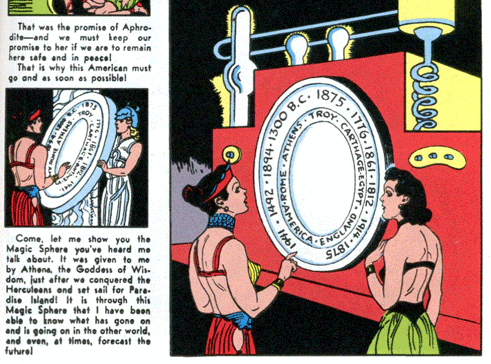
The Paradise Island of the early Wonder Woman comics is – despite its classical trappings – a technologically advanced society: the Amazons are able to keep an eye on world affairs via the oddly-named “Magic Sphere”, a circular screen built into what is clearly a large electronic apparatus that would have been at home on the set of Metropolis or the cover to Astounding Stories of Super-Science. This science fictional element may seem a strange addition to Diana’s mythological retreat – until we consider that Ayesha’s domain similarly blurs the line between magic and science. She has access to a number of seemingly supernatural phenomena (including a pool of water that can be used to summon up images, serving the same function as the Amazons’ “Magic Sphere”) which she denies are magical: “There is no such thing as magic, though there is such a thing as a knowledge of the secrets of nature”. Holly describes her as “a great chemist” who “had one of the caves fitted up as a laboratory”.
Even Wonder Woman’s career as a superheroic adventurer has precedent of sorts in the machinations of Ayesha. In her World War II adventures Diana’s heroism is defined in explicitly geopolitical terms, aligning her with America (and the democratic world in general) against the Axis forces, as these excerpts from the first five issues of Sensation Comics make clear:
“[T]he Amazon maid Diana fell in love with Captain Trevor, and decided to bring him back to America and help him wage battle for freedom, democracy, and womankind thru-out the world!”
“Wonder Woman brings to America a new hope for salvation from Old World evils, conquest and aggression!”
“Wonder Woman leads the invincible youth of America against the threatening forces of treachery, death and destruction.”
“[S]he is determined to frustrate the enemies of America and frustrate their insidious plans”
“Wonder Woman has amazed the world with her fears of daring and courage in the cause of democracy, justice and all womankind!”
In Haggard’s She, meanwhile, Ayesha offers to travel back to England with Leo, overthrow Queen Victoria and rule the country alongside her new husband. Yes, the end goals are very different – Wonder Woman fights for democracy, Ayesha envisions an absolute monarchy – but the starting points are remarkably similar. Each story envisions its goddess-like title character travelling into the modern West accompanied by her blond male beau and using her superhuman gifts to reshape the world’s political make-up.
Diana’s Sisters: Camilla and Fantomah
If Wonder Woman started life as an attempt to rework Haggard’s She-who-must-be-obeyed into a comic heroine, she was not the first of her kind. More than a year before Diana made debut, Jungle Comics – an anthology published by Fiction House – had already introduced not one but two heroines derived from Ayesha.
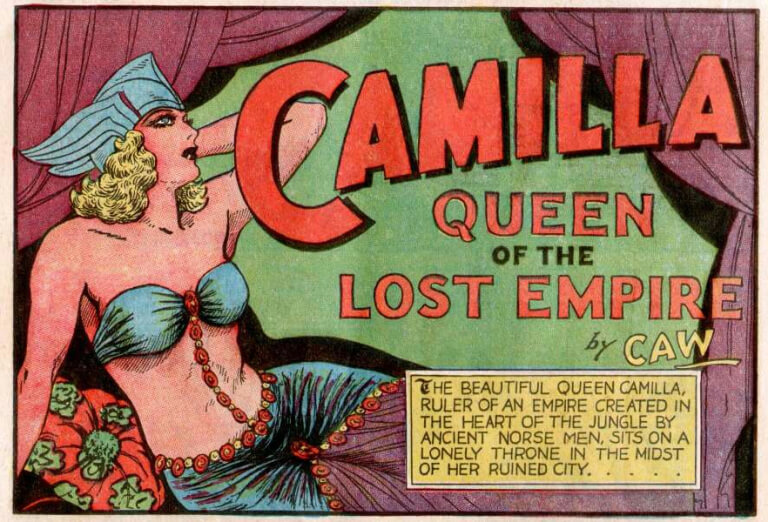
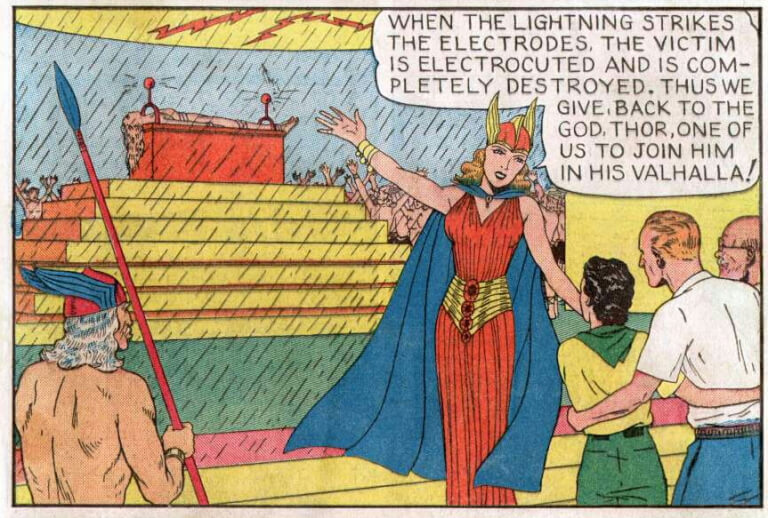
The first of these characters is Camilla, Queen of the Lost Empire, whose opening story in Jungle Comics #1 (cover-dated January 1940) is a truncated and somewhat garbled – yet still recognisable – retelling of Haggard’s She. The strip depicts “a lost civilization in Africa, composed of the same Norsemen who went there during the crusades and who have found the secret of eternal life” which is discovered by young scientist Jon Dale, older researcher Dr. Birch and the doctor’s daughter Ruth. They are greeted by the ruler of the city, Queen Camilla, who reveals that her people obtain eternal life from a secret formula mixed into a sulphur spring. Camilla also reveals that her civilisation practices daily human sacrifice, placing their victims below conductors in the belief that lightning-strikes will transport them to Thor in Valhalla. (Despite her ostensible Norse origins, Camilla bears the name of an Amazon-like character in Virgil’s Aeneid).
Camilla tries to sacrifice Ruth, but for reasons never explained the lightning fails to kill her and the queen subsequently loses her eternal youth, rapidly dying of old age. Jon Dale then fights off Camilla’s angered ex-subjects and finally destroys the city altogether by throwing a burning torch into the sulphur pit. He escapes with the formula for eternal life, but decides to discard it: “We should be satisfied with the life God has given us, and not try to improve on His wisdom!”
Jungle Comics #2 includes what would now be termed a reboot of the Camilla strip. Here, the immortal queen is no longer a Norsewoman in Wagnerian garb but a descendant of Genghis Khan (Greek, Norse, Mongolian – cultural backdrops are interchangeable to Ayesha’s comic-book daughters). Instead of Vikings, she rules over a tribe of blue-skinned men. While the original Camilla’s kingdom had no discernable technology beyond lightning conductors, the rebooted Camilla has access to ray guns, remote-controlled aircraft and even space flight, which she uses as a method of execution (“You shall die in one of our flexodium torpedoes hurled into space!”)
Subsequent issues bring back the original Norse Camilla, ignoring both her death and the reboot, and reunited her with the first story’s protagonists Jon and Ruth. The story in Jungle Comics #4 ends with Camilla seeing the error of her ways and evolving into a benevolent ruler; after this, she becomes the protagonist of the strip, the stories focusing on the swashbuckling monarch’s efforts to defend her city and subjects.
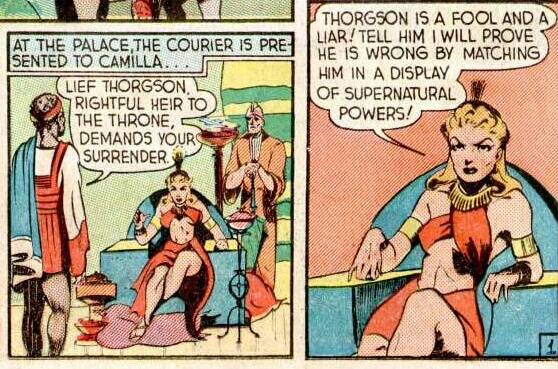
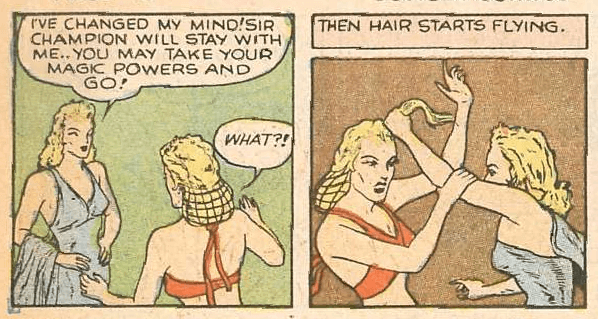
The exploits of the redeemed Camilla vary considerably depending on the present creative team. At some points the strip is a sword-and-sorcery saga, with Camilla encountering supernatural horrors and rival lost kingdoms (along with the occasional science fiction gadget). At other times Camilla stars in a pseudo-historical strip about Vikings exploring Africa. One thing that remains largely consistent, however, is the reluctance of the creators to allow Camilla centre stage: she is accompanied by a generically-named male warrior (Eric in the Viking-oriented stories, Sir Champion in the sword-and-sorcery interpretation) who does much of the heavy lifting, Camilla’s magical powers forgotten. The exception proving the rule is in Jungle Comics #13, where a confrontation between Camilla and an evil witch culminates in a hair-pulling cat-fight.
The other Ayesha-like heroine to feature in Jungle Comics was Fantomah, Mystery Woman of the Jungle, originally written and drawn by Fletcher Hanks under the pen name Barclay Flagg. While the debt to Haggard was not quite as obvious as with Camilla, given the level of popularity that She and its adaptations retained at this point it seems more likely than not that Hanks had Ayesha in mind when he came up with the character – although it has to be said, his own notoriously bizarre imagination also played a major part in the creation of Fantomah.
Fantomah is a beautiful blonde woman who made her debut wearing only a loose transparent garment; somebody involved with the comic appears to have decided that this was immodest, and she soon took to wearing a black swimsuit underneath. A shapeshifter, she can also appear variously as a floating head, a skeleton, a floating skull or a skull-faced woman (Fletcher Hanks was, according to his son, an abusive drunkard who once hit his wife so hard that he broke the bones in her face and refused to let her go to hospital, so there is much here for an armchair psychologist to ponder.) Hanks never deigned to give Fantomah a backstory: she is simply a white woman with supernatural powers who spends her time protecting an African jungle.
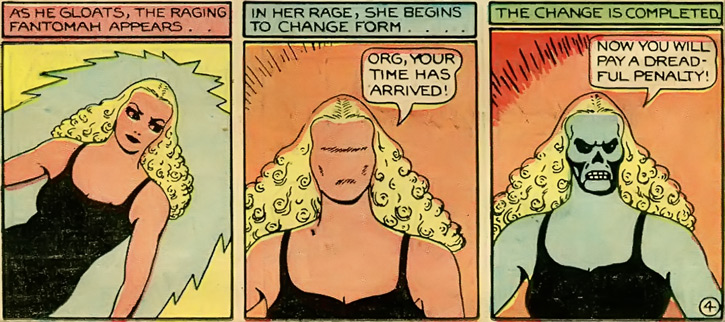
Her first appearance in Jungle Comics #2 is comparatively tame: when a pair of ivory poachers infiltrate the fabled elephants’ graveyard, Fantomah traps them so that they must die alongside the pachyderms. In later stories she goes up against rather more out-there villains including an army of resurrected mummies led by a mummy scientist, a band of glowing acrobats who ride standing on the backs of tigers, and a horde of man-made “chemical creatures” that are invisible except for their gigantic claws. But – as is generally the case with Hanks’ comics – the most remarkable aspect of Fantomah’s exploits is her line in surreally elaborate punishments.
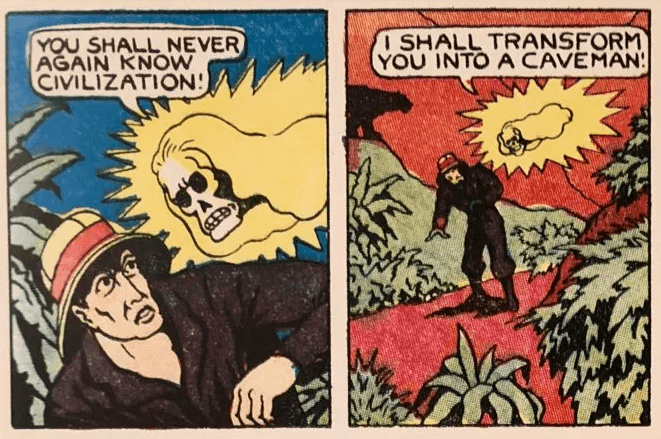
Two robbers who infiltrate a lost city of gold are transformed into weird green creatures, resembling the offspring of the Creature from the Black Lagoon and a praying mantis, before being sent home in their plane (“You have defiled the jungle’s sacred city, so you shall fly back to your own land as objects o disgrace!”) A scientist bent on world domination is torn limb from limb by his own “demonized army of gorillas”. A wrongdoer who plans “to wreck civilization” suffers the ironic punishment of being turned into a caveman. The army of an unspecified Axis power have their parachutes torn open by levitating lions. Some villains are marooned on asteroids; others are stranded in hellish underground realms inhabited by green-skinned ogre-like beings (“You shall become one of them, and eat mud and fire for the rest of you days!”)
Hanks provided fourteen Fantomah strips, after which her adventures were continued by other hands. At the same time, the stories became markedly less strange: Fantomah’s powers were reduced to little more than the ability to communicate with animals and teleport to where the plot demanded, while the threats she faced became the standard fare found in any other Tarzan-influenced comic (witch doctors, slavers, tribal conflicts and the like).
In a curious turn of events, Camilla and Fantomah underwent a further retooling that amounted to the two characters changing places. Fantomah was rebranded as “Fantomah, Daughter of the Pharaohs” and cast as the ruler of a lost Egyptian kingdom, while Camilla slipped into a zebra-skin garment and became a generic jungle girl who starred in Tarzan-like vine-swinging exploits.
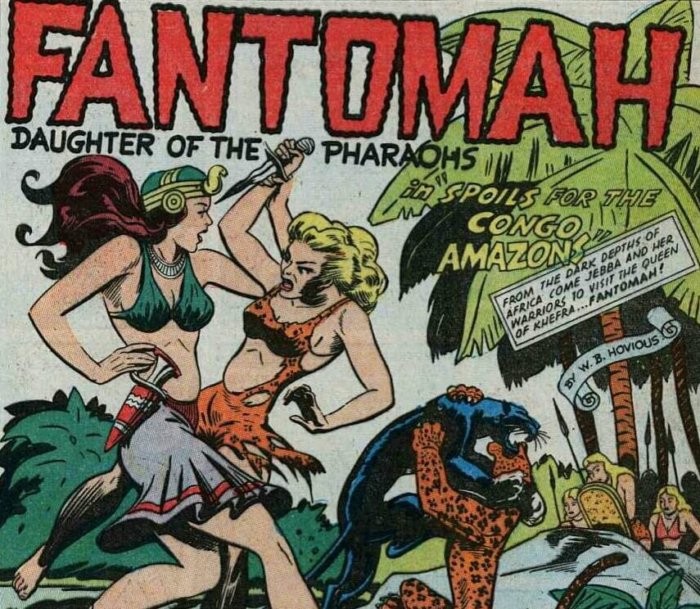
The two heroines had fairly respectable innings as back-up characters – particularly Camilla, who survived to the very last issue of Jungle Comics in 1954. But neither attempt to rework Ayesha into a comic heroine had anywhere near the staying power of their younger sister, Wonder Woman.
From Ayesha to Wonder Woman
It is not hard to see why Camilla and Fantomah failed to catch on: they are by turns either too obviously derivative (early Camilla), too bizarre (early Fantomah) or too vaguely defined (later versions of either character). But this still leaves the question of why Wonder Woman succeeded: what vital spark did Diana possess that her rival Ayesha-alikes lacked?
One prossibility is that Marston and Peters’ heroine showed a greater understanding of what made Ayesha work as a character than did Fantomah or Camilla. The precise quality that made Ayesha memorable as a villainess contributes to Wonder Woman’s status as a hero: Diana, like Ayesha, is She-who-must-be-obeyed.
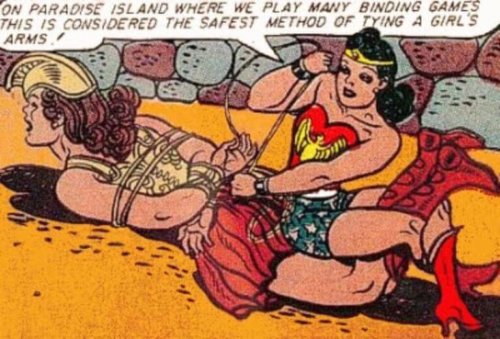
The early Wonder Woman comics make heavy use of situations in which one character is placed at another’s mercy. Granted, this is partly because protagonists escaping captivity and antagonists being apprehended are some of the most basic elements of adventure stories: it should not be too surprising that Wonder Woman’s exploits often include her tying up a villain or being bound and gagged herself. However, the comic’s bondage imagery goes rather further than allegiance to genre convention.
Sensation Comics #6 has an iconic story in which Diana and the other Amazons are shown playing a curious game that involves riding on the backs of giant kangaroos and trying to apprehend each other with lassos (“Let’s see you wiggle out of this tie-up, girl-friend!” “I can’t – I surrender!”) Wonder Woman wins the contest and is rewarded with her magic lasso; in later stories this implement would more specific ability of preventing the captive from lying, but at this point in the comic’s history, it compels obedience in general. “Having proved thyself bound by love and wisdom, we give thee power to control others!” says the goddess Aphrodite. “Whomsoever thy magic lasso binds must obey thee!” Diana immediately tries it out on a fellow Amazon.
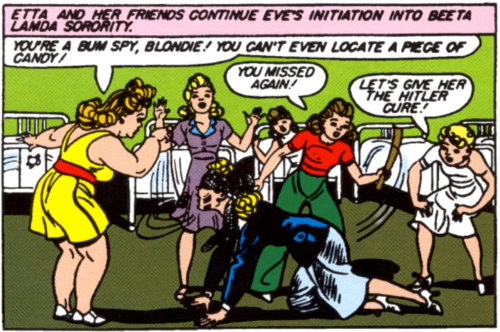
Meanwhile, Diana’s college-girl sidekicks – led by the portly Etta Candy – have a preoccupation with flagellation. They are particularly fond of whacking sorority neophytes and the occasional villain in the backside (“Woo-woo! Eve got away! Come on, girls! Bring your ropes and paddles!”) The villains naturally get in on the action as well: one early antagonist, Baroness Paula von Gunther, drugs and hypnotises young women to become her servants (“I am the slave of the baroness – she is my mistress – she commands, I obey—“) When Wonder Woman is given a limitation to her powers – an analogue to the Kryptonite that would later be added to the Superman mythos – it turns out to involve bondage: “Daughter, if any man welds chains on your bracelets, you will become weak as we Amazons were when we surrendered to Hercules and his Greeks”.
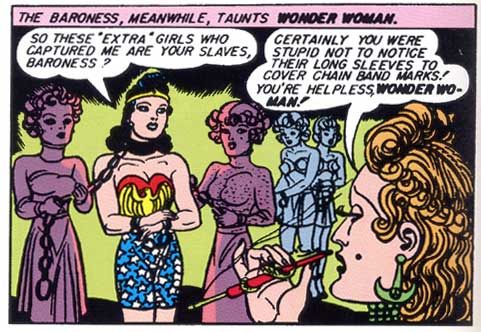
So, both William Moulton Marston and H. Rider Haggard appear to have been fascinated by the image of the domineering woman. But this fascination took a different form for each author – in large part because of their conflicting attitudes towards gender.
In She, Haggard displays a distinctly cynical view of relations between men and women. “[M]an can be bought with woman’s beauty, if it be but beautiful enough; and woman’s beauty can be ever bought with gold, if only there be gold enough” remarks Ayesha. “So was it in my day, and so it will be to the end of time. The world is a great mart, my Holly, where all things are for sale to whom who bids the highest in the currency of our desires.”
These are the words of a cold-blooded villainess, granted, but the cynicism extends to protagonist Holly. This is evident when he contemplates whether it would be right for his young companion Leo to marry Ayesha: “True, in uniting himself to this dread woman, he would place his life under the influence of a mysterious creature of evil tendencies, but then that would be likely enough to happen to him in any ordinary marriage.”
At the conclusion of the novel, Ayesha enters the mysterious flame which, in the past, has rejuvenated her. However, this time the process backfires and causes Ayesha to rapidly age into a withered, mummy-like form before perishing. Holly wonders afterwards if Ayesha might return from the dead, and is disturbed by the thought that she might return not as her beautiful, regal self, but in her wizened, shrivelled guise. At this point, we again see Haggard’s cynical view on relationships between men and women.
“What a terrifying reflection it is, by the way, that nearly all our deep love for women who are not out kindred depends—at any rate, in the first instance—upon their personal appearance”, remarks Holly. “If we lost them, and found them again dreadful to look on, though otherwise they were the very same, should we still love them?” The subtext of She is that a woman may be beautiful, alluring, and intimidating – but not much else.
William Moulton Marston, meanwhile, had a very different perspective.
The Psychology of Wonder Woman
A professional psychologist, Marston’s pre-Wonder Woman work includes the books Emotions of Normal People (1928) and Integrative Psychology (1931). Relationships between the genders were not only key to Marston’s psychological theories, they were also central to a utopian belief that he held – and, like all utopian thinkers, Marston’s ideas appear to subsequent generations both strikingly forward-looking and drastically dated. His main thesis was that world peace shall be achieved when men submit to women, and he had an intricate set of ideas as to what shape this submission should take.
After entering the world of comics, Marston used his position as a respectable public intellectual to help improve the image of this much-maligned medium. The August 14 1942 issue of Family Circle magazine published a piece entitled “Our Women Are Our Future” in which journalist Olive Reed describes an interview with Marston about the beliefs embodied in his Wonder Woman comics. In reality, Olive Reed is a fictitious character and the entire “interview” is simply a puff piece penned by Marston himself. This, if anything, makes the article all the more significant: Marston’s statements here are not merely off-the-cuff responses to the probing of an interviewer, but a considered attempt to intdroduce the philosophy behind Wonder Woman to the public.
The imagined conversation has Olive, who despairs of the war, asking Marston if men will ever stop fighting. “Oh, yes” replies the comic author. “But not until women control men”. He then goes into more detail about his theory:
“[T]he trend toward male acceptance of female love power which [Wonder Woman] represents indicates that the first psychological step has actually been taken. Boys, young and old, satisfy their wish thoughts by reading comics. If they go crazy over Wonder Woman, it means they're longing for a beautiful, exciting girl who's stronger than they are. By their comics tastes ye shall know them! Tell me anybody's preference in story strips and I'll tell you his subconscious desires. These simple, highly imaginative picture stories satisfy longings that ordinary daily life thwarts and denies. Superman and the army of male comics characters who resemble him satisfy the simple desire to be stronger and more powerful than anybody else. Wonder Woman satisfies the subconscious, elaborately disguised desire of males to be mastered by a woman who loves them."
Skeptical Olive suggests that this desire is no more than a boy’s attraction to his mother, something that ends with adolescence. Marston concedes her first point, but not the second: "They don't get over it at any age. Normal men retain their childish longing for a woman to mother them. At adolescence a new desire is added. They want a girl to allure them. When you put these two together, you have the typical male yearning that Wonder Woman satisfies."
Marston goes on to talk about “the great increase in the strength of women – physical, economic, mental” that arose from the First World War (an event that occurred, significantly, between the publication of She and the debut of Wonder Woman). Olive protests that, in reality, women do not have the bullet-repelling bracelets or magic lasso of obedience that Diana carries on her missions; but Marston begs to differ:
"Of course all women have those two powers. Wonder Woman is actually a dramatized symbol of her sex. She's true to life – true to the universal characteristics of women everywhere. Her magic lasso is merely a symbol of feminine charm, allure, oomph, attraction every woman uses that power on people of both sexes whom she wants to influence or control in any way. Instead of tossing a rope, the average woman tosses words, glances, gestures, laughter, and vivacious behavior. If her aim is accurate, she snares the attention of her would-be victim, man or woman, and proceeds to bind him or her with her charm."
Marston’s theories touch upon current affairs. He compares Wonder Woman’s lasso not only to the inherent gifts of all women, but also to the charisma and skilled oratory of Roosevelt and Churchill; meanwhile, he describes his comic-book Amazons as having been freed from “chains of the Hitler type”. Finally, he reaffirms his earlier statement that world peace depends upon the emancipation of women. “When women rule, there won't be any more [wars] because the girls won't want to waste time killing men […] Women are nature-endowed soldiers of Aphrodite, goddess of love and beauty, and theirs is the only conquering army to which men will permanently submit”. After the interview, Olive heads back home “to spread joy among all the lucky males I could rope in with my magic-lariat charm.”
Nobody can pretend that Marston’s words have aged well. Since his time, the likes of Margaret Thatcher and Hillary Clinton have demonstrated that women in power are capable of being just as hawkish as their male counterparts; meanwhile, the talk of men eagerly submitting to strong women (along with the bondage imagery in the Wonder Woman comics) possibly tells us more about circumstances in Marston’s bedroom than in society as a whole. But if nothing else, Marston’s philosophy – which draws upon mythic imagery, fantasies and romanticism – has merit as a literary theory when discussing such fanciful figures as Ayesha and Wonder Woman.
If we apply Marston’s thinking to H. Rider Haggard’s She, then Ayesha is an incomplete creation. Haggard found appeal in the figure of the dominant woman; but he failed to fully submit himself, instead having his male protagonists view She-who-must-be-obeyed with mixed fascination and fear. Jungle Comics’ Camilla and Fantomah were likewise unfinished, downplaying or distorting the roles of submission and domination.
And so it fell upon William Moulton Marston himself to complete the job. In his comics he transformed the cruel and cold-hearted Ayesha into the heroic, benevolent Wonder Woman, she who must be obeyed – in the name of love and peace.