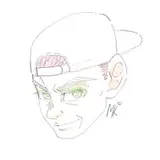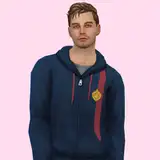
Project Morningstar is a top down isometric RPG, with modular character bodies, heads, hair styles, skin tones, and faces.
But it is also a procedurally driven AI storyteller, which lets player characters emerge from a rich pool of personality types and narrative backgrounds.
The tree pillars are explore / conquer / trade / survive.
This meas at the heart and soul of Morningstar is the character's appearance on screen, and the player needs to be able to read who this person is, what their walk of life is, how they might respond to different dialogue cues, and other story driven and gameplay driven information you may want to trade, manipulate, or kill for. (All without my hand in creating that character, it has to be created by the game when a level is loaded, and evolve according to the rules and events that unfold.)
We are also a low budget production -- starting literally with no money except a small supply of donations and patrons -- so the art can't be too extravagant, able to be produced by one person, and can't it be expensive in time or money, since we have very little of both.
I like to see my character's appearance, and I enjoy spending my time making art assets with enough detail to tell a visual story of its own while still being simple and quick to produce. I know players do as well, as proven by the success of games that feature modular character builders, from levels of detail in Skyrim and Mass Effect down to FTL and RimWorld.
So I started to experiment with art styles that accomplish all of those goals:
It has to be low cost at large volumes (produced by me alone with many options)
It has to be simple (can't be complicated to animate and each module has to be universal)
It has to convey unique appearances (so many hair and face styles for diverse people)
It has to be relevant to the mission (stick to the design document goals)
It must be procedural ready (the game must be able to produce the results itself)
That lead me to assess what would be the LOWEST VIABLE MODEL and what would be the HIGHEST VIABLE MODEL?
Obviously, the sky is the limit for the highest cost viable model. We can use Unreal Engine to develop 3d modular characters using tools like this Male and Female Customization System (which I already spent about 139$ on while they were both on sale). From there I could make new hair and armor pieces, and we have team members from our modding days who are very committed to making female and male parallel animation sets for attacks and walk cycles (and we can use Dynamic Combat System, which has a phonemically supportive community I've joined this year and learned a lot about.)
The problem there is that I can't do all of that by myself and still make the rest of the game.
The customizer system I bought isn't perfect and we'll need to have a programmer spend weeks retooling it for our needs. It also has a very flawed facial rig, so I'll have to go in and fix the jaw bones and eyelids, as well as create bones on the skeleton that fit the Unreal skeleton for our dynamic combat system.
The time it takes me to make one hair style, get it fully textured, meshed, rigged to the body and the transforms all weighted for the various morphologies of 5+ modular 3D heads, get the color masks set, and then import it to the engine and add it to the customizer bin for players and the procedural character generator -- that can take me 24-90 hours depending on the complexity of the hair style and how deeply familiar with this pipeline I am.
It could also become expensive if I have to hire and train other artists who are surely better at this than I am, as I often asked for help from other modders making New California hairstyles, or if I have to buy existing assets and then struggle with converting them artistically and technically to this system.
That's pretty complicated already, and while making hair and armour is something I have done in the past, each armor can take literal days at this level of quality and upwards of a week if I want AAA results.
5+ people typically work on faces for a AAA game like this as their sole occupation for many months. Meanwhile, my whole team is just 5 persons doing many jobs.
This all suggest a large team and lot of money. I ran the numbers with help of some other artist with industry experience and it's hundreds of thousands of dollars paying 2 team members, to do a good job with a reasonable number of diverse options, over 3+ years.
The plus sides? We'd have infinite facial variations. Hair is hard to do but I've made hair styles for New Vegas's engine in the past (but not for Unreal, so I'd have a lot to learn.) And we'd have beautiful art. It can be fit into our pipeline and gameplay systems with lot of work from our coder at the beginning of production, but get up to a high level of quality very quickly after that in a modular way that fits all these goals.
The lowest cost viable model, suggesting I am doing this all by myself in addition to my other duties, alone, says I need to go back to basics. That means thinking about what art form takes the least amount of time, overhead, and can be produced with a great deal of diversity at little cost.
While I was talking with the owner of ModDB in private messages about New California's Hall of Fame spot, I mentioned starting a new game. We talked about starting out ultra no/low budget and getting a pitch sold before a team has been formed (because to form a committed team you need money, but to get money you need a committed team), and that turned into a talk about the merits of 2D and 3D art. We both love RimWorld for its thriving modding scene, and the lessons it taught me about how to evoke a sense of emotional connection to characters with such seemingly effortless art.
I actually made some mods for RimWorld this year for Kentington's Save Our Ship 2.0, because I wanted to see firsthand just how those little sprites can go so far to evoking a sense of unique character and contribute to a robust storytelling engine.
It turns out the bottom basement you can have is 4 directional sprites:
Up, Down, Left, Right.
(Bonus if left and right are mirrored, then it's just 3 sprites!)
And the sprites have no frame animation (at all). They just face left, right, up, or down, and their weapons point in the direction of the enemy. That's their whole walk and work cycle. A little progress bar fills up as they do a job, some audio cues play, and for attack animations they just twitch a little.
Even when they die, their sprite just rotates into an odd angle and blood splatters on the terrain.
That is pretty basic, and if you don't like games with such minimal cartoon graphics, it can really turn you off. I didn't initially like RimWorld for that same reason either. It looked too cartoony and lacked the maturity I was looking for. It wasn't until I watched a LetsPlay that I got invested in the game, because of the storytelling and creativity I saw unfold.
So I started to experiment with art for Project Morningstar that could accomplish several goals in 2020.
I need concept art for the faction armors (to show how the Acavii, Hethinn, Vyn, and Gehenna factions look for future art and design documents), and I would like to experiment with possible 2D sprites.
I was a big fan of StarCraft growing up, and i spent part of this year studying the art style of the game to really understand how their terrain and unit sprites were made. I'll post an analysis of how they achieved that in the future, but needless to say, it was very complex, and the art style even 20 years later still holds up, especially with the excellent 4k overhaul recently released as StarCraft Remastered.
Those sprites were 8 directions, and in the new Remaster you can zoom in and see all the little details -- something I love to make and play with in games. The sprites are also animated 3D models (no joke) which were played in a renderer, probably an early Maya of 3DsMax Vray back in the 90s, and these days in Cinema4D. The animation cycle was played in 8 directions, with little movies of sprites exported to an atlas. That atlas then plays in game in 2D. Very low performance costs with very high results, and quick to modify by hand painting them when needed.
That was very cool, but that is also still too high cost for my needs. I tried an experiment with it and it took me days just to get it set up and over a month of my time was ultimately wasted doing the animation, renders, and building the atlas of just one character -- and it looked like future models would only add exponents to that number instead of improve it. We might as well just go fully 3D and just abandon sprites all together!
So I went back and did that RimWorld mod Save Our Ship back in October, and that took me... 3 days.
Wow!
After that I took my 3D sprite experiment and just chopped her legs off! Haha!
In a few hours I was able to make some basic animated experiments where the sprite can rotate in 8 Directions -- like StarCraft -- but still be fairly static -- like RimWorld.
At 512x512 these sprites are still fairly high detail. It can take 15-60 minutes per outfit you draw on the character body base, and the hair styles take about the same amount of time.
But compare that to the 2 or 3 days it takes me to complete armour and hair in 3D, and 15-60 minutes per outfit direction only translates to maybe a day for complex armor, but probably only a couple hours if it's simple enough. So every day I can make two of five outfits, and there we go, we're off to the races.
The animations following the mouse are also pretty basic, but remarkably, they are smoother than I anticipated. Still a little "jerky" but not so much that as many character fight on screen or explore their environment, you'll be bothered by it. Animals can also be done this way, and that honestly makes it so you can have many creatures and characters on screen for epic battles and busy towns -- perfect for an RPG set on an alien world full of weird civilizations to explore and explore / conquer / trade / survive.
The downside is a sacrifice in apparent "shock and awe" art quality and detail. You know from New California and my movies that I love that stuff. making highly detailed 3D art is my wheelhouse.
But for Morningstar I need to go far, producing lots of diverse content for many roles that can play out. That's where the meat of a game like this really comes in -0 the diversity of content and gameplay experiences.
To do that low budget, mostly solo, means I have to tackle it with these key ingredients in mind.
This may not be the art style I settle with in 2020. It's an experiment, and I'm still open to the possibility that we can get a bigger budget and go 3D, but if I am sticking with 2D and the minimum model, this is a good start for defining the art direction I'll head in.