Hey everyone, some insights about my latest practices:
Three: I loved the blue in this picture and the contrast. If you check it in black and white, you'll see how thin bright lines define the silhouette of the branches against the dark, saturated blue of the sky, and the warm, almost green shadows within the branches themselves. That combination of values and colours was beautifully balanced. I see people giving me credit for the painting, but the truth is the picture was great—I just interpreted it. Simple tip: when painting such a complex mass of shapes, balance it by choosing one focal point where the strongest contrast is. Look at the adjustment I made at the end of this practice: in the upper left side, closer to the centre, I kept the brightest values contrasted with the darkest. Around that area, I blended the edges into the background blue to reduce visual noise. These small adjustments prevent the composition from looking too busy.

.
Lobster: What I liked about this picture, besides the subject (I enjoy painting food and sea animals), was the colour. The red, orange and yellow caught my attention, so I assumed it would do the same for others. The light was coming from above, leaving little room for complex shadows, but the top highlights felt attractive enough. One thing I learned early on: highlights in pictures really catch people’s eyes—like a strong rim light or a sharp value contrast. I’m not sure why, but I guess we’re naturally drawn to light.

.
Tap: I liked the contrast between the highlight and the metal, and I thought I could push the metal colours further with a mix of green and blue. Part of painting is not just the act itself, but training your eye. By looking closely, you can start to distinguish subtle colours—maybe not even literally in the image, but imagined through how your brain plays with possibilities. I’m not sure if this makes sense, but it's something I’ve tried to explain for a while, and it’s still a bit mysterious to me.

.
Croissant: I think there’s been a meme around croissants for a while—I’m not sure why, but since I like painting food, I gave it a try. The colour palette also made it worth trying: I saw an opportunity to explore different shades of orange and texture.

.
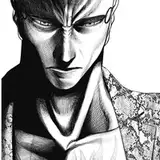
Man: I was searching for a portrait, and I wasn’t sure whether to choose a human or animal—this one had both. So painting it felt like killing two birds with one stone. The values in the face gave me room to play with different tones of brown, purple, and blue. High-contrast pictures with very bright and dark areas don’t allow much colour variation. The best ones for that are images with a lot of greys, especially in the shadows—like this one—similar to what I did a few days ago with the white/black cat. You’ll notice I tend to sketch first when painting humans or animals. I believe that’s because of the complexity of the internal shapes. For objects or landscapes, the silhouette and interior forms are usually simpler, so the challenge becomes about how many elements are in the composition.

.
Dishes: Honestly, I was looking for a very easy challenge at the end of the day—something I could finish in under an hour. This pile of dirty dishes felt just right. I played with the colours, since the original image was a bit desaturated, and pushed the perspective slightly beyond realism.

Process Video: https://youtu.be/SAx7isF7Kc0
.
If you missed the Kickstarter campaign for my book Life in Every Sketch, you can now pre-order it on the 3DTotal shop.
https://rebrand.ly/The-Art-of-RamonN90

Please let me know if you have any questions—I’ll be happy to help with art advice or book details.
Thank you for your support!