The Misogyny Vortex
Added 2023-10-25 17:20:43 +0000 UTCOn Horror, Women, Patriarchy, and Misogyny
Part 2 of a Gothic Marxist Consideration of Horror as Capitalist Cultural Production
The Conjuring movies are about good and bad women. In the first movie the central antagonist is the spirit of a dead witch who killed her own baby and then herself, and whose spirit subsequently possesses every women who movies into her house, or onto her former grounds, and makes them kill their own children. The ultimate evil then, for a woman, is to pervert the virtue of motherhood. In the story, a mother of five daughters finds herself in the home of this dead witch, gradually possessed by her. Her ultimate salvation, the thing that enables her to defeat the witch who is possessing her and trying to make her kill her daughters, is a memory of a perfect family day at the beach. Yes, that’s right – in the end, all it takes is for Elaine Warren (psychic investigator) to touch the woman’s head and enjoin her to remember family values. Ed Warren’s attempt at an exorcism fails, but Elaine is able to connect with the possessed woman directly, via their mutual motherhood. This connection allows the possessed woman to defeat the evil infanticidal witch using just the strong loving strength of her strong maternal love.
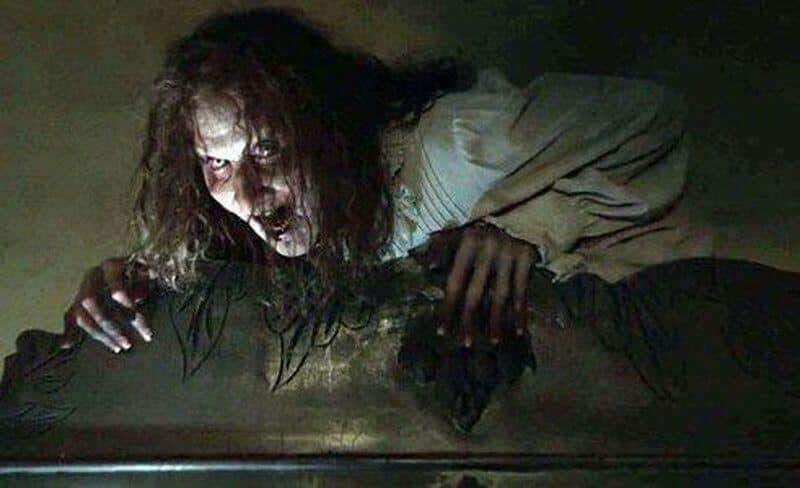
Elaine is, needless to say, a near-perfect mother herself, and when the witch ghost tries to attack her, it does so by threatening her own daughter. It threatens the daughter using (or possibly in alliance with) Annabelle the evil porcelain doll – an emblem of childhood in that it is both a toy and a figure of a girl.
In the second Conjuring movie, Ed and Elaine are called in to evaluate the case of a young girl who is supposedly being possessed by the spirit of an old man who once lived in her home, and who died there. One of the best moments in the movie is when Ed visibly stops himself from vocally disapproving of the fact that the girl’s mother is a single parent. It turns out that the entire business is a kind of trap set for Ed by a demon called Valak, which manifests as an evil-looking nun (to insult the Warrens’ faith).
The self-conscious positioning of both these movies in the setting of what we call ‘The ‘70s’ exacerbates the implications here, especially in the first film, because this was the era when the huge social effects of women venturing out of the home, taking advantage of greater freedoms, were felt to the point of moral panic. The late 60s and early 70s were the heyday of second-wave feminism.
In both films, the supernatural evil manifests in, is personified by, and is channelled by, females. This is far from new. That the films clearly stake out an intended position of support and admiration for female strength doesn’t change much. The witch in the first Conjuring movie (called Bathsheba when she lived, thus named after one of those women in the Bible who causes men to do bad things by being too sexy) is said to be related to people from Salem, thus implying that there were actual witches in Salem, rather than just people the patriarchs of Salem feared and resented, like women with unconventional sex lives, money, age and wisdom, or brown skin. Again, this isn’t new. There’s an entire industry built on pretending there was something to the idea that witches were at large in Salem, from the tourist industry in the town itself to the TV show Salem. (This industry co-exists quite happily with another (smaller) one based on the other narrative about Salem, the Crucible one.)
Peter Strickland’s brilliant movie Berberian Sound Studio ruthlessly satirises misogyny using the post-production of a fictional movie about women tortured as witches taking supernatural revenge from beyond the grave, taking full advantage of the ambivalence inherent in the idea. The slimy director spouts pretentious bullshit about how his film is an important social document, intended to honestly portray and condemn the abuse of such women, to recognise their suffering, etc… yet his film rests upon the assumption that the women who were accused of witchcraft were, in fact, witches. Otherwise, how could they come back from the dead in satanic rituals? It also rests upon depictions of the torture.
The torture – involving, at one crucial point, a red hot poker being inserted into a woman’s vagina – is shown lovingly on screen… though, as I say, we (that is, the viewers of Berberian Sound Studio) don’t see it. Gilderoy sees it though. He sees it again and again and again. He has to wait until the crucial moment to come round on a loop so he can drop fat into a frypan, thus creating the appropriate sizzling sound. He has to rip the stalks from radishes to simulate the sound of hanks of hair being ripped from women’s scalps by the priests. The film is comic in the way it shows the sound studio repeatedly ringing with the sounds of the hammering, stabbing and general abuse of various vegetables… yet, the comedy decays as we see the mangled fruit and veg decaying in buckets.
Like the tomato soup that gets splattered all over Gilderoy’s face as he uses a blender to simulate the sound of a woman being carved up with a chainsaw, the rotting cabbages and melons make us think of mutilated human flesh, dehumanized by abuse and then dumped like rubbish. Gilderoy, who spends his normal working life in the UK making gentle documentaries about nature rambling, has never imagined such horrors.
In the studio he is surrounded by women who are working for the men in charge of the picture. It is quite disconcerting to see the women co-operating (if reluctantly, in the probably vain hope of maybe being paid one day) in the production of such a blatantly misogynistic film. The men, needless to say, are unconscious of any such irony… with the possible exception of Gilderoy, who never manages to raise much resistance despite his qualms. The only woman who seemed uncowed by the relentless male dominance in the studio is the surly secretary Elena, whose legs and bum Gilderoy furtively stares at when following her down a corridor. Part of his transformation is when he learns to be rude and dismissive towards her.
Silvia (one of the voice actresses dubbing the dialogue, hired for her ability to scream) is being sexually harassed by the same director who claims to be making an important meditation on the victims of witchcraft trials. At one point, she sarcastically equates his wandering hands with the hands of the inquisitors that searched for witches’ marks. She says she is marked. He has made her feel that way. The producer harasses her too, bullying her for more realistically terrified screams, ignoring her thoughts on characterisation, putting her down with savage rudeness, suggesting that she gets jobs by performing sexual favours for casting directors, etc. When she is performing in the sound booth, the producer sneers that one of her screams sounds more like she’s faking an orgasm. He disapproves of his Director ‘directing with his dick’, but he clearly also blames the women who have to suffer his attentions. He evidently senses that she’s trouble, that she may well refuse to accept more harassment and thus cause them trouble, because at one point he tells Gilderoy that “there’s poison in those tits”.
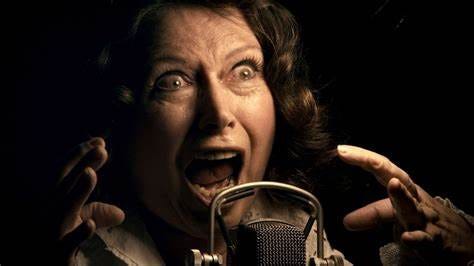
Silvia is the key figure. She herself seems to be near-magical, and also rebellious against male/boss authority. The film presents her as a possible ‘good witch’. Silvia confides to Gilderoy that she has been used and cheapened, made to feel like a whore. It is implied that she may have been coerced into sex, though she may be talking metaphorically about the way working on the film has made her feel. Silvia rebels and erases the tapes of her own performance before disappearing. She literally withdraws her labour.
Another actress is hired on the strength of her looks, after the producer and director skip through a series of photographs of applicants (front and side views, so they can judge the women’s bodies… despite the fact that they’re hiring a voice actress who will not be seen) and see one actress that, according to the director, “would give a dog a hard-on”. The actress, however, proves unable to provide satisfying screams. The producer tells Gilderoy to go and get her ready by making her cry. In a moment that represents his tipping point, Gilderoy succumbs to the order/temptation to torture the woman, in a passive and technical way entirely in keeping with his repressed and nerdy character, by sending increasingly loud feedback into her headphones. Under orders, he turns up the volume, despite her cries. But this isn’t just about the brutalising effect of authority upon a compliant subordinate, this is specifically about the exercise of male power over a woman reduced to material.
The whole film is about the men reducing women to bits and pieces. They are made into their voices, spouting lines written by men. Their bodies are cut into pieces on the screen, to the bored professionalism of the producer and the salivating delectation of another sound engineer. Those female bodies, represented in the sound studio, become melons and radishes and cabbages, stabbed and hammered, rotting in a bin.
There are other potentials. At one point, Gilderoy entrances Silvia by showing her how he can transform her voice… but the moment is immediately squashed by the intrusion of the filmmaking process. There’s another scene when, during a power cut, he reduces the entire company – men and women alike – to gasps of wonder when he makes a light bulb emit the sounds of a UFO. At home, Gilderoy uses this trick for “children’s programmes”. Again, the moment is sadly curtailed once the lights come back on. The commercial imperatives of the work make the prolongation of such a magic moment impossible. The lights come up and the director snaps back to business.
Gilderoy is the only man in the situation who notices the misogyny, but he is extremely repressed in his relations with women. Ultimately, his sympathies with the women come to nothing. Indeed, he is driven towards embracing the misogynistic attitudes that prevail. His fear of women, combined with his helplessness to do anything about their treatment, causes his resentment to boil over. Given the opportunity to cause a woman pain with feedback, he does so. It isn’t just obedience to an order; he is expressing his own hatred. His nightmarish internalisation of the film entails a woman sneaking up on him the darkness of his own bedroom and attacking him, whereupon he overpowers and dismembers her. He literally takes on the persona of the violent man, suppressing the vengeful woman, whose antics so shocked him when he first saw a clip of the film. His guilty co-operation in the exploitation of female bodies and voices has brought him to internalise the terror of female revenge and the fascination with the idea of violent suppression, with the reduction of the female menace via violence. This, of course, is the whole meaning of the film he’s been helping to make… the abused witch/woman returns for revenge (as did Silvia) and this is a terrifying threat that must be put down. But it also entails the depiction of women as threatening. It interrogates the misogynistic anxiety rather than simply depicting it. Even so, it does depict it for the audience’s enjoyment.
Both Conjuring movies are explicitly about mother/child relationships. This, like many things in these movies, deliberately harks back to earlier cinema. In The Exorcist, The Omen, and Rosemary’s Baby, the mother/child relationship is highlighted. In the cases of the first two, the relationship becomes overtly hostile and violent owing the child’s possession by demonic forces. In the third, the mother accepts the child despite its possession of a demonic nature. However, it’s interesting to note that in the Conjuring films it is the child or children that are victimised. The anxiety has been turned on its head. It’s no longer about the potential horrors of parenthood, and has become instead about the potential horrors of having a mother. Even so, the young victims – almost all female – remain implicated. It is the intensely female world of the household in the first movie – a mother, her husband, and five daughters; all living in a home haunted by a witch and various ghosts, mostly female – that seems to be the cause of the trouble.
The Babbadook is another film which centres on the potential of a mother to harm her child if ‘possessed’ by an evil force. It literalises the threat by reifying depression and grief into the metaphorical/hallucinated titular monster, but is still fundamentally about a ‘bad mother’ who is open to alien forces (the film’s view of depression is strangely simplistic) which pervert the ‘maternal instinct’.
In The VVitch, the fear of witchcraft is again justified, with witches depicted as a genuine threat at the end of the film. Like Berberian Sound Studio, The VVitch is interrogative rather than just representative. It depicts witchcraft as a reaction against, an act of resistance to, a patriarchal family system. Patriarchy thus creates witchcraft literally rather than just metaphorically. The idea of witchcraft comes into the world as a social force because of the paranoia about (mostly) women and girls, but in The VVitch this social dynamic is again literalised and reified. Nor is The VVitch simplistic in its depiction of how patriarchy works. It depicts the male head of the household as intensely weak and passive, and his wife as a dominant personality. We see an essentially submissive personality forced into the role of ruler, while an essentially dominant personality is forced into the role of ruled. We see both trying to negotiate their roles in ways that cripple the family’s ability to function. Here again, though, the film is intensely concerned with the ‘bad mother’, as the wife of the household redirects her frustrations at being subordinated into hostility towards her eldest daughter, a hostility that eventually has catastrophic consequences.
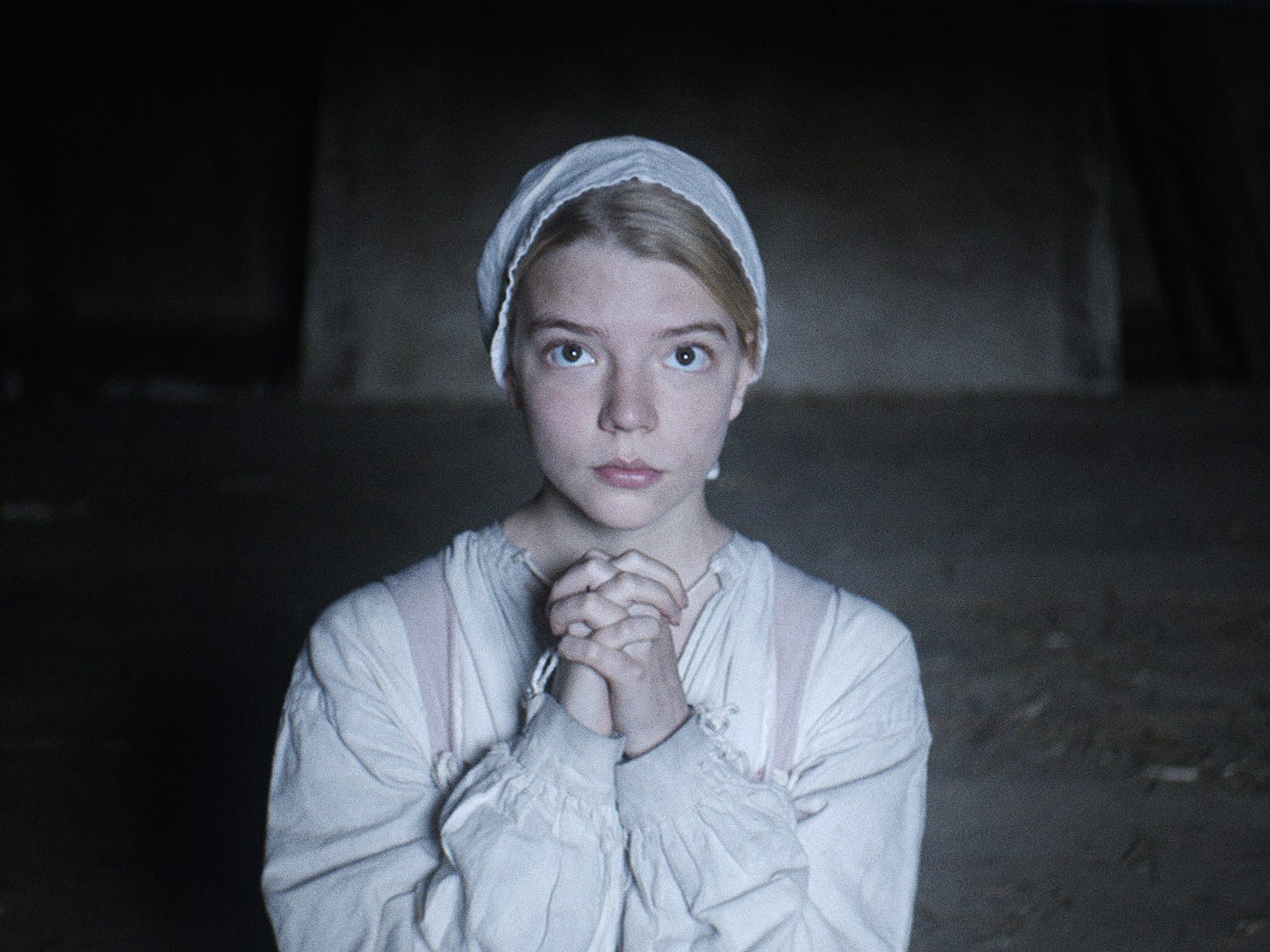
The VVitch is far from a misogynist film, in that it shows the behaviour of the mother stemming from intense alienation within a patriarchal system that has subordinated her to a weak man. Even so, you see a common thread with other less sophisticated films – such as the Conjuring movies and The Babbadook – in that The VVitch is concerned with treating witches as if they were real things, and thus treating women as a potential supernatural threat to the family order. It is also concerned with the ‘betrayal’ of children (especially female children) by a mother who forgets her ascribed nurturing role (though The VVitch subjects this ascription to some scrutiny). It is also about an intensely felt loss of male potency in the face of the responsibility that supposedly comes with patriarchal power in the family.
The Conjuring movies both portray Ed Warren as, essentially, the theological and detective intellect accompanying his wife’s intuitive, emotional, psychic abilities. But he is definitely the ‘sidekick’. It’s notable that his attempted exorcism in the first film fails, and it’s Lorraine’s emotional connection with the possessed mother (along lines of shared family feeling) which ultimately defeats the evil. Similarly, though Ed has an insight which helps solve the case in the second film, it is Lorraine who ultimately saves him from the demon which is targeting him. There seems to be a distinct attempt to represent issues of haunting and possession as both emanating from, and ultimately only resolvable or curable by, females. Even so, the films place a huge onus on women as both sickness and cure, with the derangement and reordering of female gender roles with patriarchal family as primary in causing and solving the problem. Meanwhile, the men are left floundering on the sidelines. It’s almost comical the way men try to console themselves about their sidelined status in the Conjuring movies, especially the first one. There are long pauses in the action when Ed and the father of the haunted house stop to bond over car maintenance, and talk about the pain of being unable to help their wives. When the evil force is defeated, the two men share significant manly looks as they both hug their respective families. To be clear, I’m not doing an MRA and complaining about ‘misandry’ in the films. I’m pointing out the way in which maleness is depicted as being threatened with marginalisation in a disordered family system in which uncanny forces emanate from, and can only be resolved by, women. The takeaway isn’t to decry the depiction of men but to see what such depictions tell us about how patriarchy is being negotiated and recuperated in texts which centre upon the threatening power of women. This, again, is nothing new. A huge part of the power of Dracula comes from the fact that all the male heroic characters attempt to recover their masculinity and patriarchal authority in the face of a threat to the established order, a threat which is channelled through the deranged, uncanny, and potentially disastrous power of female sexuality.
A huge influence on James Wan, director of the Conjuring movies, is the original Poltergeist. Poltergeist is notable for its intensely female-centred storyline. The main character is the mother of the family, who is aided by a female paranormal investigator and a female psychic in venturing into the netherworld beyond death to recover her abducted daughter. Wan’s movie Insidious is, in some respects, almost a remake of Poltergeist. And yet in Insidious it is a little boy who is abducted to ‘the other side’ and his father who must venture in and get him. Similarly, in the actual remake of Poltergeist (not directed by Wan), it’s still a little girl who is abducted but the story centres far more on her father, it is the son of the family who ventures into the abyss to find her, and the psychic who eventually sorts everything out becomes a man.
It’s interesting that we’re telling ourselves these kinds of stories now, contextualising some of them in terms of the semiotics of the 70s. It’s like an attempt to resurrect the anxieties of a previous age, and then twist them into something more pertinent to us. It would be easy to see the reconfiguration of these kinds of movies to centre more upon the threat of disordered women, bad mothers, family units menaced by loss of clear gender roles, etc, as nothing more than a reaction against progress. And certainly, in the age of rotting zombie neoliberalism, threatened by endemic crisis, there is a retrenchment of reactionary values that these films could be seen as expressing. But I think it goes a tad deeper than that, though it’s probably a factor. I think what we’re seeing in this films is a representation of the feeling (widespread but erroneous) that we now live in some species of post-sexism or post-patriarchy world. It is felt to be permissible now to craft texts with such emphasis on the threat of women and mothers, the threat to the nuclear family, the embattled role of men in the face of deranged and uncanny forces unleashed by women and girls, and about (in some cases) the reconquering of male roles as hero and saviour, because we now live in a world where such things no longer have the same political valences they once did. Notice that the films where men are passive, confused, shut out, unable to help with a hermetic female problem, threatened, or even saved by women, are set in the past (The VVitch, the Conjuring films). They are period pieces. Costume dramas. The films where the man is repositioned as (ultimately) the hero are set in the present day (Insidious, the Poltergeist remake). This is, of course, far too schematic an account, but I think it holds as a description of a general trend, at least in horror that centres upon the uncanny rather than on any other kind of threat. The idea is that you can represent the era of strife and misunderstanding between the genders as something in the past, particularly in terms of an irruption of female power. Meanwhile, we today have sorted everything out. Equality has been achieved. You know that because the proper people are back in control.